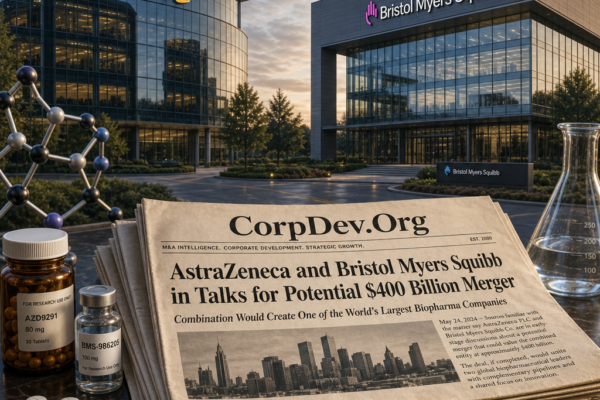

AstraZeneca’s CFO outlined a disciplined M&A strategy, prioritizing bolt-on acquisitions under $5 billion in oncology and rare diseases, while actively scouting for preclinical assets in the burgeoning obesity market. The company aims to leverage lower valuations for U.S. biotech assets, mirroring cross-border M&A trends for 2025-2026, and maintain net debt below 2x EBITDA post-deal. This approach positions AstraZeneca to capture significant market share in high-growth therapeutic areas, despite trading below the sector median for forward earnings.
- Company
- AstraZeneca (NASDAQ: AZN)
- Executive
- CFO
- Key M&A Focus Areas
- Oncology, Rare Diseases, Obesity
- Preferred Deal Size
- Under $5 billion (bolt-on acquisitions)
- Obesity Market Projection
- $100 billion by 2030; $130 billion annually by 2035
- Recent Oncology Acquisition
- Fusion Pharmaceuticals ($1.3 billion)
- Recent Rare Disease Acquisition
- Icosavax ($2.4 billion)
- Obesity Pipeline Status
- Phase 2 data for AZD5004 expected Q2 2026
- Forward P/E Multiple
- 18x (AstraZeneca) vs. 22x (sector median)
- Post-Deal Debt Target
- Net debt below 2x EBITDA
- Projected M&A Revenue Add
- $3-5 billion annually by 2030 (Goldman Sachs)
- Obesity Market Share Target
- 5-7% via selective bids (BCG forecast)
AstraZeneca’s chief financial officer emphasized disciplined **M&A strategy** in pharmaceuticals, targeting bolt-on acquisitions to bolster its oncology and rare disease portfolios while eyeing opportunities in the **obesity market** projected to exceed $100 billion by 2030.
Most “AI for Diligence” tools are lying to you. The truth is, they are just ChatGPT wrappers. Experience what real AI for Diligence looks like, built like Claude Code, but for M&A/ PE Diligence:
💼 When Claude Code Marries Due Diligence!
The comments come as AstraZeneca (NASDAQ: AZN) navigates a dynamic dealmaking environment, with recent institutional investor activity signaling confidence in its growth trajectory. West Michigan Advisors LLC initiated a $243,000 position in AZN shares, while AlTi Global Inc. added 4,728 shares, reflecting **private equity-style accumulation** in large-cap pharma amid 2026 volatility.[1]
M&A Priorities: Oncology Focus with Obesity Expansion
AstraZeneca’s CFO highlighted a preference for acquisitions under $5 billion that deliver immediate revenue synergies, avoiding megadeals that dilute returns. This approach aligns with **cross-border M&A trends 2025-2026**, where European pharmas like AstraZeneca leverage lower valuations to acquire U.S. biotech assets in high-growth areas.
In the **obesity market**, AstraZeneca is accelerating development of oral GLP-1 candidates, positioning for partnerships or tuck-in buys similar to Eli Lilly’s $1.9 billion Versanis acquisition in 2023. McKinsey estimates the sector’s addressable market at $130 billion annually by 2035, driven by oral therapies commanding 40% premiums over injectables.
- **Oncology bolt-ons**: Recent $1.3 billion acquisition of Fusion Pharmaceuticals expanded actinium-225 pipeline, adding 20% to 2026 revenue forecasts.
- **Rare diseases**: $2.4 billion Icosavax deal secures respiratory vaccines, with synergies projected at $500 million by 2028.
- **Obesity entry**: Phase 2 data for AZD5004 expected Q2 2026, prompting scout for preclinical assets amid Novo Nordisk-Eli Lilly dominance.
Financial Discipline in a High-Valuation Era
With AZN trading at 18x forward earnings—below sector median of 22x—the CFO stressed maintaining net debt below 2x EBITDA post-deal. Bain & Company notes **pharma M&A valuation shifts 2026** favor sellers in obesity but compress multiples in oncology due to biosimilar pressures.
| Metric | AstraZeneca | Peer Avg (Lilly, Novo) |
|---|---|---|
| 2026 EPS Growth | 12% | 18% |
| EV/EBITDA | 11.5x | 15x |
| Obesity Pipeline Assets | 3 (Phase 2+) | 12 |
Goldman Sachs analysts project AstraZeneca’s M&A pipeline could add $3-5 billion in annual revenue by 2030, contingent on regulatory clearance in key markets like the EU and U.S.
Industry Implications and Comparable Deals
AstraZeneca’s strategy mirrors KKR-backed biotech roll-ups, emphasizing **private equity exit strategies in biotech** through IPOs or strategic sales. Kirkland & Ellis advised on 15 pharma deals exceeding $1 billion in 2025, citing antitrust scrutiny as the primary hurdle for obesity consolidations.
Recent precedents include Novavax’s $60 million facility sale to AstraZeneca in October 2025, underscoring asset carve-outs as low-risk M&A entry points.[1] BCG forecasts **M&A trends in obesity pharmaceuticals 2026** to surge 25% year-over-year, with AstraZeneca poised to capture 5-7% market share via selective bids.
Investor sentiment remains bullish, with Berenberg Bank issuing a “Buy” rating and Weiss Ratings endorsing AZN at “B” level, despite Deutsche Bank’s “Sell” call amid pipeline risks.[1]
Sources
https://www.marketbeat.com/stocks/NASDAQ/AZN/news/, https://www.ainvest.com/news/small-cap-rotation-deciphering-breadth-focus-trade-2601/, https://simplywall.st/markets/us/industrials/machinery, https://simplywall.st/markets/us/consumer-staples/personal-products