
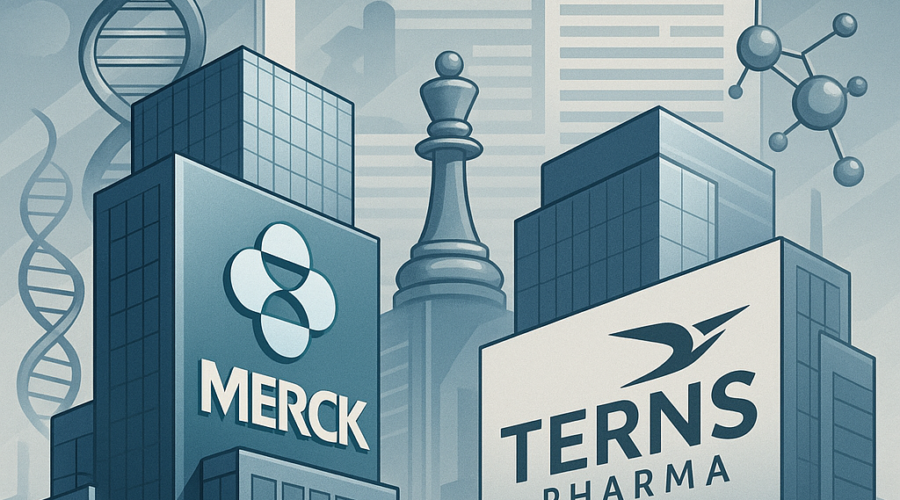
Merck & Co. has launched a $6.7 billion all-cash unsolicited offer for Terns Pharma, a biotech firm specializing in small-molecule drug candidates for metabolic disorders like NASH. The acquisition is a strategic move to accelerate Merck's R&D cycle and counteract upcoming patent expirations by securing long-dated intellectual property. This high-premium bid underscores a key 2026 M&A trend where large pharmaceutical companies are aggressively pursuing mid-cap biotechs with validated science to secure leadership in high-growth therapeutic areas. The transaction serves as a valuation litmus test, signaling that scarcity premiums for differentiated platforms will drive consolidation despite heightened FTC scrutiny.
- Acquirer
- Merck & Co.
- Target
- Terns Pharma
- Transaction Value
- $6.7 Billion
- Offer Type
- Unsolicited Offer
- Financing Structure
- All Cash Offer
- Sector
- Pharmaceuticals / Biotechnology
- Therapeutic Focus
- Metabolic Disease (NASH) & Small Molecule Therapeutics
- Strategic Rationale
- To accelerate R&D cycles, counteract patent expirations, and expand its pipeline in the growing metabolic disease market.
- Valuation Insight
- The valuation reflects a 'scarcity premium' for a high-performing biotech firm that has successfully navigated early-stage regulatory hurdles.
- Primary Risk Factor
- Heightened antitrust scrutiny from the Federal Trade Commission (FTC) and moderate integration risk.
In a move that underscores the intensifying race for leadership in metabolic and chronic disease therapeutics, Merck & Co. has launched a $6.7 billion unsolicited offer for Terns Pharma. This acquisition attempt reflects the broader industry imperative for large-cap pharmaceutical entities to aggressively replenish late-stage pipelines ahead of impending patent cliffs, a trend defining the current biotech acquisition landscape in 2026.
Most “AI for Diligence” tools are lying to you. The truth is, they are just ChatGPT wrappers. Experience what real AI for Diligence looks like, built like Claude Code, but for M&A/ PE Diligence:
💼 When Claude Code Marries Due Diligence!
The Rationale: Pipeline Consolidation and Metabolic Focus
For Merck, the interest in Terns Pharma is not about immediate revenue scale but about long-term R&D acceleration. Terns has established a specialized footprint in small-molecule drug candidates, particularly in NASH (Non-Alcoholic Steatohepatitis) and other metabolic disorders. As the global obesity and metabolic disease markets continue to expand, incumbent players like Merck are under immense pressure to secure proprietary assets that complement their existing cardiovascular and diabetic portfolios.
Financial analysts view this move as a classic “tuck-in” strategy, albeit at a significant valuation. By integrating Terns, Merck seeks to:
- Accelerate R&D Cycles: Leverage Merck’s global clinical trial infrastructure to fast-track Terns’ phase-two and phase-three candidates.
- Counteract Patent Expirations: Secure long-dated intellectual property to maintain revenue growth trajectories into the next decade.
- Synergistic Commercialization: Utilize established global supply chains to scale production of Terns’ novel compounds immediately upon regulatory approval.
Deal Metrics and Valuation Analysis
A valuation of $6.7 billion represents a substantial premium for Terns, placing the company at a high multiple of its current book value. This reflects the “scarcity premium” often attached to high-performing biotech firms that have successfully navigated early-stage regulatory hurdles.
Table 1: Strategic Deal Parameters
| Metric | Details |
|---|---|
| Transaction Value | $6.7 Billion (All Cash Offer) |
| Primary Focus | Metabolic Disease (NASH) & Small Molecule Therapeutics |
| Strategic Rationale | Pipeline diversification and R&D capacity expansion |
| Integration Risk | Moderate; contingent on Phase 3 trial data consistency |
Industry Context: The 2026 M&A Environment
The pharmaceutical sector is currently grappling with a dual challenge: the exhaustion of pandemic-era cash reserves and the tightening of regulatory scrutiny regarding drug pricing. Despite these headwinds, cross-sector M&A trends in 2026 indicate that larger pharmaceutical corporations are increasingly willing to pay a premium for mid-cap biotech firms that demonstrate clear, validated science.
Institutional investors and deal advisors observe that high-quality assets in metabolic and oncology fields remain the most competitive. Goldman Sachs and other industry analysts have noted that pharma giants are prioritizing companies with “differentiated platforms”—technology that can produce multiple drug candidates rather than those relying on a single, binary-outcome asset.
Regulatory and Execution Risks
While the strategic logic is sound, the deal faces a challenging antitrust environment. The Federal Trade Commission (FTC) has become increasingly aggressive in reviewing pharmaceutical mergers, particularly those involving companies with existing dominance in specific therapeutic categories. Merck’s legal team must demonstrate that this acquisition fosters innovation rather than consolidating market power to suppress competition.
Furthermore, integration remains a persistent challenge in life sciences M&A. Cultural alignment between a large, established multinational pharmaceutical corporation and a research-driven, agile biotech firm often proves difficult. Success will depend on Merck’s ability to preserve the research autonomy that made Terns Pharma an attractive target in the first place.
Implications for Investors
For shareholders of both companies, the proposed $6.7 billion deal serves as a litmus test for biotech valuation strategies in the mid-market. If the deal closes successfully, it will likely trigger further consolidation, as competitors scramble to acquire similar metabolic-focused biotechs. Investors should watch for the Terns board’s official response and potential counter-bids, which could escalate the price further in a competitive bidding environment.