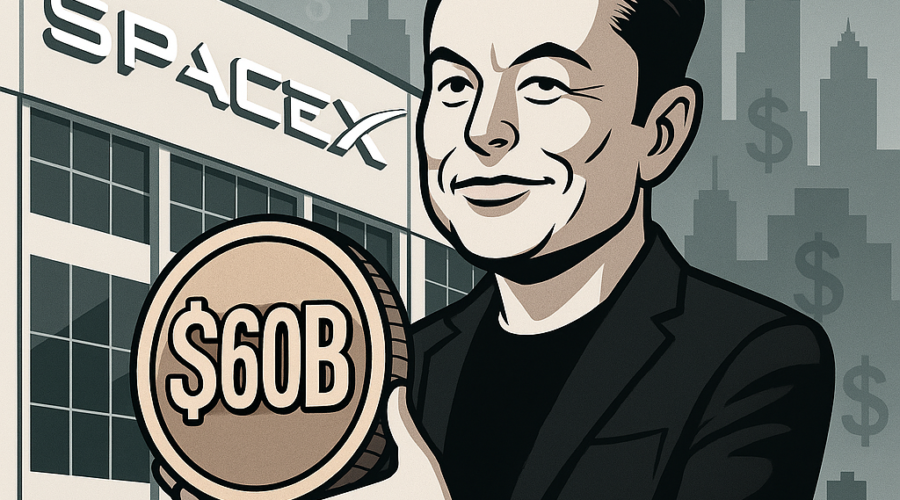
SpaceX has executed a preemptive M&A maneuver by securing a $60 billion buyout option for the AI coding startup Cursor, developed by Anysphere. The deal includes an immediate $10 billion non-dilutive "collaboration fee" and an exclusive call option exercisable before the end of 2026. This move successfully dismantled a pending $2 billion Series E fundraising round at a $50 billion valuation that was co-led by Andreessen Horowitz and Thrive Capital. This "option-first" strategy signals a major shift where high-scale, pre-IPO companies use their private market liquidity to consolidate key technology assets, bypassing traditional venture capital exit paths and blocking competitors.
- Acquirer
- SpaceX
- Target
- Cursor (developed by Anysphere)
- Transaction Type
- Preemptive Buyout Option & Collaboration Agreement
- Buyout Option Price
- $60 Billion
- Upfront Payment
- $10 Billion ("collaboration fee")
- Option Expiration
- Before the end of 2026
- Preempted Round
- $2 Billion Series E at a $50 Billion valuation
- Sidelined Investors
- Andreessen Horowitz and Thrive Capital
- Strategic Driver
- Vertical integration of AI-driven software engineering to support SpaceX's transition into an AI and infrastructure conglomerate.
- Acquirer Context
- Pre-IPO with an anticipated $1.75 trillion valuation
On the eve of its highly anticipated $1.75 trillion initial public offering, SpaceX has executed what is being described by Wall Street advisors as the most aggressive preemptive M&A maneuver in the history of the software industry. By securing an exclusive $60 billion buyout option for the AI coding sensation Cursor, SpaceX has effectively dismantled a $2 billion fundraising round that was hours away from closing with a syndicate of blue-chip venture capital firms.
Most “AI for Diligence” tools are lying to you. The truth is, they are just ChatGPT wrappers. Experience what real AI for Diligence looks like, built like Claude Code, but for M&A/ PE Diligence:
💼 When Claude Code Marries Due Diligence!
The deal, structured as a dual-path agreement, provides Cursor with an immediate $10 billion “collaboration fee” for joint development work, while granting SpaceX a call option to acquire the startup outright for $60 billion before the end of 2026. This move not only secures SpaceX’s vertical integration of AI-driven software engineering but also blocks rivals OpenAI and Anthropic from acquiring the platform that has become the industry standard for “vibe coding.”
The Mechanics of Preemption: Sidelining the $2 Billion Round
Before the SpaceX intervention, Cursor—developed by the San Francisco-based Anysphere—was in final documentation to raise $2 billion in a Series E round co-led by Andreessen Horowitz and Thrive Capital. That round, which would have valued the three-year-old company at $50 billion, was intended to fund massive compute expenditures. However, the preemptive M&A strategy deployed by Elon Musk offered a valuation floor 20% higher than the VC terms and, crucially, immediate access to SpaceX’s “Colossus” supercomputer.
Comparative Deal Structures: Cursor (April 2026)
| Metric | Proposed VC Round | SpaceX Preemptive Deal |
|---|---|---|
| Implied Valuation | $50 Billion | $60 Billion (Buyout Floor) |
| Immediate Capital | $2 Billion (Dilutive) | $10 Billion (Non-Dilutive Fee) |
| Compute Access | Market Rate (Public Cloud) | Direct (Colossus H100 Cluster) |
| Strategic Lockup | Standard ROFR | Exclusive Call Option |
The Rationale: Building the Software-Defined Aerospace Giant
For SpaceX, this is more than an AI coding startup valuation play; it is a defensive move to insulate its lead in the space economy 2026. As the company transitions from a launch provider to a vertically integrated AI and infrastructure conglomerate, the ability to automate complex aerospace software via Cursor’s “Composer” model becomes a core competency. Analysts at Goldman Sachs and Morgan Stanley suggest that the integration of Cursor into the newly formed “SpaceXAI” division—which recently absorbed xAI—is designed to justify the $1.75 trillion IPO valuation by proving SpaceX can scale software at the same velocity it scales hardware.
“We are seeing a shift where high-scale private companies no longer wait for the public markets to fund their inorganic growth,” says a senior M&A partner at Kirkland & Ellis. “SpaceX is using its private-market secondary liquidity—currently trading at $614 per share—as a high-octane currency to consolidate the AI application layer.”
Timeline: From Startup to $60 Billion Target
- January 2025: Cursor valued at $2.5 billion following early success in the developer community.
- November 2025: Series D raises $2.3 billion at a $29.3 billion valuation; Nvidia joins the cap table.
- February 2026: SpaceX merges with xAI; internal “Project Starforge” begins exploring AI-automated rocket telemetry.
- April 22, 2026: SpaceX preempts the Series E round with a $60 billion buyout option and $10 billion partnership fee.
Industry Implications: The Death of the Independent Model-Agnostic AI?
The deal sends a chilling signal to the venture capital community. For years, the bull case for private equity exit strategies in AI relied on the assumption that “interface” companies like Cursor could remain model-agnostic and serve all masters. By tethering Cursor to the Colossus supercomputer and the SpaceX balance sheet, Musk has demonstrated that in the era of vertical integration in AI software, compute and capital are the ultimate gravity.
Investors who were sidelined by this deal, including many late-stage venture capital firms, now face a market where the “Magnificent Seven” and SpaceX have the capital and the infrastructure to “buy the market” before a startup even reaches the public stage. This trend towards cross-border M&A trends 2026 suggests that the next generation of enterprise software may never be independent, but rather born-and-bred within the ecosystems of the world’s largest compute owners.
Financial Framing: Preparing for the $2 Trillion Frontier
With SpaceX’s confidential S-1 filing already at the SEC, the Cursor deal serves as a massive narrative tailwind. The SpaceX IPO 2026 is no longer just a bet on Starship or Starlink’s 10 million subscribers; it is a bet on the “Orbital AI” economy. By paying a $10 billion “premium for optionality,” SpaceX has secured the world’s most advanced AI coding tool without the immediate regulatory friction of a completed merger—a masterclass in C-suite dealmaking for the age of hyper-scale AI.
As the June 2026 listing date approaches, the question for deal advisors is whether this “option-first” model becomes the new standard for high-profile strategic M&A, allowing titans to lock up innovation while maintaining the flexibility to walk away if the “vibe coding” hype cycle cools. For now, however, SpaceX has proven that in the race for AI dominance, the most powerful rocket in the world is a well-timed, massive checkbook.