
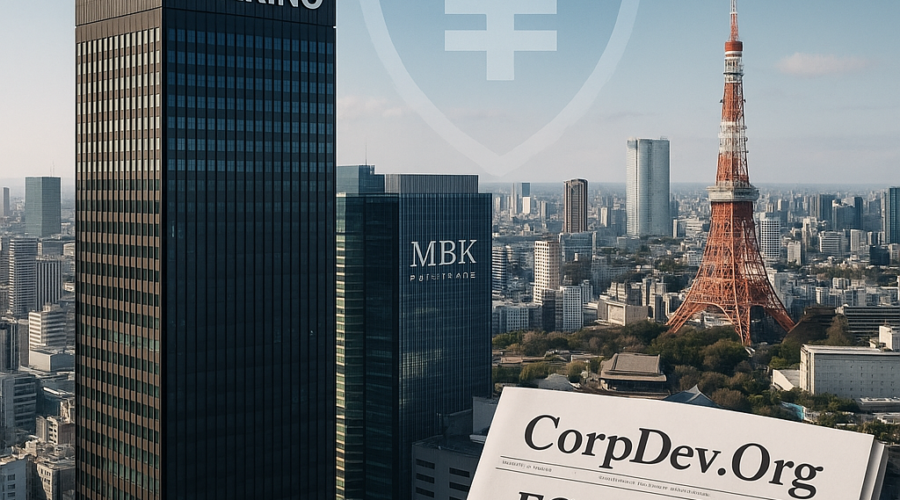
The Japanese government, invoking its Foreign Exchange and Foreign Trade Act (FEFTA), has formally blocked MBK Partners' proposed ¥275 billion ($1.72 billion) acquisition of Makino Milling Machine Co. Regulators cited national security risks, classifying Makino's high-precision five-axis machining centers as critical 'dual-use' technology. This rare intervention, only the second of its kind in Japanese history, reverses a deal where MBK was initially welcomed as a 'white knight' against a hostile bid. The decision establishes a formidable 'CFIUS-style' precedent, signaling that Japan's economic security agenda now outweighs foreign private equity investment in its core industrial and defense-related sectors.
- Deal Name
- MBK Partners / Makino Milling Machine Co.
- Parties
- Acquirer: MBK Partners; Target: Makino Milling Machine Co. (6335.T)
- Original Value
- Approx. ¥275 Billion ($1.72 Billion)
- Announced Date
- June 2025 (MBK's friendly tender offer)
- Collapsed Date
- April 23, 2026
- Failure Mode
- Regulatory Intervention (Blocked by Japanese Government)
- Root Cause
- National Security Concerns (Dual-use technology leakage)
- Regulatory Basis
- Foreign Exchange and Foreign Trade Act (FEFTA)
- Affected Technology
- High-precision five-axis machining centers
- Market Reaction
- Makino shares declined 10% following the announcement
TOKYO — In a move that signals a tightening of Japan’s regulatory borders, the Ministry of Economy, Trade and Industry (METI) and the Ministry of Finance have formally called on Asia-based private equity giant MBK Partners to shelve its proposed acquisition of Makino Milling Machine Co. (6335.T). The intervention, announced Thursday, marks a watershed moment for cross-border M&A trends in 2026, as Tokyo prioritizes “Economic Security” over the free flow of institutional capital into sensitive industrial sectors.
Most “AI for Diligence” tools are lying to you. The truth is, they are just ChatGPT wrappers. Experience what real AI for Diligence looks like, built like Claude Code, but for M&A/ PE Diligence:
💼 When Claude Code Marries Due Diligence!
A Rare Regulatory Hammer: The FEFTA Intervention
The recommendation to halt the approximately ¥275 billion ($1.72 billion) deal was issued under the Foreign Exchange and Foreign Trade Act (FEFTA). This is only the second time in Japanese history that the government has used these powers to stop a foreign acquisition, and the first since the law was significantly tightened in 2017. The only other precedent remains the 2008 blocking of The Children’s Investment Fund’s attempt to increase its stake in J-Power.
The government’s rationale centers on “dual-use” technology. Makino is a global leader in high-precision five-axis machining centers—equipment essential for manufacturing aircraft components, missiles, and other defense systems. Chief Cabinet Secretary Minoru Kihara stated that an acquisition by a non-Japanese entity poses an unacceptable risk of technology leakage and could undermine the integrity of the domestic defense supply chain.
| Deal Metric | Details |
|---|---|
| Target Company | Makino Milling Machine Co. (6335.T) |
| Acquirer | MBK Partners (via MM Holdings K.K.) |
| Transaction Value | Approx. ¥275 Billion ($1.72 Billion) |
| Regulatory Basis | FEFTA Section: Core National Security Assets |
| Market Reaction | Makino shares declined 10% following the announcement |
From White Knight to Regulatory Roadblock
The current impasse is a dramatic reversal of fortune for MBK Partners. In mid-2025, the firm emerged as a “white knight” for Makino after the machine tool maker faced a hostile, unsolicited tender offer from Nidec Corporation. Makino’s board had initially welcomed MBK’s bid, viewing the private equity firm as a way to maintain management independence while accessing capital for digital transformation and global expansion.
However, the Japan foreign investment regulations have evolved faster than many dealmakers anticipated. Under the Economic Security Promotion Act (ESPA), machine tools are now classified as “specified critical materials.” Regulators noted that even if MBK implemented strict information barriers (ring-fencing), such measures would prevent the firm from exercising the operational oversight required to “enhance corporate value”—the very justification for the buyout.
Timeline of the Makino Takeover Battle
- April 2025: Nidec Corporation launches a hostile ¥250 billion bid for Makino; Makino adopts defensive measures.
- June 2025: MBK Partners enters the fray with a friendly ¥275 billion tender offer; Nidec withdraws.
- December 2025: Regulatory reviews in the US, EU, and China clear the deal, but Japan’s METI extends its probe.
- April 23, 2026: The Japanese government issues a formal recommendation to halt the deal, citing national security.
Industry Implications: A Chilling Effect on Inbound PE?
For investment professionals, this intervention signals a shift in private equity exit strategies in Japan. While the Japanese market remains attractive due to low valuations and corporate governance reforms, the “Monozukuri” (manufacturing) core is increasingly protected by a “CFIUS-style” scrutiny that favors domestic consolidation over foreign buyouts.
Consulting leaders at firms like Bain and BCG have recently noted that while Japan’s “New Capitalism” encourages M&A, the definition of “core business sectors” has widened to include advanced robotics, semiconductors, and precision tools. Deal advisors must now factor in a “security premium” and significantly longer closing timelines when navigating the Japanese regulatory landscape for M&A.
The Road Ahead for MBK and Makino
MBK Partners has 10 days to respond to the government’s recommendation. Should they refuse, the government is expected to issue a binding “stop order.” For Makino, the collapse of the deal necessitates a strategic pivot. Without the private equity infusion, the company must now convince a skeptical public market that it can thrive as an independent entity while adhering to increasingly rigid export controls and domestic security mandates.
This case serves as a stark reminder to C-level executives: in the 2026 M&A environment, the highest bid no longer guarantees a seat at the table. Geopolitics has officially become a primary stakeholder in the Japanese boardroom.
Sources
 koreaherald.com
 fnnews.com
 biggo.com
 investing.com
 chosun.com
 biggo.com
 chambers.com
 chosun.com
 tipranks.com
 sedaily.com