
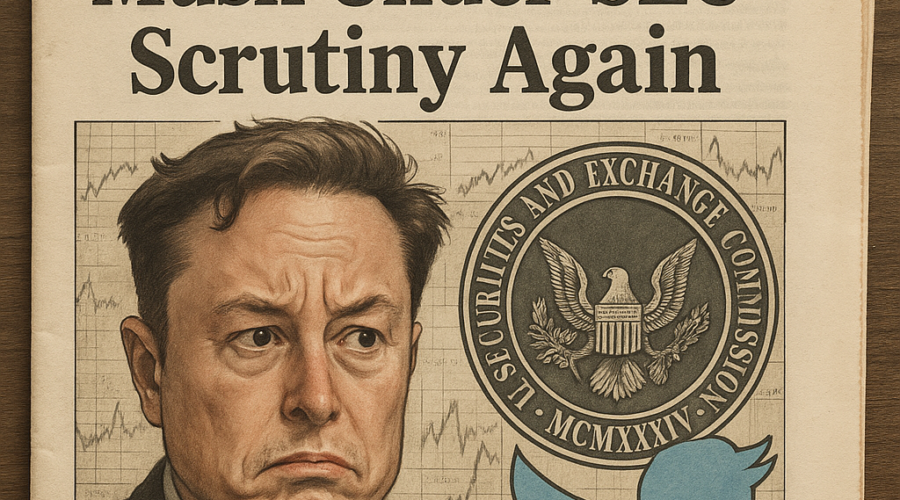
A federal appeals court in the Ninth Circuit revived the SEC’s civil lawsuit against Elon Musk on January 28, 2026, accusing him of failing to promptly disclose his Twitter stock purchases in 2022. The SEC alleges Musk violated Section 13(d) by delaying his Schedule 13D filing after crossing the 5% beneficial ownership threshold, allowing him to acquire additional shares at lower prices. This ruling overturns a prior dismissal, finding plausible allegations of intent to deceive. The case highlights heightened regulatory scrutiny on disclosure compliance in high-profile tech take-private deals, signaling increased compliance costs and potential penalties like $150 million in disgorgement for executives in M&A.
- Regulator
- U.S. Securities and Exchange Commission (SEC)
- Jurisdiction
- Ninth Circuit federal appeals court
- Defendant
- Elon Musk
- Allegation
- Failure to promptly disclose Twitter stock purchases (Section 13(d) violation)
- Key Date (Ruling)
- January 28, 2026
- Stock Purchase Period
- Starting January 2022
- Ownership Threshold Crossed
- March 14, 2022 (over 5%)
- Schedule 13D Filing Date
- April 4, 2022
- Shares Acquired
- More than 9% (approx. 73.5 million shares)
- Estimated Value of Shares
- $6.9 billion
- Potential Penalties
- Disgorgement of profits (estimated $150 million), civil fines, injunctions
- Trial Slated For
- Q3 2026
Elon Musk’s 2022 acquisition of Twitter, now X Corp, continues to draw regulatory fire from the U.S. Securities and Exchange Commission. On January 28, 2026, a federal appeals court in the Ninth Circuit revived the SEC’s civil lawsuit accusing Musk of failing to disclose his stock purchases promptly, rejecting his bid to dismiss the case. The ruling escalates risks for Musk and xAI, his AI venture, amid broader private equity and M&A scrutiny on disclosure compliance in high-profile tech take-private deals.
Most “AI for Diligence” tools are lying to you. The truth is, they are just ChatGPT wrappers. Experience what real AI for Diligence looks like, built like Claude Code, but for M&A/ PE Diligence:
💼 When Claude Code Marries Due Diligence!
Case Background and Court Ruling
The SEC alleges Musk violated Section 13(d) of the Securities Exchange Act by delaying disclosure of his beneficial ownership exceeding 5% in Twitter shares. Musk bought more than 9% of the company—about 73.5 million shares worth $6.9 billion—starting in January 2022 but filed his Schedule 13D form on April 4, only after crossing the threshold on March 14. The agency claims this nondisclosure allowed Musk to acquire additional shares at lower prices, potentially defrauding investors.
U.S. District Judge Edward Chen dismissed the suit in March 2025, ruling the SEC failed to prove Musk acted with scienter, or intent to deceive. The appeals court overturned that decision, finding sufficient evidence at the pleading stage to proceed. “The SEC has plausibly alleged that Musk knew he had a duty to disclose,” the panel wrote, citing Musk’s own tweets and communications.
Financial Stakes and Deal Implications
Musk completed the $44 billion Twitter buyout in October 2022 at $54.20 per share, funded by $13 billion in debt from banks including Morgan Stanley and Bank of America, plus equity from Musk and co-investors like Larry Ellison and Sequoia Capital. Post-acquisition, X’s valuation has fluctuated; Fidelity marked it down to $9.4 billion by late 2024 before partial recoveries tied to xAI integrations.
| Component | Amount ($B) | Source |
|---|---|---|
| Debt | 13.0 | Banks (Morgan Stanley lead) |
| Equity (Musk) | 27.25 | Personal + margin loans |
| Co-Investors | 7.1 | PE firms, Ellison, others |
| Total | 47.35 |
Potential penalties include disgorgement of profits—estimated at $150 million by SEC filings—civil fines, and injunctions. For private equity firms eyeing tech LBOs, the case underscores disclosure risks in activist-to-buyout strategies, echoing Carl Icahn’s 2013 Apple filings.
Broader M&A and Regulatory Trends
Bain & Company’s 2026 M&A Report notes a 15% uptick in SEC 13D enforcement actions since 2023, driven by volatile tech valuations and activist investing. Cross-border M&A trends 2025-2026 highlight similar scrutiny, with EU equivalents probing delayed filings in deals like Thoma Bravo’s $10.7 billion Darktrace buyout.
McKinsey analysis flags “disclosure arbitrage” as a rising hurdle for private equity exit strategies in SaaS and social media, where founders like Musk blend personal stakes with fund vehicles. Goldman Sachs strategists predict courts will tighten 10-day disclosure windows amid AI-fueled deal acceleration.
Implications for Investors and Executives
For C-level executives in M&A, the Musk case signals heightened compliance costs in take-private transactions. Kirkland & Ellis partners advise pre-filing “shadow 13D” simulations to mitigate risks. xAI’s $6 billion funding round in May 2024 now faces indirect pressure, as Musk’s divided attention draws board scrutiny.
Similar historical deals include Elon Musk’s 2018 Tesla privatization tweet, settled for $40 million, and Bill Ackman’s 2012 Herbalife activism, which incurred $100 million in fines. As PE dry powder hits $3.8 trillion per Preqin 2026 data, regulators aim to curb “stealth accumulation” in public-to-private shifts.
- Key Risks: Scienter proof, profit disgorgement, personal liability for CEOs.
- Market Impact: Chilled bidding in social media M&A, per BCG’s 2026 outlook.
- Next Steps: Musk’s team plans Supreme Court appeal; trial slated for Q3 2026.
Sources