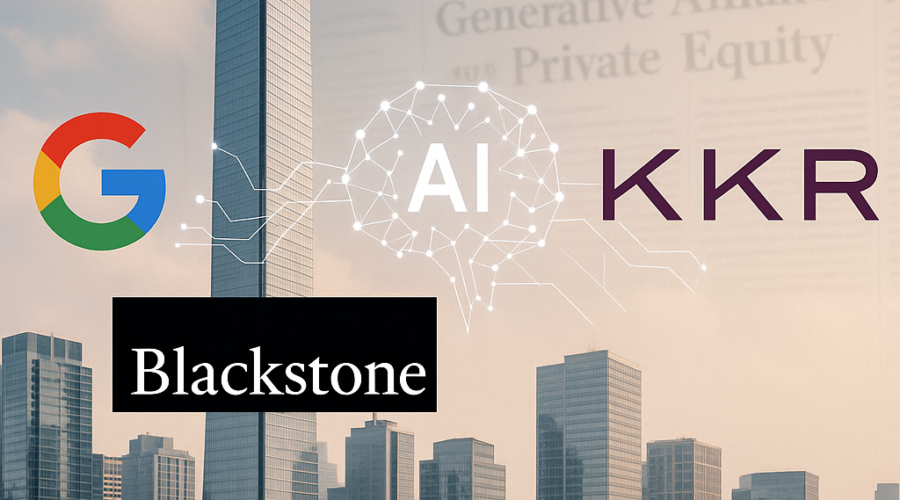
Blackstone and KKR are in advanced discussions with Google, finalized around May 6, 2026, for portfolio-wide access to its Gemini and Vertex AI platforms. This follows similar partnerships by Thoma Bravo and Vista Equity Partners, signaling a major trend among buyout firms. The primary driver is the defensive need to protect SaaS valuations from multiple contraction as agentic AI disrupts traditional seat-based software models. These 'omnibus' agreements represent a fundamental shift in the private equity playbook, transforming firms from financial engineers into operational technology platforms to institutionalize AI and secure terminal value.
- Topic
- Portfolio-wide Generative AI Partnerships in Private Equity
- Key Firms
- Blackstone Inc., KKR & Co., EQT AB, Thoma Bravo, Vista Equity Partners
- Technology Partner
- Google (Alphabet Inc.)
- AI Platforms
- Google Gemini architecture and Vertex AI platform
- Strategic Driver
- Protecting SaaS portfolio valuations from 'multiple contraction' due to agentic AI disruption.
- Key Market Risk
- Widening valuation gap for software companies lacking an AI-native roadmap.
- Supporting Data (McKinsey)
- 80% of PE buyers report a valuation uplift for AI-native companies, but only 6% of firms have achieved significant earnings impact from deployments.
- Partnership Model
- Omnibus agreements for direct model integration and infrastructure scaling, making PE firms channel partners.
- Primary Hurdle
- Data residency and 'cross-portfolio leakage' risks, creating potential anti-trust and IP conflicts.
- Reported Date
- May 6, 2026
In a move that signals a fundamental shift in the private equity value-creation playbook, Blackstone Inc. and KKR & Co. are in advanced discussions with Alphabet’s Google to secure portfolio-wide access to generative artificial intelligence (AI) models. According to reports finalized on May 6, 2026, the discussions aim to provide hundreds of portfolio companies with direct, streamlined access to Google’s Gemini architecture and Vertex AI platform.
Most “AI for Diligence” tools are lying to you. The truth is, they are just ChatGPT wrappers. Experience what real AI for Diligence looks like, built like Claude Code, but for M&A/ PE Diligence:
💼 When Claude Code Marries Due Diligence!
The negotiations, which reportedly include Swedish investment group EQT AB, represent a strategic pivot for the buyout industry. Rather than treat AI as a standalone consulting project, these “omnibus” agreements would embed high-performance computing and foundational models into the core operations of the firms’ vast holdings. This approach allows private equity (PE) firms to act as channel partners, accelerating portfolio-wide AI deployment strategies at a scale previously reserved for the world’s largest tech conglomerates.
The Defensive Necessity: Protecting SaaS Valuations
The urgency behind these talks is driven by a widening valuation gap in the software-as-a-service (SaaS) sector. According to Bain & Company’s 2026 Global Private Equity Report, the traditional “buy-and-build” software model has faced significant SaaS valuation risks in 2026 as “agentic AI” begins to automate the manual workflows that once justified seat-based pricing models.
Investment professionals are increasingly concerned with “multiple contraction” in portfolio companies that lack a clear AI-native roadmap. By partnering with Google, Blackstone and KKR aim to provide their software holdings with the infrastructure needed to transition from legacy tools to agentic platforms. McKinsey data suggests that while 80% of PE buyers now report a valuation uplift for AI-native companies, only 6% of firms have achieved significant earnings impact from their deployments, highlighting a massive “execution gap” that these partnerships are designed to bridge.
Strategic Comparison: Google vs. OpenAI and Anthropic
The proposed structure of the Google deal differs markedly from recent collaborations between rival AI providers and alternative asset managers. While OpenAI and Anthropic have focused on forming joint ventures and standalone consulting arms—such as OpenAI’s “Frontier Alliances” with TPG and Advent International—the Google discussions prioritize direct model integration and infrastructure scaling.
- Google’s Approach: Direct access to the Gemini Enterprise platform and dedicated “Forward Deployed Engineering” (FDE) teams to assist in production-level integration.
- OpenAI/Anthropic Approach: Focused on advisory-led transformations and co-investing in AI-native ventures to build a long-term revenue ecosystem.
- Financial Implications: Google’s model likely focuses on driving cloud consumption (GCP) and data gravity, while the startup-led models focus on per-user licensing and professional services.
Re-platforming the Buyout: A New Operational Paradigm
This convergence between Big Tech and private capital is not isolated. In April 2026, Thoma Bravo and Vista Equity Partners signed similar strategic partnerships with Google Cloud to overhaul their combined portfolio of over 600 software companies. These deals are increasingly viewed by deal advisors as a method of private equity AI-driven value creation, transforming PE firms from financial engineers into operational technology platforms.
| Value Driver | Legacy PE Playbook | 2026 AI-First Playbook |
|---|---|---|
| Operational Focus | Cost reduction & Margin expansion | Agentic automation & Product re-platforming |
| Revenue Model | Seat-based SaaS subscriptions | Value-based / Outcome-based pricing |
| Tech Infrastructure | Vendor-by-vendor procurement | Portfolio-wide Hyperscaler agreements |
| Exit Rationale | Stable cash flow / EBITDA growth | AI-native defensibility & Market leadership |
Regulatory and Data Governance Hurdles
While the strategic benefits are clear, the enterprise AI partnerships for buyout firms face significant headwinds. Kirkland & Ellis and other top-tier legal advisors have pointed to “data residency” and “cross-portfolio leakage” as primary concerns. Managing proprietary data across dozens of competing portfolio companies within a single Google Cloud environment requires sophisticated legal and technical silos to avoid anti-trust and intellectual property conflicts.
Furthermore, as Google increases its capital expenditure—projected to reach $180 billion in 2026—it is aggressively seeking “anchor tenants” for its AI infrastructure. Blackstone, with over $1 trillion in assets under management, offers the ultimate distribution network. By securing these partnerships, Google effectively bypasses the traditional sales cycle, gaining access to a massive captive market of mid-market and enterprise businesses.
Outlook for the Dealmaking Environment
The Blackstone-KKR-Google talks represent more than a simple vendor agreement; they are a precursor to a new era of agentic AI transformation in private equity. For C-level executives and LPs, the message is clear: the ability to scale AI across a diverse portfolio is no longer a luxury but a prerequisite for maintaining terminal value in a rapidly automating economy. As the “AI Reset” of 2026 continues, the success of these partnerships will likely determine the winners of the next buyout cycle.
Sources
 softwareequity.com
 intellectia.ai
 oliverwyman.com
 akingump.com
 googlecloudpresscorner.com
 techinasia.com
 marketscreener.com
 letsdatascience.com
 pwc.com
 thomabravo.com
 livmo.com
 prnewswire.com