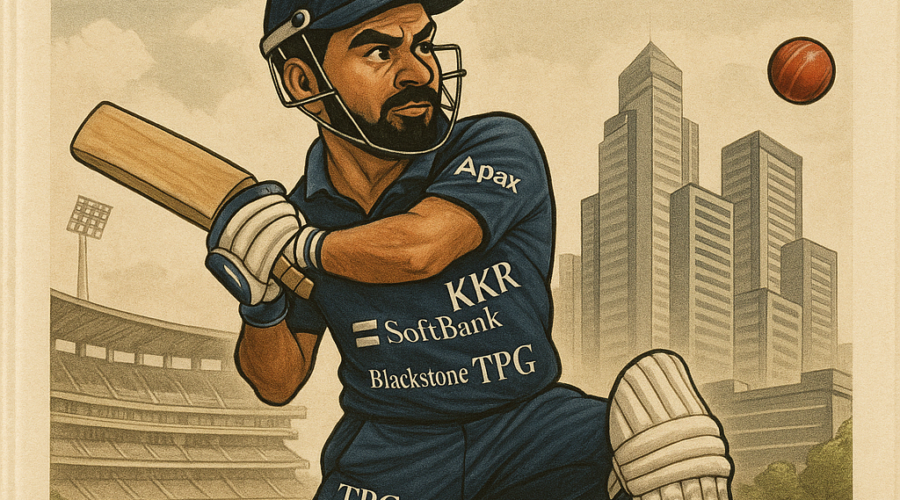
U.S. private equity firms like Blackstone are aggressively entering the Indian Premier League (IPL), highlighted by landmark acquisitions such as Royal Challengers Bengaluru for $1.8 billion and Rajasthan Royals for $1.65 billion. Investors are attracted by the IPL's 'closed-loop' ecosystem, which offers 100% foreign ownership, a player wage cap of around 20% of revenue, and no risk of relegation. These deals command high revenue multiples of 20x to 25x, reflecting a significant growth premium over U.S. and European leagues. This pivot represents the 'Americanization' of Indian cricket, transforming it from a regional sport into a globally recognized, high-yield asset class for institutional capital seeking predictable returns in a scarce market.
- Sector
- Global Sports Private Equity
- Geography
- India
- Asset Class
- Indian Premier League (IPL) Franchises
- Key Investors
- Blackstone, David Blitzer
- Recent Transaction (RCB)
- $1.8 billion for Royal Challengers Bengaluru
- Recent Transaction (Royals)
- $1.65 billion for Rajasthan Royals
- Implied Revenue Multiple
- 20x – 25x
- Player Cost Structure
- Wages capped at approx. 20% of total revenue
- Foreign Ownership Rule
- Up to 100% permitted by the BCCI
- Key Structural Advantage
- Closed-league model with no relegation risk
- Future Growth Driver
- Direct-to-consumer (DTC) monetization
- Key Risk
- Lack of specific sports-governance laws and regulatory volatility
In the high-stakes world of sports M&A, a new asset class has matured from a regional pastime into a global financial juggernaut. As of May 2026, the Indian Premier League (IPL) has officially transcended its “emerging market” status, commanding valuations that rival mid-market MLB franchises and elite European football clubs. The recent landmark acquisitions of Royal Challengers Bengaluru (RCB) for $1.8 billion and the Rajasthan Royals for $1.65 billion signal a fundamental shift in how institutional capital views the South Asian sporting landscape.
Most “AI for Diligence” tools are lying to you. The truth is, they are just ChatGPT wrappers. Experience what real AI for Diligence looks like, built like Claude Code, but for M&A/ PE Diligence:
💼 When Claude Code Marries Due Diligence!
The Billion-Dollar Wicket: Decoding the Deal Rationale
The entry of U.S.-based institutional heavyweights—most notably Blackstone and David Blitzer (co-founder of Harris Blitzer Sports & Entertainment)—marks a sophisticated play on scarcity and structural stability. Unlike the fragmented ownership models seen in the NFL or the promotion-relegation risks inherent in the English Premier League (EPL), the IPL offers a “closed-loop” ecosystem designed for capital preservation and aggressive margin expansion.
Key Value Drivers for Private Equity:
- Unprecedented Control: The Board of Control for Cricket in India (BCCI) allows for 100% foreign ownership, a stark contrast to the NFL’s 10% cap on private equity stakes.
- Fixed Cost Structures: Player wages are capped at approximately 20% of total revenue, far below the 50% benchmarks in the NBA or the often unsustainable 70-85% ratios seen in European soccer.
- Absence of Relegation: The closed-league model ensures that asset values do not evaporate due to a single poor season, providing the “downside protection” that PE mandates require.
Comparative Valuation: IPL vs. Global Peers
The recent transactions for RCB and Rajasthan Royals imply revenue multiples between 20x and 25x. While these multiples appear aggressive, they reflect a “growth premium” based on India’s expanding middle class and untapped digital monetization strategies.
| League | Typical Revenue Multiple | Avg. Team Valuation (Est. 2025/26) | PE Ownership Flexibility |
|---|---|---|---|
| IPL (India) | 20x – 25x | $1.5B – $1.8B | High (Up to 100%) |
| NBA (USA) | 8x – 11x | $4.0B | Moderate (Caps apply) |
| Premier League (UK) | 4x – 6x | $1.2B – $5.0B | High (But high risk/relegation) |
Operational Synergies and Digital Monetization
For firms like Blackstone, the value creation plan extends beyond passive appreciation. Analysts from Goldman Sachs and McKinsey have frequently highlighted that the next frontier for the IPL lies in direct-to-consumer (DTC) monetization. With a young, mobile-first audience of 1.4 billion, the transition from traditional broadcasting to integrated gaming, fantasy sports, and hyper-localized branded content offers a multi-decade runway for growth.
However, the 2024 merger between Viacom18 and Disney Star has introduced a new variable: a consolidated domestic media market. As competition for broadcast rights potentially cools, the emphasis for new owners must shift toward cross-border M&A trends in sports and ancillary revenue streams to maintain historical growth rates.
Risk Mitigation in an Emerging Regulatory Environment
Despite the optimism, the “cricket-as-an-asset-class” thesis faces headwinds. Institutional investors must navigate a landscape that lacks specific sports-governance laws. The intervention of the Indian Supreme Court in previous years underscored the volatility of the BCCI’s internal governance. Furthermore, recent regulatory shifts—such as the Indian government’s restrictions on fantasy gaming and crypto advertising—have pressured short-term ad revenue growth.
To mitigate these risks, PE firms are increasingly employing private equity exit strategies in SaaS-like models, treating team apps and fan engagement platforms as recurring revenue engines rather than relying solely on the triennial cycle of media rights auctions.
The Verdict for Dealmakers
The “Americanization” of the IPL—characterized by cost certainty, closed leagues, and high-margin digital plays—has turned a regional sport into a cornerstone of the global sports private equity landscape. While the entry price is no longer cheap, the structural advantages of the IPL offer a level of financial predictability that is increasingly rare in more mature Western markets. For the C-suite and institutional allocators, the Indian cricket pitch is no longer just a game; it is one of the most efficient yield-generating machines in professional sports today.
Executive Summary for Advisors:
The scarcity of IPL franchises, combined with a 20% player-cost ratio, creates a unique margin profile. Expect continued secondary market PE deals as original owners seek liquidity and institutional giants seek to export U.S. sports-tech stacks into the Indian market.