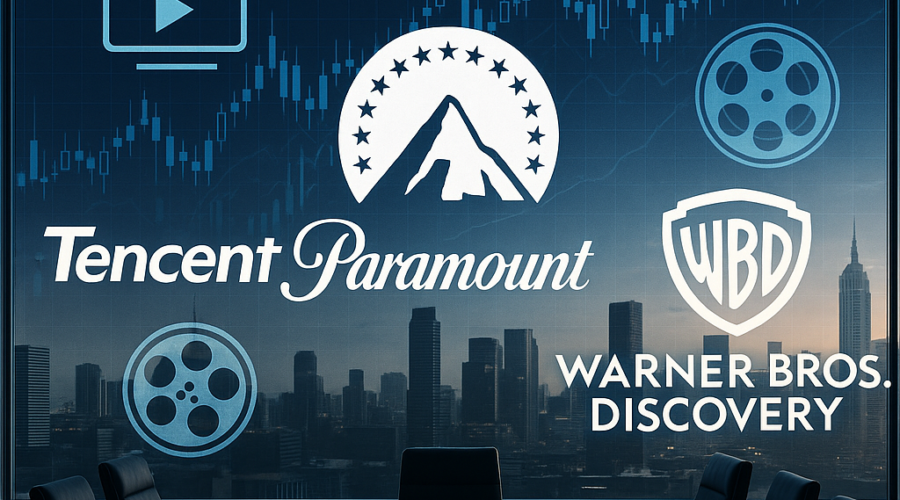
Tencent Holdings is considering a passive investment of several hundred million dollars in Paramount Skydance’s $110.9 billion acquisition of Warner Bros. Discovery. This follows its earlier withdrawal of a $1 billion commitment over concerns it would trigger a rigorous CFIUS review. The deal, led by David Ellison and RedBird Capital, is primarily financed with $47 billion in U.S.-centric equity and $54 billion in debt. Tencent’s recalibration from an active participant to a passive capital provider demonstrates a crucial de-risking strategy, signaling that the origin and structure of capital are now as critical as valuation in securing approval for media megadeals.
- Target
- Warner Bros. Discovery (WBD)
- Acquirer
- Paramount Skydance
- Transaction Type
- Acquisition
- Enterprise Value
- $110.9 Billion
- Offer Price
- $31 per share
- Core Equity Financing
- $47 Billion
- Debt Financing
- $54 Billion
- Key Equity Backers
- Ellison Family, RedBird Capital Partners
- Debt Providers
- Bank of America, Citigroup, Apollo Global Management
- Potential Passive Investor
- Tencent Holdings
- Expected Close
- September – December 2026
- Key Regulatory Hurdle
- Committee on Foreign Investment in the United States (CFIUS)
In a significant development reshaping the media landscape, Tencent Holdings is reportedly contemplating a fresh, smaller investment in Paramount Skydance’s $110 billion acquisition of Warner Bros. Discovery (WBD). This potential fresh capital injection—measured in the “several hundred million dollars” range—marks a strategic recalibration by the Chinese technology giant to maintain exposure to one of the largest media transactions in recent history while sidestepping the intense regulatory friction that previously stalled its involvement.
Most “AI for Diligence” tools are lying to you. The truth is, they are just ChatGPT wrappers. Experience what real AI for Diligence looks like, built like Claude Code, but for M&A/ PE Diligence:
💼 When Claude Code Marries Due Diligence!
The move is a masterclass in navigating complex international M&A, where geopolitical sensitivities now dictate financing structures. C-suite executives tracking global consolidation must note this pivot from active equity participant to strictly passive financial backer, a necessary concession to secure U.S. regulatory clearance for the takeover.
The $110 Billion Media Consolidation Play
Paramount Skydance, led by CEO David Ellison, secured the winning bid for WBD in late February 2026, topping a vigorous contest with Netflix. The transaction values WBD at $110.9 billion, or $31 per share, and will fuse assets including CBS, CNN, HBO, and the vast IP libraries encompassing Harry Potter and the DC Universe into a single entity.
The foundational financing structure is heavily reliant on domestic capital to assure Washington regarding national security concerns. The core is a substantial equity package, bolstered by the Ellison family and RedBird Capital Partners, designed to present a stable, U.S.-centric ownership profile.
Financing Stack for the Paramount-WBD Merger
| Component | Amount (USD) | Key Backers |
|---|---|---|
| Equity Package (Core) | $47 Billion | Ellison Family, RedBird Capital Partners |
| Debt Commitments | $54 Billion | Bank of America, Citigroup, Apollo Global Management |
| Total Enterprise Value | $110 Billion+ | N/A |
The potential addition of a “several hundred million dollar” passive investment from Tencent would serve to further fortify this financing wall as the deal moves toward an anticipated closing between September and December 2026.
The CFIUS Calculus: A Lesson in De-Risking International Capital
Tencent’s initial commitment of $1 billion was formally withdrawn late last year after WBD voiced apprehension that the Chinese group’s participation might invite rigorous review from the Committee on Foreign Investment in the United States (CFIUS). This history underscores a critical contemporary risk for private equity professionals and deal advisors executing large-scale cross-border M&A involving sensitive U.S. technology or media assets.
By stepping back into a role with no governance rights or voting power, Tencent attempts to sanitize the transaction from the regulatory viewpoint. This aligns with a broader trend in high-stakes transactions where sponsors strategically prioritize domestic or politically palatable funding sources to smooth the path through federal scrutiny, making the negotiation of private equity exit strategies in media increasingly complex.
It is worth noting that Tencent is not an unknown entity in this ecosystem. The firm already holds a minority non-voting stake in Paramount and has maintained a strategic partnership with Skydance since 2018, including co-financing and supporting the distribution of studio blockbusters. This existing familiarity suggests Tencent views the combined entity as a long-term strategic holding, regardless of its passive status.
Implications for Media Sector Investment
The successful navigation of regulatory concerns by the Ellison-RedBird consortium will set a precedent for future industry megadeals. For advisors, the episode highlights that in high-value media transactions, the origin of capital is as material as the valuation metric. While Tencent could still ultimately decide against the smaller investment, its current posture signals a pragmatic approach to maintaining influence in the evolving Hollywood structure.
The creation of this entertainment behemoth—controlling key linear channels alongside major streaming and film production—positions the new Paramount for aggressive restructuring, likely including significant post-merger cost-cutting initiatives to manage the substantial debt load assumed. This pursuit of scale reflects the enduring mandate in the sector: survival necessitates global footprint and control over premium content pipelines.
Sources
 pe-insights.com
 mybroadband.co.za
 rthk.hk
 wikipedia.org
 mexc.com
 moneyweb.co.za
 infonasional.com