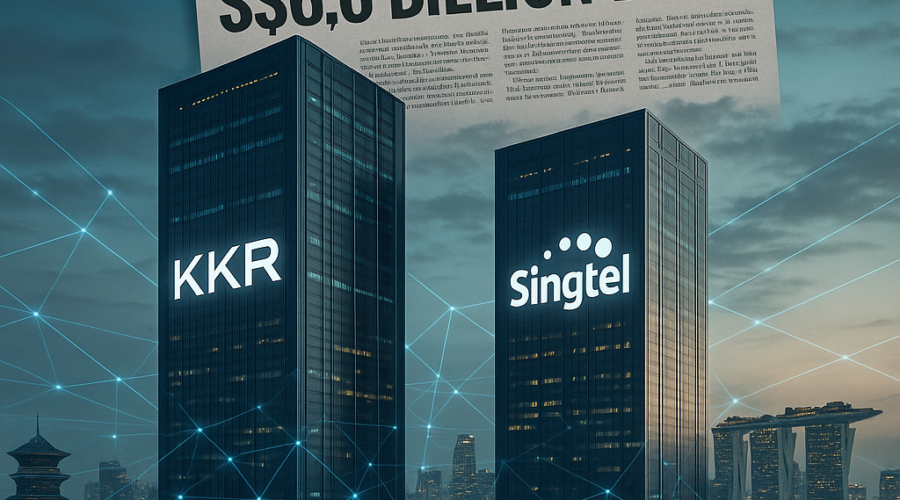
KKR has agreed to acquire Singtel’s data centre business for S$6.6 billion ($4.9 billion), marking one of Southeast Asia’s largest infrastructure transactions as of early 2026. Announced on February 4, the deal values the unit at approximately 25x EBITDA, reflecting strong market demand. KKR will acquire 100% of the business, with Singtel retaining a minority stake via convertible notes, and plans S$2 billion in expansion capex. This transaction underscores private equity’s aggressive expansion into digital infrastructure, driven by surging demand for AI-driven computing power and hyperscaler leases across the Asia-Pacific region.
- Target
- Singtel’s data centre business
- Acquirer
- KKR
- Enterprise Value
- S$6.6 billion ($4.9 billion)
- Announced Date
- February 4
- Expected Close
- Second half of 2026
- EV/EBITDA Multiple
- 25x
- Capacity
- 1.2 GW (existing)
- Expansion Capex Plan
- S$2 billion over three years for 500MW additional capacity
- Singtel Retained Stake
- ~10% (convertible notes)
- Advisors (Acquirer)
- Kirkland & Ellis
- Advisors (Target)
- Allen & Gledhill
- Strategic Driver
- Surging demand for AI-driven computing power and digital infrastructure
Singapore Telecommunications (Singtel) has agreed to sell its data centre business to KKR for S$6.6 billion ($4.9 billion), marking one of Southeast Asia’s largest infrastructure transactions as of early 2026. The deal, announced February 4, underscores private equity’s aggressive expansion into digital infrastructure amid surging demand for AI-driven computing power.
Most “AI for Diligence” tools are lying to you. The truth is, they are just ChatGPT wrappers. Experience what real AI for Diligence looks like, built like Claude Code, but for M&A/ PE Diligence:
💼 When Claude Code Marries Due Diligence!
Deal Structure and Financial Terms
The transaction values Singtel’s data centre unit, which operates 17 facilities across Singapore, Australia, and India with 1.2 gigawatts of capacity, at an enterprise value implying a multiple of approximately 25x EBITDA. KKR will acquire 100% of the business through a newly formed entity, with Singtel retaining a minority stake via convertible notes. Closing is targeted for the second half of 2026, subject to regulatory approvals from bodies including Singapore’s IMDA and Australia’s ACCC.
| Metric | Value |
|---|---|
| Enterprise Value | S$6.6 billion |
| 2025 EBITDA (Pro Forma) | S$260 million |
| EV/EBITDA Multiple | 25x |
| Capacity | 1.2 GW |
| Singtel Retained Stake | ~10% (convertible) |
Financing includes KKR’s balance sheet commitment of $2 billion alongside debt from Asia-focused lenders, reflecting compressed debt yields in the sector at 4-5% post-2025 rate cuts.
Strategic Rationale and Synergies
For KKR, the acquisition bolsters its $50 billion global digital infrastructure portfolio, including prior investments in EdgeConneX and AirTrunk. “This positions us at the epicenter of Asia-Pacific hyperscaler demand,” said KKR Infrastructure Managing Director Rahul Advani in a statement. The firm plans S$2 billion in expansion capex over three years, targeting 500MW additional capacity in high-growth markets like Indonesia and Thailand.
Singtel, seeking to streamline operations amid telco margin pressures, will recycle proceeds into 5G spectrum auctions and enterprise AI services. CEO Bill Chang noted the sale “unlocks value from mature assets” while maintaining strategic exposure. Bain & Company analysis highlights such carve-outs as key private equity exit strategies in telecom infrastructure, with similar deals yielding 20-30% IRRs.
Market Context: Data Centre M&A Trends 2026
Asia-Pacific data centre transactions reached $25 billion in 2025, up 40% year-over-year, per McKinsey’s Global Infrastructure Report. Valuations have stabilized at 22-28x EBITDA following 2024 peaks, driven by supply constraints and power shortages. KKR’s move aligns with peers: Blackstone’s $16 billion AirTrunk buyout in 2024 and DigitalBridge’s $10 billion ESR stake acquisition.
- Regulatory Risks: Heightened scrutiny on foreign ownership in critical infrastructure; Singapore mandates local control thresholds.
- Valuation Shifts: BCG forecasts 15% cap rate compression in 2026 due to AI workloads, favoring brownfield expansions like Singtel’s assets.
- Industry Implications: Accelerates consolidation, with telcos divesting to PE for hyperscaler leases (e.g., AWS, Google Cloud commitments totaling 40% utilization).
Leadership and Integration Outlook
Singtel’s data centre CEO Sam Fenwick transitions to KKR as executive chair, ensuring continuity. No immediate layoffs are planned; instead, headcount grows 20% to support development pipelines. Kirkland & Ellis advised KKR, while Allen & Gledhill represented Singtel.
Goldman Sachs equity research pegs the deal as a benchmark for cross-border M&A trends 2025-2026 in data centres, signaling sustained PE appetite despite geopolitical tensions in the region.
This transaction reinforces data centres as a cornerstone of private equity infrastructure strategies, with implications for valuation multiples and hyperscaler supply chains extending through the decade.
Sources