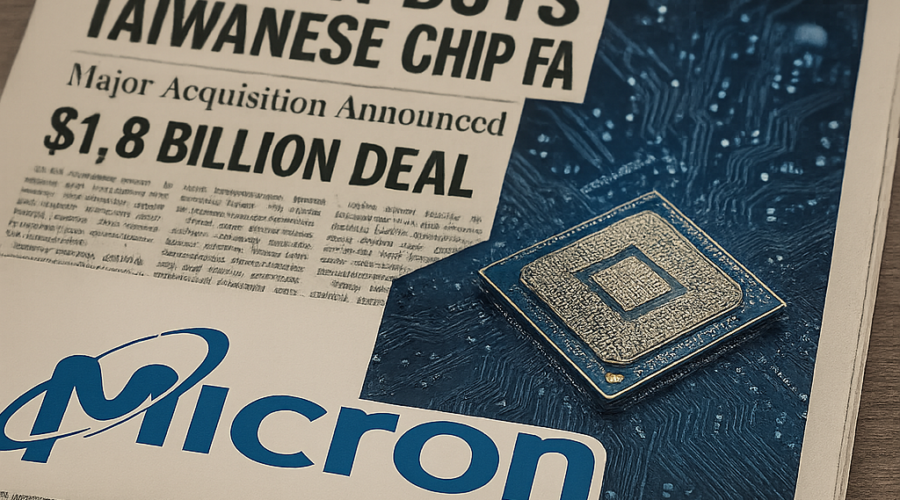
Micron Technology has signed a letter of intent to acquire a fabrication site in Taiwan’s Tongluo from Powerchip Semiconductor Manufacturing Corp. (PSMC) for $1.8 billion in cash. This acquisition aims to expand Micron’s DRAM production, specifically for HBM3E and future nodes, to meet surging AI-driven memory demand. The deal reflects a strategic move by Micron to secure advanced manufacturing capacity in a key semiconductor hub, aligning with broader semiconductor supply chain realignment trends. This cross-border M&A highlights the continued importance of Taiwan’s manufacturing edge for U.S. tech firms despite domestic incentives, positioning Micron for significant growth in the AI memory market.
- Acquirer
- Micron Technology
- Target
- Fabrication site in Tongluo, Taiwan (from Powerchip Semiconductor Manufacturing Corp. – PSMC)
- Transaction Type
- Acquisition (Letter of Intent)
- Enterprise Value
- $1.8 billion
- Consideration
- Cash
- Strategic Driver
- Expand DRAM production, secure advanced capacity for HBM3E, meet AI-driven memory demand
- Target Facility
- P5 cleanroom facility
- Seller’s Rationale
- Refocus on specialty processes
- Expected Close
- Mid-2026 (contingent on due diligence)
- Acquirer’s YTD Stock Gain (2026)
- 26.9%
Micron Technology has signed a letter of intent to acquire a fabrication site in Taiwan’s Tongluo from Powerchip Semiconductor Manufacturing Corp. (PSMC) for $1.8 billion, aiming to expand DRAM production amid surging AI-driven memory demand.[1][6][11]
Most “AI for Diligence” tools are lying to you. The truth is, they are just ChatGPT wrappers. Experience what real AI for Diligence looks like, built like Claude Code, but for M&A/ PE Diligence:
💼 When Claude Code Marries Due Diligence!
The P5 cleanroom facility would enable Micron to ramp up output in Taiwan, a key semiconductor hub, as global AI workloads strain high-bandwidth memory (HBM) supplies.[1][3] This cross-border M&A move reflects **semiconductor supply chain realignment strategies** in response to U.S. onshoring pressures and Taiwan’s entrenched manufacturing edge.[5]
Deal Rationale and Financial Terms
Micron, a Boise-based leader in DRAM and NAND flash, targets the acquisition to secure advanced capacity for HBM3E and future nodes critical to AI data centers.[3][10] PSMC, facing strategic shifts, divests the Tongluo site to refocus on specialty processes.[1] The $1.8 billion price tag—payable in cash—aligns with Micron’s aggressive capex, including a separate $100 billion U.S. fab groundbreaking.[3]
Analysts view the deal as accretive, with Micron’s stock up 26.9% year-to-date to $362.75 as of early 2026, trading at a forward P/E of 28.86 amid “Buy” consensus and $200.64 targets.[10] Institutional flows remain strong, though CEO Sanjay Mehrotra’s recent share sales signal caution.[11]
Strategic Context in AI Semiconductor M&A Trends
The transaction underscores **Taiwan semiconductor acquisition trends 2026**, where U.S. firms like Micron deepen Asia ties despite CHIPS Act incentives for domestic builds.[5] Taiwan’s FDI inflows hit $11.39 billion in 2025, up 45%, fueled by AI exports.[5] Comparable deals include TSMC’s U.S. expansions and Nvidia’s supplier shifts amid 25% U.S. tariffs on select chips.[4][5][9]
| Metric | Micron (MU) | TSMC (TSM) |
|---|---|---|
| Market Cap | $245.84B | N/A (Leader in Foundry) |
| YTD Stock Gain (2026) | 26.9% | Up on AI Guidance |
| Key Driver | AI Memory Demand | Blackwell Wafers |
| Recent Capex | $1.8B Taiwan + $100B U.S. | U.S./Japan Fabs |
Industry Implications and Risks
- Synergies: Boosts Micron’s HBM capacity, positioning it for “Nvidia-like growth” per investors, as AI servers demand tripled memory.[3][10]
- Regulatory Hurdles: U.S.-Taiwan tech transfer scrutiny under Trump-era tariffs; CFIUS review likely for IP flows.[5][9]
- Geopolitical Exposure: Enhances Taiwan reliance amid China tensions, counterbalanced by Micron’s U.S. investments.[4]
- Valuation Shifts: SOXX ETF up 40% on AI sentiment; rotation risks if tariffs hit Nvidia suppliers.[7]
Bain & Company notes **private equity exit strategies in semiconductor assets** could accelerate, with PE firms eyeing memory plays amid 3.8% Taiwan GDP forecast tied to AI.[5] McKinsey highlights HBM shortages persisting through 2027, validating Micron’s capacity grab.[10]
Leadership under CEO Sanjay Mehrotra emphasizes innovation in AI workloads, with no immediate layoffs signaled.[10] Closing hinges on due diligence, expected mid-2026.
Sources
https://techsoda.substack.com/p/micron-and-psmcs-strategic-realignment, https://www.marketbeat.com/stocks/NYSE/TSM/news/, https://www.tipranks.com/news/nvidia-like-growth-says-top-investor-about-micron-stock, https://www.tipranks.com/news/topic/tsm, https://www.taipeitimes.com/News/biz, https://www.investing.com/news/company-news, https://www.ainvest.com/news/soxx-40-surge-tracking-ai-trade-viral-sentiment-2601/, https://www.tipranks.com/news/cathie-wood-buys-amd-tsmc-and-other-growth-stocks-trims-stakes-in-kratos-defense-1-17-2026, https://www.business-standard.com/topic/semiconductor-industry, https://www.marketbeat.com/stocks/NASDAQ/MU/, https://www.marketbeat.com/stocks/NASDAQ/MU/news/, https://theedgemalaysia.com/flash-categories/Tech