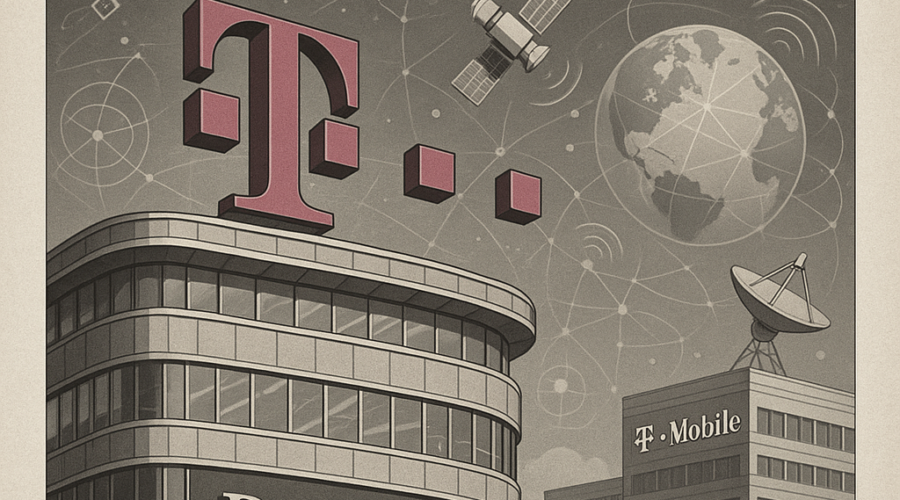
Deutsche Telekom AG, which holds a 53.7% stake in T-Mobile US, is evaluating a full combination of the two entities through a stock-for-stock bid via a new global holding company. T-Mobile US, with an estimated $220 billion market cap, contributes approximately 65% of the group's total revenue. A full merger would allow DT to capture T-Mobile's massive free cash flow, eliminate a persistent holding company discount on its stock, and achieve global scale. This potential transaction signals a strategic shift in the telecom sector, where future competition will be defined by unified global infrastructure and AI-driven network efficiency rather than regional market share.
- Potential Acquirer
- Deutsche Telekom AG (DT)
- Target
- T-Mobile US (TMUS)
- Transaction Type
- Potential full combination / stock-for-stock buyout
- Acquirer's Current Stake
- 53.7% equity (56.2% voting power)
- Target Market Cap
- $220 Billion (as of April 2026)
- Target's Revenue Contribution
- Approximately 65% of group's total revenue
- Strategic Driver
- Capital efficiency, simplified corporate structure, and achieving global scale for the '6G supercycle'
- Proposed Structure
- Creation of a new global holding company with a dual listing in Europe and the U.S.
- Key Synergies
- Streamlined hardware/spectrum procurement and global scaling of T-Mobile's 5G SA and agentic AI network technologies
- Potential Hurdles
- CFIUS review, valuation gap due to T-Mobile's premium multiple, and leadership integration
Shares of T-Mobile US (TMUS) rose as much as 3% on Tuesday following reports that its majority shareholder, Deutsche Telekom AG (DT), is evaluating a full combination of the two entities. The move, which would consolidate the German carrier’s most valuable asset, signals a definitive pivot in the transatlantic telecommunications landscape and could rank as one of the largest public M&A transactions in history.
Most “AI for Diligence” tools are lying to you. The truth is, they are just ChatGPT wrappers. Experience what real AI for Diligence looks like, built like Claude Code, but for M&A/ PE Diligence:
💼 When Claude Code Marries Due Diligence!
The Rationale: Unified Capital and Global Scale
The strategic logic for a full combination rests on capital efficiency and the simplification of a complex corporate structure. As of April 2026, Deutsche Telekom holds a 53.7% majority stake in T-Mobile US, with voting power boosted to 56.2% through proxy agreements. However, the current “parent-subsidiary” model creates friction in capital allocation, particularly as the U.S. “Un-carrier” now generates approximately 65% of the group’s total revenue and significantly outweighs its parent in market capitalization.
According to sources familiar with the matter, the proposed structure involves the creation of a new global holding company. This entity would issue a stock-for-stock bid for the remaining minority shares of both companies, potentially seeking a dual listing on a major European exchange and a U.S. exchange. For C-level executives at rival firms, this move suggests that DT is preparing for a “6G supercycle” where global infrastructure scale—rather than regional dominance—will be the primary differentiator.
Current Market Snapshot: The Big Three (April 2026)
| Carrier | Market Cap (Est.) | Key Strategic Focus |
|---|---|---|
| T-Mobile US | $220 Billion | Fixed-wireless expansion; Agentic AI integration |
| Verizon | $185 Billion | Private 5G; Enterprise digital twins |
| AT&T | $145 Billion | Fiber-to-the-home (FTTH) leadership |
Financial Implications and Synergies
Analysts at firms like Goldman Sachs and JP Morgan have long noted that a full buyout would allow Deutsche Telekom to fully capture T-Mobile’s massive free cash flow, which reached record levels in 2025. Currently, T-Mobile’s aggressive $10 billion annual share buyback program indirectly increases DT’s ownership stake, but a formal merger would remove the “holding company discount” often applied to DT’s stock.
Furthermore, cross-border M&A trends in 2026 show an increasing appetite for “infrastructure-first” deals. By combining, the unified group could streamline its procurement for hardware and spectrum, while leveraging T-Mobile’s lead in 5G standalone (SA) networks to bolster DT’s lagging European deployments. The integration of “agentic AI” into the core network—a key pillar of T-Mobile CEO Srini Gopalan’s strategy—could be scaled globally, reducing operational expenditures through automated network fault-finding and customer service.
Regulatory and Political Hurdles
Despite the financial allure, a telecommunications megamerger of this scale faces significant scrutiny. Any transaction would require “political support” from both Washington and Berlin. While the U.S. Department of Justice (DOJ) and the FCC previously approved the T-Mobile/Sprint merger, a full takeover by a foreign entity—even a friendly NATO ally—may trigger Committee on Foreign Investment in the United States (CFIUS) reviews regarding national security and digital infrastructure sovereignty.
- Regulatory Risk: Potential pushback on the concentration of U.S. consumer data under a foreign holding company.
- Valuation Gap: The “magenta” premium. T-Mobile’s valuation trades at a higher multiple than its parent, making a stock-swap ratio highly contentious for minority shareholders.
- Leadership Transition: Ensuring continuity as Srini Gopalan (appointed late 2025) and DT CEO Tim Höttges navigate the integration.
The “Un-carrier” Outlook
For investment professionals, the deal represents the final evolution of a 25-year journey for Deutsche Telekom in the U.S. market. What began as the acquisition of VoiceStream Wireless in 2001 has transformed into the primary engine of German corporate growth. Whether the “combination” occurs via a tender offer or a complex reverse-merger, the move signals that the era of the regional telecom is ending, replaced by a global model focused on private equity exit strategies in SaaS-like recurring revenue and AI-driven network efficiency.
T-Mobile is scheduled to report its Q1 2026 results next Tuesday, where management will likely face intense questioning regarding the feasibility and timing of this historic consolidation.