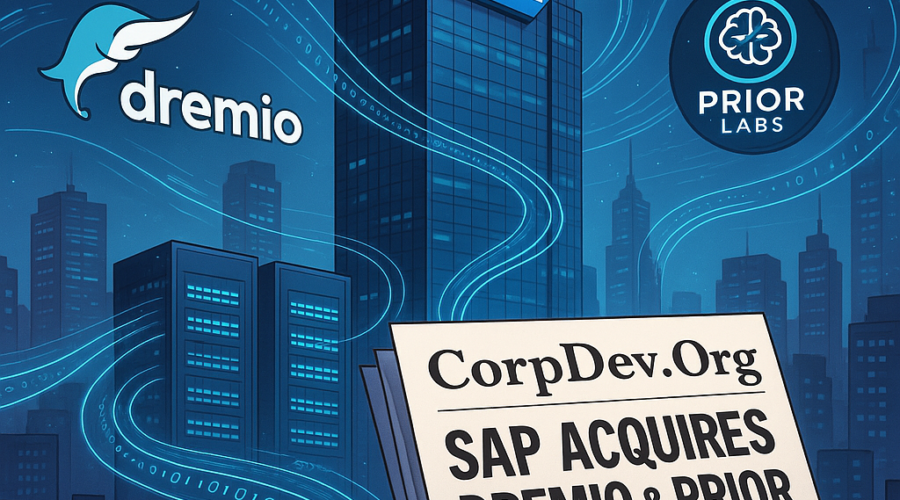
On May 4, 2026, SAP SE announced the dual acquisition of Dremio, an open data lakehouse company, and Prior Labs, a specialist in Tabular Foundation Models. The deal includes a committed €1 billion ($1.17 billion) investment over four years to scale Prior Labs. This move is designed to solve enterprise AI's core challenge: making accurate predictions on structured business data. By combining Dremio's data access layer with Prior Labs' specialized models, SAP is strategically shifting from simple AI copilots to building an 'agentic AI' architecture capable of autonomous decision-making, directly challenging data platforms like Databricks and Snowflake.
- Acquirer
- SAP SE
- Targets
- Dremio and Prior Labs
- Transaction Type
- Dual Acquisition
- Announced Date
- May 4, 2026
- Committed Investment
- €1 billion ($1.17 billion) over four years to scale Prior Labs
- Expected Close (Dremio)
- Q3 2026
- Expected Close (Prior Labs)
- Q2 or Q3 2026
- Strategic Driver
- To build an 'agentic AI' architecture for autonomous enterprise workflows by solving data fragmentation and model underperformance on structured data.
- Target 1 Technology
- Dremio: Open data lakehouse built on Apache Iceberg for universal data access.
- Target 2 Technology
- Prior Labs: Tabular Foundation Models (TFMs) like TabPFN for predictive AI on structured data.
- Market Reaction
- SAP stock saw a 1.5% uptick following the announcement.
In a decisive move to bridge the “execution gap” in enterprise artificial intelligence, SAP SE announced a dual acquisition on May 4, 2026, targeting the two most persistent bottlenecks in the sector: data fragmentation and the underperformance of models on structured business data. By acquiring Dremio, an open data lakehouse pioneer, and Prior Labs, a frontier specialist in Tabular Foundation Models (TFMs), SAP is effectively attempting to rewrite the foundational architecture of the modern ERP.
Most “AI for Diligence” tools are lying to you. The truth is, they are just ChatGPT wrappers. Experience what real AI for Diligence looks like, built like Claude Code, but for M&A/ PE Diligence:
💼 When Claude Code Marries Due Diligence!
The deal, which includes a committed €1 billion ($1.17 billion) investment over the next four years to scale Prior Labs into a global research powerhouse, signals that SAP is moving beyond simple “copilot” features. Instead, it is positioning itself as the primary orchestrator for agentic AI workflows—autonomous systems capable of making real-time business decisions across finance, supply chain, and procurement.
The Rationale: Why Large Language Models (LLMs) Aren’t Enough
For most C-level executives, the frustration with AI has been a matter of “pilot purgatory.” While LLMs excel at creative text and summaries, they notoriously struggle with the structured, tabular data—spreadsheets, ledgers, and transaction records—that forms the backbone of global commerce. SAP CTO Philipp Herzig was blunt about the constraint: “Enterprise AI doesn’t stall because the models aren’t good enough; it stalls because the data isn’t ready for AI agents.”
By integrating Prior Labs, SAP is doubling down on Tabular Foundation Models. Unlike general-purpose LLMs, TFMs like Prior Labs’ flagship TabPFN are specifically trained on structured datasets. They can predict supplier risk, payment delinquencies, and customer churn with far greater accuracy and speed than traditional machine learning, which often requires months of manual data preparation and model training.
Strategic Integration: The “Fourth Layer” of the SAP Stack
The simultaneous acquisition of Dremio solves the “plumbing” half of the equation. Dremio’s architecture is built on Apache Iceberg, an open table format that allows companies to query data across disparate systems—both SAP and non-SAP—without moving or converting it. This transition makes the SAP Business Data Cloud “Iceberg-native,” a move that directly challenges the dominance of Databricks and Snowflake in the data lakehouse market.
Comparative Analysis: SAP’s Dual Acquisition Strategy
| Feature | Dremio (Data Layer) | Prior Labs (Model Layer) |
|---|---|---|
| Core Function | Universal open data access | Predictive AI for structured tables |
| Key Technology | Apache Iceberg / Polaris | TabPFN (Tabular Foundation Model) |
| Business Impact | Eliminates data silos & migration | Automates complex forecasting |
| Strategic Goal | “Single open platform” | “Agentic AI” execution |
Industry Implications: A Shift Toward Agentic AI 2026
This deal marks a fundamental shift in cross-border M&A trends 2026, where the focus has moved from acquiring raw talent to acquiring specialized infrastructure. SAP’s strategy is clear: it no longer expects data to live exclusively within its own ecosystem. Instead, it is building the tools to operate across the entire enterprise data estate.
Market analysts from firms like Goldman Sachs and McKinsey have recently highlighted that 2026 will be the year of “multi-agent orchestration.” In this environment, a company’s AI doesn’t just answer questions; it acts on them. For example, an AI agent using SAP’s new stack could detect a delay in a supply chain (via Dremio’s real-time access), predict the resulting cash flow impact (via Prior Labs’ models), and autonomously suggest alternative sourcing (via SAP S/4HANA).
Financials and Regulatory Outlook
While the specific purchase prices for Dremio and Prior Labs were not disclosed, SAP’s commitment to a €1 billion research lab investment signals the magnitude of the bet. The Dremio acquisition is expected to close in Q3 2026, with Prior Labs likely closing earlier in Q2 or Q3, pending regulatory approvals.
Investors have reacted with cautious optimism. Following the announcement, SAP’s stock saw a modest 1.5% uptick, supported by strong Q1 2026 earnings where operating profit rose 17% to €2.7 billion. However, the true test will be SAP Sapphire 2026 later this month, where the company is expected to detail how these acquisitions will be integrated into the Joule agentic layer.
Conclusion: The End of “Narrow” AI?
For years, enterprises had to build “narrow” AI models for every single task—one for churn, one for fraud, one for inventory. With the acquisition of Prior Labs and the data access provided by Dremio, SAP is betting that the era of fragmented AI is over. By creating a unified foundation that can handle any structured data task in a single forward pass, SAP isn’t just selling software; it is selling the ability to turn raw data into autonomous decisions at scale.
As the market for enterprise AI exit strategies matures, the message to competitors is clear: owning the data context is the ultimate competitive moat. SAP, with its vast footprint in business operations, is now weaponizing that context with the most advanced data and model layers available.
Sources
 crn.com
 sapinsider.org
 ciodive.com
 techzine.eu
 siliconangle.com
 stocktitan.net
 constellationr.com
 bitget.com
 sap.com
 channellife.com.au
 narwal.ai
 sap.com
 investing.com
 thenextweb.com
 pa40.com
 pulse2.com
 tikr.com