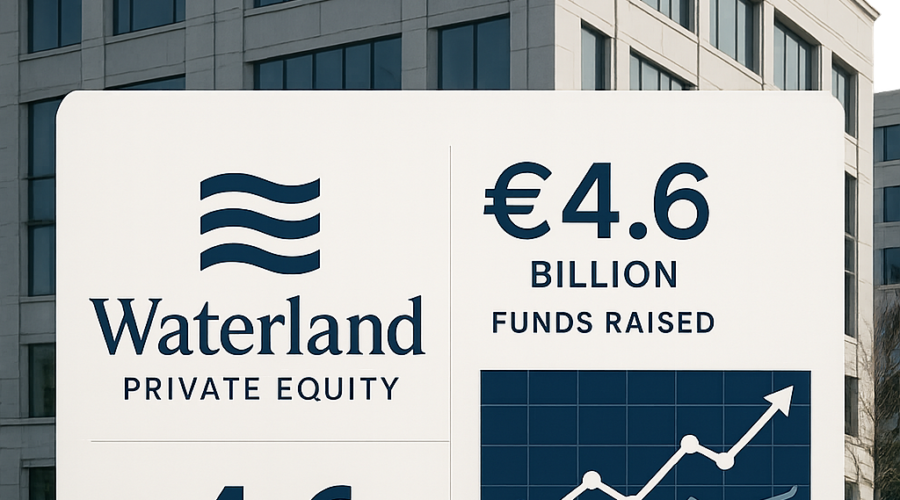
Waterland Private Equity achieved a final close of €4.6 billion across two funds, WPEF X (€4B) and WPF II (€600M), in less than four months, announced April 24, 2026. Both funds hit their hard caps, driven by the firm's strong track record of returning capital, with its preceding Fund IX reporting a net IRR over 25%. This rapid fundraise in a selective environment signals a significant "flight to quality" among LPs, who are prioritizing managers with proven, operationally-focused buy-and-build strategies over those reliant on financial leverage.
- Topic
- Private Equity Fundraising
- Key Firm
- Waterland Private Equity
- Total Capital Raised
- €4.6 Billion
- Fund Vehicles
- Waterland Private Equity Fund X (€4B) and Waterland Partnership Fund II (€600M)
- Fundraising Timeframe
- Less than four months
- Announcement Date
- April 24, 2026
- Core Strategy
- European mid-market buy-and-build
- Key Market Dynamic
- LP 'flight to quality' and focus on Distributions to Paid-in Capital (DPI)
- Preceding Fund Performance
- Fund IX reported a net IRR exceeding 25%
- Total AUM (Post-Raise)
- Exceeds €20 Billion
- Advisors (Fundraise)
- Kirkland & Ellis, Evercore
In a fundraising environment where capital remains selective and liquidity cycles have extended, Waterland Private Equity has achieved a blistering final close of €4.6 billion across two funds in less than four months. The dual fundraise, announced April 24, 2026, comprises the 10th institutional flagship fund, Waterland Private Equity Fund X (WPEF X) at €4 billion, and Waterland Partnership Fund II (WPF II) at €600 million.
Most “AI for Diligence” tools are lying to you. The truth is, they are just ChatGPT wrappers. Experience what real AI for Diligence looks like, built like Claude Code, but for M&A/ PE Diligence:
💼 When Claude Code Marries Due Diligence!
Both vehicles reached their respective hard caps shortly after launch, reflecting a significant “flight to quality” among global limited partners (LPs). For institutional investors, Waterland’s ability to return capital—a metric increasingly scrutinized in the current “DPI crisis”—remains a primary differentiator. The firm’s preceding Fund IX reportedly generated a net internal rate of return (IRR) exceeding 25%, buoyed by a record year of realizations in 2025.
The “Buy-and-Build” Premium: Strategy and Rationale
The success of Fund X underscores the continued dominance of European mid-market buy-and-build strategies. While mega-cap buyout activity has faced headwinds from persistent interest rate uncertainty and shifting valuation multiples, the mid-market remains a fertile ground for consolidation. Waterland’s mandate focuses on fragmented growth markets across Europe, where they identify “platform” companies and execute aggressive bolt-on acquisitions to build regional leaders.
Industry analysts from Bain & Company and McKinsey suggest that the “new math” of private equity—often referred to as “12 is the new 5″—requires firms to generate roughly 12% annual EBITDA growth through operational improvements rather than the historical 5% reliant on leverage. Waterland’s model is tailor-made for this shift, utilizing a network of 13 European offices to source proprietary, relationship-driven deals.
Fund Snapshot: Waterland 2026 Dual Raise
| Fund Vehicle | Capital Raised | Target Strategy |
|---|---|---|
| Waterland Private Equity Fund X | €4.0 Billion | Control investments in mid-market European SMEs. |
| Waterland Partnership Fund II | €600 Million | Minority stakes in selected exiting portfolio companies. |
| Total New Commitments | €4.6 Billion | Total AUM now exceeds €20 Billion ($22B). |
High-Velocity Fundraising in a “K-Shaped” Market
The speed of this raise—less than 120 days—is a stark contrast to the broader private equity landscape. According to the Bain Global Private Equity Report 2026, the average time to close a fund has elongated for many managers as LPs prioritize consistent distributions to paid-in capital (DPI) over unrealized gains. Waterland’s ability to bypass this “liquidity logjam” is attributed to its high volume of recent exits.
In the weeks leading up to the fund close, Waterland demonstrated its realization prowess with several high-profile exits:
- Wtech Fire Group: Acquired by U.S.-listed APi Group in April 2026, marking a successful exit from the Irish market.
- Coeo Inkasso: A majority stake sale to doValue completed in mid-April 2026.
- Skaylink: The divestment of the cloud services specialist to Vodafone for €175 million in late 2025.
Industry Implications: Scaling the Mid-Market
The €4 billion cap on Fund X allows Waterland to compete for larger platforms while remaining agile enough to execute the small-cap “bolt-ons” that drive their value creation. This approach addresses cross-border M&A trends in 2026, where corporate and private buyers are increasingly seeking resilient, technology-enabled service providers to hedge against geopolitical volatility.
The firm’s leadership, now steered by Group Managing Partner Cedric Van Cauwenberghe, intends to deploy capital across key sectors including sustainability, healthcare, and digital transformation. Notable recent platform investments include partnerships with Condio (food ingredients) and Dartshopper (specialty retail), indicating a diverse sector appetite.
Strategic Outlook for Deal Advisors
For investment banks and legal advisors (such as Kirkland & Ellis and Evercore, who advised on this raise), the message is clear: capital is concentrating among the “alpha” managers. As competition for quality assets intensifies, dealmaking will favor firms with a proven private equity exit strategy and the ability to institutionalize family-owned businesses at scale.
With more than €20 billion now under management, Waterland’s rapid success suggests that while the overall fundraising market may be plateauing, specialized managers with a localized, execution-heavy playbook are still operating in a bull market for capital.
Sources
 substack.com
 waterlandpe.com