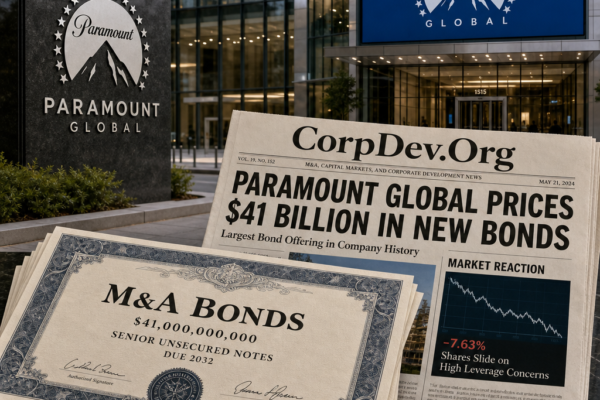

Paramount Skydance is launching a $49 billion corporate bond offering, led by Bank of America, Citigroup, and J.P. Morgan, to finance its acquisition of Warner Bros. Discovery (WBD). The transaction carries a total enterprise value of $110.9 billion, funded by the new debt and a $47 billion equity injection from the Ellison family and RedBird Capital. The all-cash tender offer is set at $31 per share, with a projected close in Q3 2026. This mega-merger represents the ultimate consolidation play in media, creating a streaming giant to rival Netflix while testing the capital markets' appetite for large-scale, leveraged transformations in a high-interest-rate environment.
- Acquirer
- Paramount Skydance
- Target
- Warner Bros. Discovery (WBD)
- Total Enterprise Value
- $110.9 Billion
- Offer Price
- $31 per share (all-cash tender offer)
- New Debt Issuance
- $49.0 Billion
- Equity Injection
- $47.0 Billion (from Ellison Family & RedBird Capital)
- Projected Synergies
- $6.0 Billion+
- Announced Date
- February 27, 2026
- Expected Close
- Q3 2026 (Target)
- Lead Buy-Side Advisors
- Centerview Partners, M. Klein & Company
- Lead Sell-Side Advisors
- Allen & Company, J.P. Morgan, Evercore
- Lead Debt Underwriters
- Bank of America, Citigroup, J.P. Morgan
Wall Street’s capital markets desks are mobilizing for what is expected to be the largest corporate bond offering of the year. Bankers at Bank of America, Citigroup, and J.P. Morgan are reportedly finalizing the structures for a $49 billion debt sale to fund Paramount Skydance’s acquisition of Warner Bros. Discovery (WBD). The move signals a critical pivot for CEO David Ellison as he seeks to solidify the financing for the $110 billion mega-merger ahead of a projected third-quarter close.
Most “AI for Diligence” tools are lying to you. The truth is, they are just ChatGPT wrappers. Experience what real AI for Diligence looks like, built like Claude Code, but for M&A/ PE Diligence:
💼 When Claude Code Marries Due Diligence!
The Financing Architecture: Leveraging a Media Empire
The debt issuance is a cornerstone of a complex multi-layered financing strategy designed to absorb WBD’s existing leverage while providing the liquidity necessary for the all-cash $31-per-share tender offer. This $49 billion tranche is expected to be split across multiple tenors, targeting institutional investors hungry for yield in a market increasingly dominated by tech-media convergence.
Consolidated Deal Terms & Financing (Pro Forma)
| Category | Metric / Detail |
|---|---|
| Total Enterprise Value | $110.9 Billion |
| New Debt Issuance | $49.0 Billion (Banker Target) |
| Equity Injection | $47.0 Billion (Backstopped by Ellison Family & RedBird Capital) |
| Projected Synergies | $6.0 Billion+ (Operational & Tech Efficiencies) |
| Advisor Lead (Buy-Side) | Centerview Partners, M. Klein & Company |
| Advisor Lead (Sell-Side) | Allen & Company, J.P. Morgan, Evercore |
Strategic Rationale: Scaling the “Streaming Survivor”
The deal represents the ultimate consolidation play in the media and entertainment M&A landscape. By combining Paramount+ and Max, the “New Paramount” aims to achieve a critical mass capable of rivaling Netflix and Disney. Analysts at Goldman Sachs and Morgan Stanley have noted that the “Paramount One” initiative—a plan to merge technology stacks and content libraries—could yield significant cross-border M&A trends by setting a template for how legacy studios transition to digital-first entities.
- Library Dominance: The combined entity will control a vast portfolio including Harry Potter, DC Universe, Star Trek, Mission: Impossible, and Game of Thrones.
- Linear Stability: Despite the secular decline of cable, the merger provides a unified front for negotiating carriage fees with distributors, leveraging a massive live-sports portfolio including the NFL and UFC.
- Operational Synergies: The company is targeting $6 billion in cost-savings, primarily through the elimination of redundant corporate overhead and a unified global content distribution network.
Regulatory Gauntlet and Market Risks
Despite the successful shareholder approval on April 23, 2026, the transaction faces a rigorous regulatory environment. The Department of Justice (DOJ) and the Federal Trade Commission (FTC) are scrutinizing the potential for content concentration, particularly in the theatrical and news sectors. California Attorney General Rob Bonta has already signaled “red flags,” suggesting that a coalition of state attorneys general could file a lawsuit to block the deal, potentially delaying the close into 2027.
For C-level executives and deal advisors, the primary risk remains the debt-to-EBITDA leverage. Pro forma net leverage is expected to hover around 3.3x, a figure the new management team has pledged to reduce through “aggressive non-core asset divestitures.” Investors are closely watching for potential spin-offs of legacy cable networks or international linear assets as part of a post-merger private equity exit strategy for non-performing divisions.
Deal Timeline: The Road to Closing
- February 27, 2026: Definitive merger agreement announced at $31 per share.
- March 2026: Paramount+ and Max integration plan (“Paramount One”) unveiled.
- April 23, 2026: WBD shareholders vote overwhelmingly to approve the sale.
- May 19, 2026 (Present): Bankers initiate the $49 billion debt marketing phase.
- Q3 2026 (Target): Anticipated regulatory clearance and deal consummation.
Impact on the Investment Banking Landscape
This mandate is a landmark for the participating banks. For Bank of America and Citi, the $54 billion total financing commitment (including bridge loans) is one of the largest in recent corporate history. The fees associated with the $49 billion bond sale will likely anchor league table rankings for the current fiscal year. As high-profile strategic M&A returns to the media sector, this deal is being viewed as the ultimate test of the capital markets’ appetite for large-scale transformation in an era of high interest rates and shifting consumer behavior.
As the marketing roadshow for the bonds begins, the focus shifts to whether the “Ellison premium”—the perceived stability of tech-scion leadership backed by deep-pocketed private capital—can overcome the inherent volatility of a shifting Hollywood landscape.