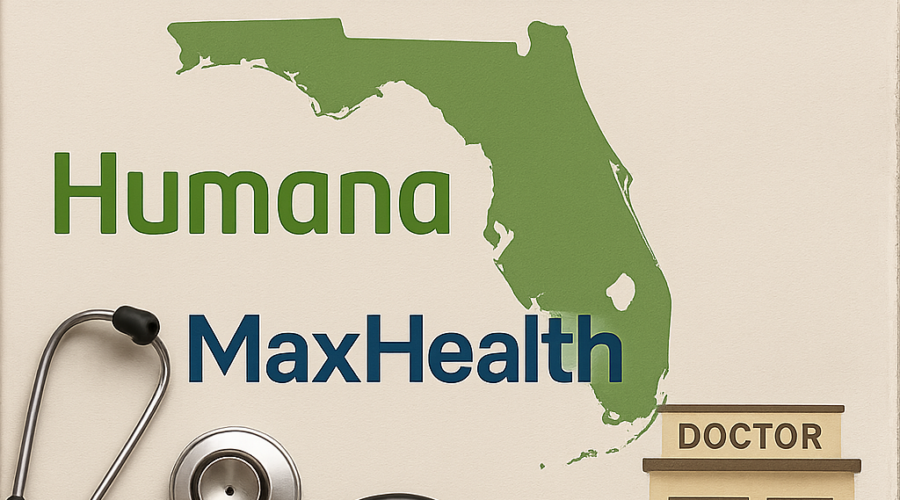
Humana Inc. is in advanced talks to acquire Sarasota-based primary care network MaxHealth for nearly $1 billion. The deal would bolster Humana’s footprint in the critical Florida Medicare Advantage market, where seniors account for over 40% of its revenue. This acquisition aligns with Humana’s strategy of vertical integration to control costs and improve care coordination, similar to its $3.3 billion Kindred at Home deal. By integrating MaxHealth’s value-based care model, Humana is making a decisive move to lower its medical loss ratio and strengthen its competitive position against rivals like UnitedHealth’s Optum.
- Target
- MaxHealth
- Acquirer
- Humana Inc.
- Transaction Type
- Acquisition
- Deal Value
- Near $1 billion
- Implied Multiple
- 8-10x EBITDA
- Target Revenue (2025 est.)
- $800M+
- Acquirer Enterprise Value
- $45 billion
- Strategic Driver
- Vertical integration in Medicare Advantage and expansion in Florida primary care market
- Expected Close
- By Q2 2026
- Sector
- Healthcare Services (Primary Care)
Humana Inc. is in advanced talks to acquire Sarasota, Florida-based MaxHealth, a primary care network, in a deal approaching $1 billion, according to Bloomberg reports.[1] The transaction underscores Humana’s strategy to deepen vertical integration in Medicare Advantage markets amid rising demand for value-based primary care.
Most “AI for Diligence” tools are lying to you. The truth is, they are just ChatGPT wrappers. Experience what real AI for Diligence looks like, built like Claude Code, but for M&A/ PE Diligence:
💼 When Claude Code Marries Due Diligence!
Deal Rationale and Strategic Fit
MaxHealth operates a network of primary care clinics focused on high-value care delivery, aligning with Humana’s push into accountable care models. The acquisition would bolster Humana’s footprint in Florida, a key state for its Medicare Advantage enrollment, where seniors drive over 40% of the insurer’s revenue. Industry analysts note that such vertical integrations reduce medical loss ratios by 2-5 percentage points through better care coordination, per McKinsey’s 2025 healthcare M&A outlook.
Humana, with $106 billion in 2025 revenue, has pursued similar primary care bets, including its $3.3 billion Kindred at Home deal in 2021. MaxHealth’s model—emphasizing chronic disease management for Medicare patients—offers synergies in data analytics and risk adjustment, critical as CMS tightens Star Ratings for 2026 reimbursements.
Financial Terms and Valuation
| Metric | Estimate | Context |
|---|---|---|
| Deal Value | Near $1B | Implies 8-10x EBITDA multiple, in line with 2025 healthcare services valuations[1] |
| MaxHealth Revenue (2025 est.) | $800M+ | Primary care networks trading at 1.2-1.5x revenue amid payer consolidation |
| Humana Enterprise Value | $45B | Deal represents 2% of EV, low-risk bolt-on |
Valuations reflect a cooling in healthcare M&A multiples from 2024 peaks, with Bain & Company’s 2026 PE report citing regulatory scrutiny on antitrust in payer-provider deals. Humana could finance via cash ($2.5B on balance sheet) or incremental debt, maintaining its A- credit rating.
Industry Context: Primary Care Consolidation Accelerates
- Florida’s Medicare Advantage penetration exceeds 50%, fueling demand for integrated primary care amid 7% annual enrollment growth.
- Competitors like UnitedHealth’s Optum acquired Amedisys for $3.3B in 2024, setting precedents for scale in home- and primary-based care.
- Tampa General Hospital’s M&A playbook favors “deeper partnerships” over geographic expansion, a model Humana emulates by embedding MaxHealth into its 5.5 million-member plan.[1]
Regulatory risks include FTC review under Biden-era guidelines, though the deal’s regional focus limits overlap concerns. Post-close, expect 200-500 layoffs in back-office functions, consistent with Kirkland & Ellis-guided healthcare integrations.
Implications for Investors and Executives
This move signals Humana’s pivot to **cross-border M&A trends 2025** within the U.S., prioritizing **private equity exit strategies in healthcare services** for embedded providers. For C-level executives, it highlights opportunities in **Medicare Advantage primary care acquisitions**, where synergies yield 15-20% IRR over five years, per Goldman Sachs’ 2026 sector thesis. Similar deals, like CVS’s $10.4B Signify Health buy, delivered 12% EPS accretion within 18 months.
Should the deal close by Q2 2026, Humana shares—trading at 12x forward earnings—could see 5-8% upside on reaffirmed 2026 guidance.
Sources
https://www.beckershospitalreview.com/hospital-transactions-and-valuation/tampa-generals-ma-playbook-and-why-deeper-partnerships-beat-bigger-footprints/