
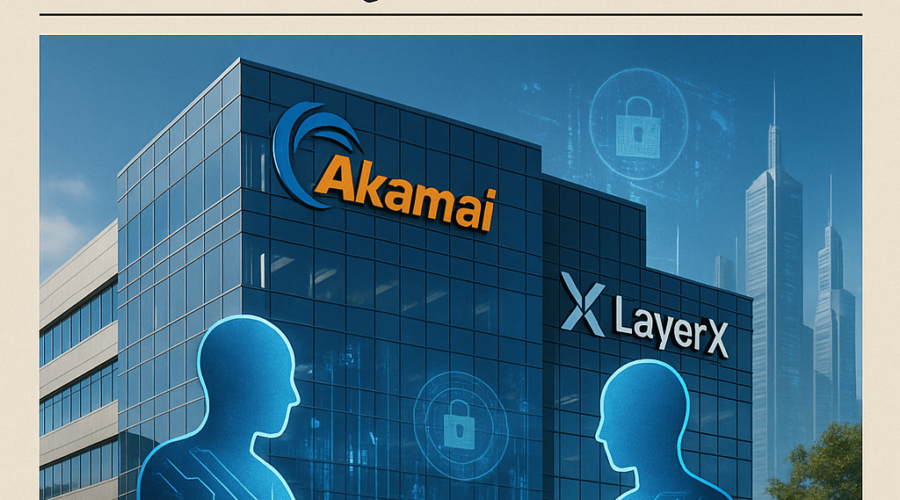
Akamai Technologies (NASDAQ: AKAM) announced on May 14, 2026, its definitive agreement to acquire Tel Aviv-based cybersecurity firm LayerX for approximately $205 million. The valuation represents a ~20.5x multiple on LayerX's projected ~$10 million in 2026 annual recurring revenue and is expected to be dilutive to Akamai's non-GAAP EPS by ~$0.12 in FY2026. The acquisition provides Akamai with a browser-extension-based security solution to monitor and control enterprise interactions with generative AI tools. This deal signals a strategic imperative for security platforms to acquire high-multiple, AI-governance assets to control the 'last mile' of security, even at the cost of short-term earnings dilution.
- Acquirer
- Akamai Technologies (NASDAQ: AKAM)
- Target
- LayerX
- Transaction Type
- Acquisition
- Purchase Price
- ~$205 Million
- Valuation Multiple
- ~20.5x forward ARR
- Target Revenue (2026)
- ~$10 Million ARR
- Financial Impact
- Dilutive to non-GAAP EPS by ~$0.12 in FY2026
- Announced Date
- May 14, 2026
- Expected Close
- Q3 2026
- Sector
- Cybersecurity (Browser Security)
- Strategic Driver
- Control enterprise data usage in web-based AI tools and secure the browser as a primary work layer.
In a strategic maneuver to dominate the “last mile” of enterprise security, Akamai Technologies (NASDAQ: AKAM) announced on May 14, 2026, a definitive agreement to acquire Tel Aviv-based cybersecurity firm LayerX for approximately $205 million. The deal underscores a fundamental shift in the browser security market trends of 2026, as organizations move away from legacy network perimeters toward securing the browser—the primary execution layer for modern work and generative AI applications.
Most “AI for Diligence” tools are lying to you. The truth is, they are just ChatGPT wrappers. Experience what real AI for Diligence looks like, built like Claude Code, but for M&A/ PE Diligence:
💼 When Claude Code Marries Due Diligence!
The Rationale: Securing the “Agentic” Enterprise
As enterprises accelerate the adoption of agentic AI and SaaS-heavy workflows, traditional Zero Trust Network Access (ZTNA) and Secure Service Edge (SSE) solutions have left a critical visibility gap. While those tools manage the connection to an application, they often fail to govern the data moving within the browser itself. LayerX provides a browser-agnostic extension that transforms standard commercial browsers like Chrome or Edge into secure workspaces without the friction of proprietary “enterprise browsers.”
For Akamai, the acquisition is less about immediate revenue and more about AI usage control for enterprises. LayerX’s technology allows CISOs to monitor and control interactions with Large Language Models (LLMs), preventing sensitive data exfiltration through AI prompts—a top concern as “shadow AI” becomes a standard operational risk in 2026.
Deal at a Glance: Akamai & LayerX
| Purchase Price | ~$205 Million (subject to adjustments) |
| Target Revenue (End of 2026) | ~$10 Million ARR |
| Valuation Multiple | ~20.5x forward ARR |
| Financial Impact | Dilutive to non-GAAP EPS by ~$0.12 in FY2026 |
| Expected Closing | Q3 2026 |
Financial Framing and Market Consolidation
The purchase price of $205 million represents less than 1% of Akamai’s market capitalization, yet the 20x forward ARR multiple reflects the premium status of cross-border M&A trends in 2026 within the cybersecurity sector. According to Capstone Partners, while median sector multiples have stabilized at 4.3x revenue, strategic “tuck-in” acquisitions for AI-governance assets continue to command outsized premiums.
This transaction marks Akamai’s fourth cybersecurity acquisition in Israel over the past five years, following its successful integrations of Guardicore and Neosec. By absorbing LayerX, Akamai is directly challenging the market position of “rip-and-replace” browser competitors like Island and Enterprise Browser offerings from Palo Alto Networks and CrowdStrike (which recently acquired Seraphic Security for $420 million).
Strategic Synergies within the Zero Trust Portfolio
- Unified Visibility: LayerX integrates directly into Akamai’s existing Zero Trust portfolio, providing a control layer that spans from the user’s browser to the infrastructure’s AI inference workloads.
- DLP for GenAI: The technology offers real-time Data Loss Prevention (DLP) specifically for web-based AI tools, addressing a market Gartner predicts will be a priority for 30% of enterprises by 2028.
- Low-Friction Deployment: Unlike competitors that require a dedicated browser, the LayerX extension-based model allows for rapid global rollout—a key selling point for enterprise browser security solutions in decentralized workforces.
Industry Implications: The Pivot to AI Infrastructure
The deal follows Akamai’s Q1 2026 earnings report, which highlighted a 40% surge in Cloud Infrastructure Services (CIS) revenue. CEO Tom Leighton has been vocal about transforming Akamai from a legacy Content Delivery Network (CDN) into a distributed AI and security platform. However, this transformation comes with a cost: Akamai expects capital expenditures to hit 23–26% of revenue in 2026 as it builds out global AI inference data centers.
Investment professionals should view this acquisition as a defensive and offensive play. Defensively, it prevents competitors like Zscaler from owning the “last mile” of the user experience. Offensively, it positions Akamai to capture the burgeoning spend on AI governance. As noted by McKinsey, the next phase of cybersecurity growth will be defined by “reframing existing categories” to absorb AI capabilities—a mandate this deal fulfills precisely.
Leadership and Integration
Post-closing, LayerX co-founders Or Eshed and David Vaisbrud will join Akamai’s Zero Trust organization. Akamai plans to maintain LayerX as a standalone offering while simultaneously embedding its telemetry into the broader Akamai Connected Cloud. This dual-track strategy aims to maximize account penetration among existing security customers who are currently struggling with the governance of unmanaged AI browser extensions and personal SaaS logins.
For deal advisors and C-level executives, the Akamai cybersecurity M&A strategy serves as a blueprint for the current era: prioritize high-growth, high-multiple strategic assets that solve the immediate “AI anxiety” of the enterprise, even if those deals are dilutive in the short term. In a market where the browser has become the new operating system, owning the security of that environment is no longer optional—it is a prerequisite for platform relevance.
Sources
 investingnews.com
 stocktitan.net
 bankinfosecurity.com
 pulse2.com
 govinfosecurity.com
 securityweek.com
 bleepingcomputer.com
 layerxsecurity.com
 investing.com
 businessinsider.com
 marketchameleon.com
 times-online.com