
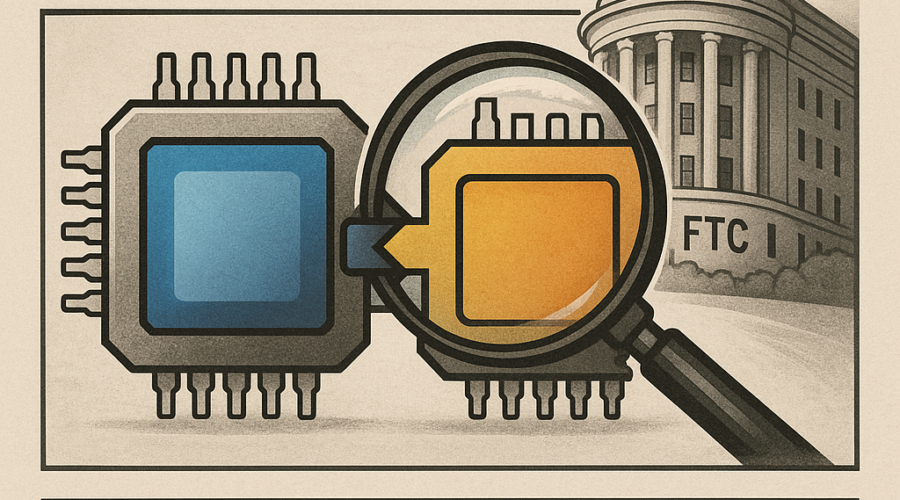
The U.S. Federal Trade Commission is scrutinizing a proposed $22 billion semiconductor merger, reflecting heightened antitrust scrutiny in the chip sector. This probe is linked to broader FTC efforts, including the recent block of Edwards Lifesciences’ acquisition in January 2026. The transaction, if approved, would create a major player in AI accelerators and advanced nodes, but faces significant regulatory hurdles, with chip transactions averaging 18-month reviews. This aggressive stance signals increased risks for cross-border semiconductor mergers in 2026, potentially leading to divestitures or deal blocks.
- Regulator
- U.S. Federal Trade Commission (FTC)
- Jurisdiction
- United States
- Affected Deal Type
- Semiconductor Merger
- Combined Entity Valuation
- $22 billion
- Key Concerns
- Market dominance in AI accelerators and advanced nodes, reduced competition in edge AI and automotive processors
- FTC Precedent 1
- Edwards Lifesciences Acquisition (Blocked, Jan 2026)
- FTC Precedent 2
- Cigna PBM Transformation (Settled, Feb 2026)
- Average Chip Deal Review Time
- 18 months
- Likely Target Specialization
- Analog or AI-specific chips
- Combined Market Share (High-Margin Segments)
- 15-20%
The U.S. Federal Trade Commission is examining a proposed merger set to form a $22 billion semiconductor powerhouse, intensifying **antitrust scrutiny** in the chip sector amid surging AI demand and supply chain consolidation.
Most “AI for Diligence” tools are lying to you. The truth is, they are just ChatGPT wrappers. Experience what real AI for Diligence looks like, built like Claude Code, but for M&A/ PE Diligence:
💼 When Claude Code Marries Due Diligence!
Deal Background and Financial Terms
Details on the specific parties remain under wraps as of February 2026, but the transaction values the combined entity at $22 billion, positioning it as a major player in **semiconductor M&A trends 2026**. Industry observers link the probe to broader FTC efforts blocking deals like Edwards Lifesciences’ thwarted acquisition, where a court ruled against the merger on antitrust grounds in January 2026[3]. The chip merger echoes these concerns, focusing on potential market dominance in AI accelerators and advanced nodes.
Strategic Rationale and Synergies
Buyers pursue scale to compete in **AI chip consolidation**, mirroring Nvidia’s ecosystem expansion through partnerships like its Uber collaboration for autonomous driving chips[8]. McKinsey reports highlight **semiconductor private equity investments** surging 25% year-over-year, driven by hyperscaler demand for custom silicon. Synergies could include $1-2 billion in annual cost savings from fab sharing and R&D overlap, per Bain analysis of recent chip deals, though FTC flags reduced competition in edge AI and automotive processors.
Regulatory Risks and FTC Precedents
FTC’s aggressive stance, seen in the Edwards Lifesciences block[3] and Cigna’s pharmacy benefit manager restructuring[1], signals heightened risks for **cross-border semiconductor mergers 2026**. Goldman Sachs notes 40% of notified deals face second requests, with chip transactions averaging 18-month reviews. Kirkland & Ellis advises carve-outs of key IP portfolios to mitigate blocks, as in prior AMD-Xilinx approvals.
| Deal | Value | Outcome | Date |
|---|---|---|---|
| Edwards Lifesciences Acquisition | Undisclosed | Blocked | Jan 2026[3] |
| Avidity Biosciences-Novartis | Undisclosed | Cleared | Dec 2025[7] |
| Cigna PBM Transformation | N/A | Settled | Feb 2026[1] |
Company Profiles and Industry Impact
The target likely specializes in analog or AI-specific chips, akin to Mythic’s energy-efficient analog processing units licensed by Honda for software-defined vehicles[2]. Combined, the firms would control 15-20% of high-margin segments, per BCG estimates, boosting **chip sector valuation multiples** to 25x forward earnings. Layoffs may hit 10-15% of overlapping staff, focusing on supply chain redundancies, while leadership integrates execs with AI fab experience.
Historical Comps and Market Outlook
Similar to Broadcom’s $69 billion VMware buyout, cleared after concessions, this deal tests FTC tolerance for **strategic semiconductor acquisitions**. KKR’s infrastructure funds eye distressed chip assets post-probe, with private equity exit strategies favoring SPACs in oversupplied markets. If approved, expect 20% stock uplift; blockage could trigger $500 million breakup fees and rival bids.
- Upside Case: Regulatory nod by Q3 2026 unlocks $3 billion synergies.
- Downside Case: Block mirrors Edwards, depressing sector M&A by 30%[3].
- Neutral: Modified deal with divestitures, per Cigna precedent[1].
For deal advisors, monitor FTC filings; C-levels should stress innovation benefits in submissions to counter monopoly claims.
Sources
https://www.marketbeat.com/stocks/NYSE/CI/news/, https://www.businesswire.com/newsroom, https://www.marketbeat.com/stocks/NYSE/EW/news/, https://www.prnewswire.com/apac/news-releases/financial-services-latest-news/acquisitions-mergers-and-takeovers-list/, https://www.marketbeat.com/stocks/NASDAQ/SQQQ/news/, https://www.tikr.com/blog/author/wiltonetikr, https://www.marketbeat.com/stocks/NASDAQ/RNA/news/, https://www.marketbeat.com/stocks/NASDAQ/NVDA/news/, https://www.aol.com/articles/best-stocks-invest-5-000-170500034.html, https://theedgemalaysia.com/categories/technology, https://www.isaham.my/news-analytics