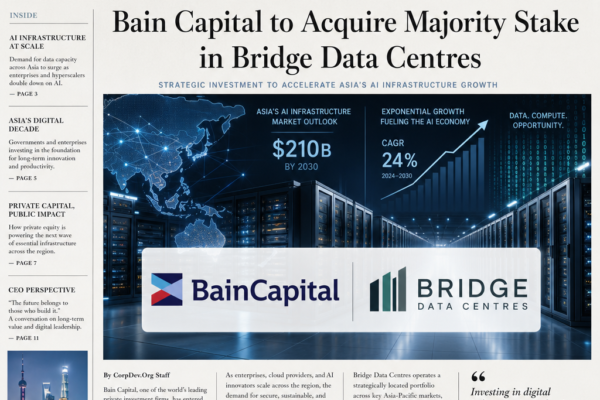

Blue Owl Capital Inc. is exploring a full or partial divestment of the Asia-Pacific operations of its data center platform, Stack Infrastructure, according to people familiar with the matter. The potential transaction, which could be valued at upwards of $30 billion, would represent one of the largest infrastructure realizations in the region’s history and signals a strategic shift in how alternative asset managers are balancing “AI-ready” development against institutional liquidity needs.
Most “AI for Diligence” tools are lying to you. The truth is, they are just ChatGPT wrappers. Experience what real AI for Diligence looks like, built like Claude Code, but for M&A/ PE Diligence:
💼 When Claude Code Marries Due Diligence!
Strategic Realignment and Capital Recycling
The discussions, which remain in the preliminary stages, involve assets across critical Tier-1 markets including Australia, Japan, and Malaysia. The timing of the potential exit is a calculated maneuver. Since acquiring Stack Infrastructure through its takeover of IPI Partners in 2024, Blue Owl has presided over a period of aggressive expansion fueled by the hyperscale AI arms race. However, the firm recently informed investors it would limit withdrawals from two of its private credit funds following a surge in redemption requests—a move that has increased the internal pressure to crystallize gains from high-performing infrastructure sleeves.
By divesting the Asian portfolio, Blue Owl can effectively recycle capital into its burgeoning U.S. pipeline. This includes a massive $12 billion campus development for Amazon and a $2.45 billion commitment for a Meta-leased facility. Investment professionals view this as a transition from “early-stage development” to “capital-intensive scaling” within the North American market, where power grid constraints are increasingly dictating deal flows.
Key Deal Components and Market Valuation
- Geography: Core clusters in Tokyo, Sydney, and Melbourne, alongside a high-growth 220-megawatt campus in Johor, Malaysia.
- Valuation Multiples: While specific EBITDA figures are undisclosed, recent 2025-2026 data center M&A trends suggest hyperscale-leased assets are commanding premiums of 25x to 30x EBITDA.
- Buyer Profile: Likely suitors include sovereign wealth funds (GIC, ADIA), global infrastructure giants (Blackstone, KKR, Brookfield), or consolidated platforms like AirTrunk, which is itself eyeing a multi-billion dollar Singapore REIT listing.
The Rise of “Sovereign AI Corridors”
The valuation of Stack’s Asian assets is underpinned by a structural shift in regional digital infrastructure. As Singapore maintains its strict power-rationing policies, capital is flowing into what deal advisors call “sovereign AI corridors” in neighboring Johor (Malaysia) and Batam (Indonesia). These regions provide the land and power density required for large language model training that legacy urban centers can no longer support.
| Metric | Projected 2026 APAC Outlook |
|---|---|
| Data Center CapEx | $400 Billion (Global Hyperscaler Total) |
| Capacity Growth (CAGR) | 13.7% through 2033 |
| Power Scarcity Risk | High (Grid wait times 24-96 months) |
Implications for Institutional Investors
For C-level executives, the Blue Owl exit strategy highlights a nuanced reality in the 2026 market: data centers are no longer just “tech real estate,” but have evolved into a critical utility asset class. However, the sector is not without headwinds. While digital infrastructure investment remains robust, a growing bifurcation is emerging between “announced” projects and “active construction.” Recent reports indicate that nearly half of planned builds for 2026 have faced delays due to shortages in high-power transformers and switchgear components.
A $30 billion price tag for Stack Asia would set a new benchmark for private equity exit strategies in digital infrastructure. It tests the depth of the secondary market and the willingness of pension funds to absorb large-scale, stabilized portfolios at a time when interest rates—though stabilized—remain significantly higher than the previous decade’s average. If successful, this sale will provide Blue Owl the necessary dry powder to dominate the next phase of the AI-driven infrastructure supercycle in the United States, further concentrating market share among a handful of global mega-platforms.
The Road Ahead
As deliberations continue, the broader industry will be watching for the final structure of the deal. A partial stake sale could allow Blue Owl to retain upside in the high-growth Asian markets while securing the liquidity required to satisfy redemption requests. For deal makers, this transaction serves as a blueprint for navigating the complex intersection of portfolio concentration, regional regulatory shifts, and the relentless demand for compute power.
Sources
 privateequitywire.co.uk
 techinasia.com
 bloomberglaw.com
 businesstimes.com.sg
 theedgesingapore.com
 newmarketpitch.com
 mintz.com
 intelmarketresearch.com
 datacenterknowledge.com
 thestar.com.my
 substack.com
 reddit.com
 spglobal.com
 jll.com
 seekingalpha.com
 youtube.com
 avidsolutionsinc.com
 tomshardware.com