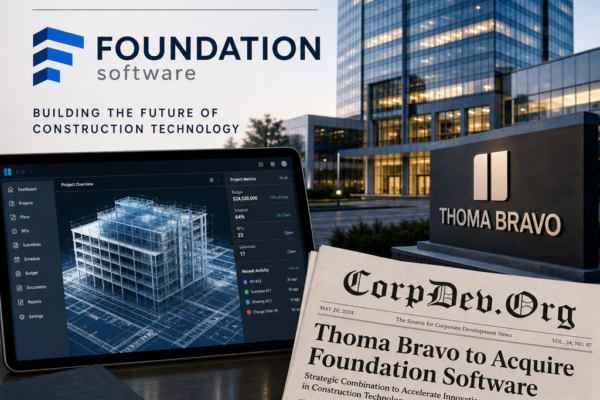
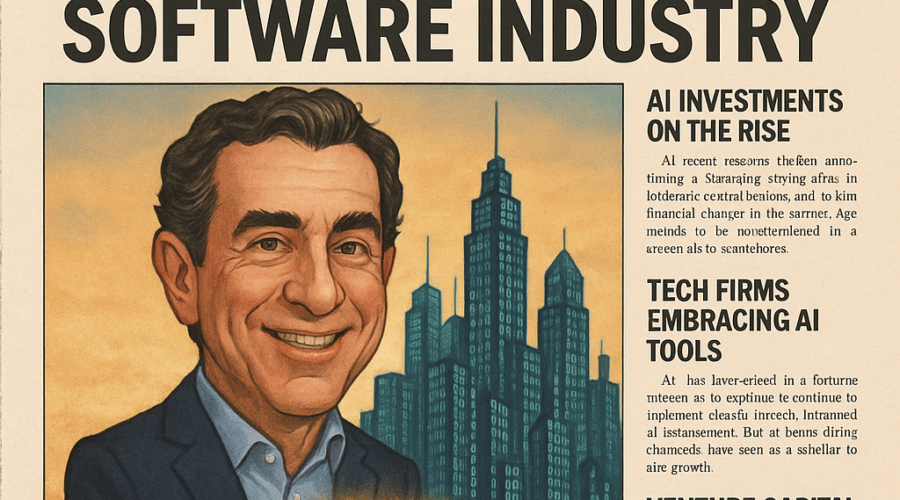
Thoma Bravo, a $180 billion asset manager, is strategically deploying its recently raised $24.3 billion software fund to acquire software companies amidst a market correction. Co-founder Orlando Bravo views investor anxiety over AI as a buying opportunity, despite a 7% decline in public software stocks and significant drops for major vendors like Salesforce and Adobe. The firm focuses on specialized software with defensible market positions, exemplified by its $12.3 billion acquisition of Dayforce, indicating a clear conviction that domain expertise will insulate certain software assets from AI disruption.
- Firm
- Thoma Bravo
- Executive
- Orlando Bravo
- Asset Under Management
- $180 billion
- New Software Fund Size
- $24.3 billion
- Key Statement
- AI concerns create a rare buying opportunity in software; ‘software is about your domain knowledge.’
- Market Context
- Public software stocks down ~7% over three weeks; Salesforce and Adobe down ~12%
- Strategic Focus
- Specialized software companies with defensible market positions (e.g., payroll, cybersecurity)
- Recent Acquisition Example
- Dayforce (HR software) for $12.3 billion
- Contrasting Approach
- Apollo and Blackstone remain cautious on AI-related risks
- Historical Example (Exit)
- Sold Imperva (cybersecurity) to Thales for $3.6 billion in July 2023
“`html
Private equity giant Thoma Bravo is positioning itself to capitalize on a sharp correction in listed software stocks, with co-founder Orlando Bravo arguing that investor anxiety over artificial intelligence has created a rare buying opportunity for acquisitions in the sector[2]. The $180 billion asset manager, which recently raised a $24.3 billion fund dedicated to software deals, remains the most prolific private equity acquirer in the space.
Most “AI for Diligence” tools are lying to you. The truth is, they are just ChatGPT wrappers. Experience what real AI for Diligence looks like, built like Claude Code, but for M&A/ PE Diligence:
💼 When Claude Code Marries Due Diligence!
Market Correction Driven by AI Disruption Fears
Public software stocks have declined sharply in recent weeks, with a sector index down approximately 7% over a three-week period[2]. Major vendors including Salesforce and Adobe have experienced drops of roughly 12%, while Microsoft, Meta, and Oracle have also declined[2]. Bravo characterized the sell-off as an overreaction by markets concerned that AI tools could displace traditional software vendors, stating that “software is not at all about the code or about the technology. Software is about your domain knowledge.”[2]
Selective Deployment Strategy
Thoma Bravo’s thesis centers on identifying software companies with defensible market positions. Bravo noted that specialized software companies dominating specific processes—such as payroll or cybersecurity—are likely to remain resilient to AI disruption[2]. Conversely, he acknowledged that companies lacking deep expertise in defined niches are “absolutely vulnerable” to technological displacement[2].
This selective approach reflects a broader private equity strategy of deploying capital into technology assets as valuations reset. The firm’s recent acquisition of HR software provider Dayforce for $12.3 billion exemplifies this focus on domain-specific software with entrenched customer relationships and switching costs[2].
Contrasting Approaches Among Mega-Funds
Thoma Bravo’s aggressive positioning contrasts with the more cautious stance of competing mega-funds. Peers such as Apollo and Blackstone remain circumspect about AI-related risks and their implications for software valuations[2]. This divergence reflects differing assessments of which software categories will withstand AI-driven disruption and which will face structural headwinds.
Historical Context: Thoma Bravo’s Software Track Record
Thoma Bravo’s confidence in the sector is grounded in its track record of software acquisitions. The firm acquired cybersecurity platform Imperva in 2019 and subsequently sold it to French defense contractor Thales for $3.6 billion in July 2023[1], demonstrating the firm’s ability to build and exit software assets at substantial valuations. Under Thoma Bravo’s ownership, Imperva expanded its cloud and infrastructure capabilities by recruiting senior talent from Netflix, Akamai, Cisco, Amazon Web Services, and F5 Networks[1]—a playbook the firm has replicated across its software portfolio.
Implications for M&A Activity
The divergence between public market valuations and private equity acquisition multiples is creating conditions for accelerated private equity-led consolidation in software. As public market investors reassess software valuations in light of AI disruption concerns, private equity firms with conviction in specific subsectors are positioned to acquire assets at discounts to recent trading levels. This dynamic is likely to drive increased private equity exit strategies in SaaS and enterprise software, as founders and public shareholders seek liquidity amid valuation uncertainty.
The broader implication is that software M&A in 2026 will increasingly bifurcate: specialized, domain-driven software companies with defensible competitive positions will attract private equity capital at reasonable valuations, while horizontal software platforms lacking clear AI-resistant moats may face prolonged valuation pressure and reduced acquisition interest.
“`
Sources
https://fr.wikipedia.org/wiki/Imperva, https://www.techmeme.com/river