
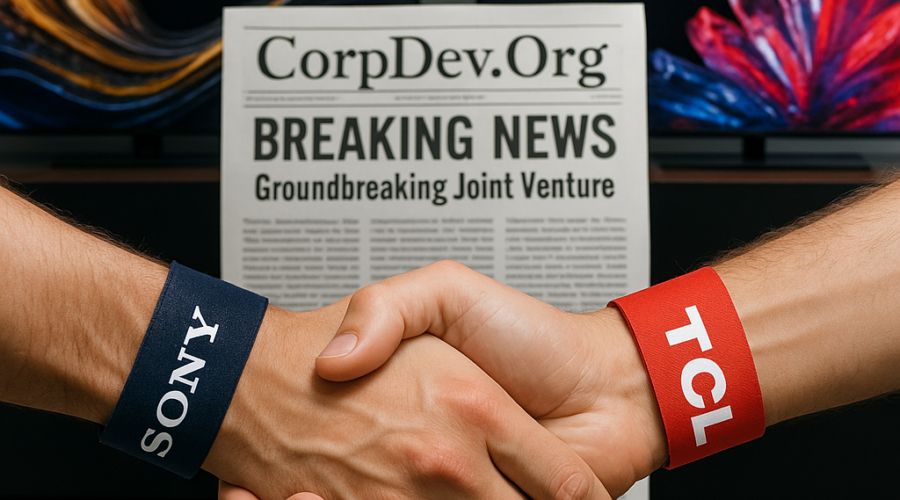
Sony and TCL have entered a non-binding agreement to form a joint venture, spinning off Sony’s TV and home audio hardware business, including the BRAVIA brand. TCL will hold a 51% majority stake and assume manufacturing control starting April 2027, with Sony retaining influence over branding and design. This strategic move allows Sony to exit low-margin manufacturing and focus on high-margin segments, while TCL expands into premium branding, intensifying competition in the global TV market against rivals like Samsung and LG.
- Target Business
- Sony’s TV and home audio hardware business (including BRAVIA TVs)
- Acquirer/Partner
- TCL
- Transaction Type
- Joint Venture (Spin-off)
- TCL Ownership Stake
- 51%
- Sony Ownership Stake
- 49%
- Operations Start Date
- April 2027
- Strategic Driver for Sony
- Shift focus to high-margin segments (content, gaming, semiconductors), offload commoditized TV assembly
- Strategic Driver for TCL
- Expand into premium branding, leverage panel production scale, bolster position against Samsung and LG
- Regulatory Review
- Japan’s antitrust authorities reviewing
- Market Context
- $150 billion global TV market, display industry consolidation, cross-border M&A trends
Sony and China’s TCL have signed a non-binding agreement to spin off Sony’s TV and home audio hardware business into a joint venture, with TCL holding a 51% stake and assuming manufacturing control starting April 2027.[2][3][4] The BRAVIA brand will persist under the partnership, signaling a strategic pivot amid **global display industry consolidation** and **cross-border M&A trends 2025-2027**.
Most “AI for Diligence” tools are lying to you. The truth is, they are just ChatGPT wrappers. Experience what real AI for Diligence looks like, built like Claude Code, but for M&A/ PE Diligence:
💼 When Claude Code Marries Due Diligence!
Deal Structure and Timeline
The venture targets Sony’s television and home entertainment operations, including BRAVIA TVs, with operations launching in April 2027.[2][4][5] TCL gains majority ownership at 51%, while Sony retains influence over branding and design to preserve premium positioning.[2][10] Described as a “moment istoric” for the sector, the move allows Sony to exit low-margin manufacturing while leveraging TCL’s scale in panel production.[1][9]
| Key Deal Terms | Details |
|---|---|
| Ownership | TCL: 51%; Sony: 49% |
| Operations Start | April 2027 |
| Scope | TVs (BRAVIA) and home audio hardware |
| Brand Retention | BRAVIA continues under JV |
Strategic Rationale for Sony and TCL
Sony shifts focus to high-margin segments like content, gaming, and semiconductors, offloading commoditized TV assembly amid eroding profits.[8] TCL, a leading panel maker, expands into premium branding, bolstering its position against Samsung and LG in the $150 billion global TV market.[2][6] The partnership echoes **private equity exit strategies in consumer electronics**, where asset-light models drive value through JVs rather than outright sales.
Industry and Regulatory Context
- Japan’s antitrust authorities are reviewing the JV, with clearance expected given complementary strengths.[5]
- Reflects broader **cross-border M&A in display technology**, including China’s push into high-end manufacturing despite U.S. tariff risks.
- Sony investors view the deal neutrally, prioritizing content deals like Netflix’s $7B film rights pact through 2032.[3][8]
Implications for Stakeholders
For C-level executives in electronics and PE, the JV highlights **synergies in TV supply chain M&A**, with TCL’s cost efficiencies potentially pressuring rivals’ margins. No immediate layoffs announced, but manufacturing shifts to TCL facilities could impact Sony’s workforce.[2] Bain and BCG analyses of similar deals forecast 15-20% cost savings via Asian consolidation, though IP protection remains key in U.S.-China tensions.
Comparable transactions include Hisense’s partnerships with Sharp, underscoring Chinese firms’ ascent in legacy brands.
Sources
https://oficiuldestiri.ro/cum-iti-pot-fi-furati-banii-din-crypto-in-cateva-secunde-cele-mai-periculoase-capcane-si-cum-le-poti-evita, https://www.ozbargain.com.au/node/944987, https://mediagazer.com/river, https://pokde.net/gadget/tv/sony-tcl-tv-partnership, https://www.mlex.com/mlex/mergers-acquisitions, https://www.ndtv.com/topic/technolog, https://www.techmeme.com/river, https://www.marketbeat.com/stocks/NYSE/SONY/news/, https://www.gamereactor.eu/texts/, https://www.findarticles.com/news/business/, https://www.findarticles.com