
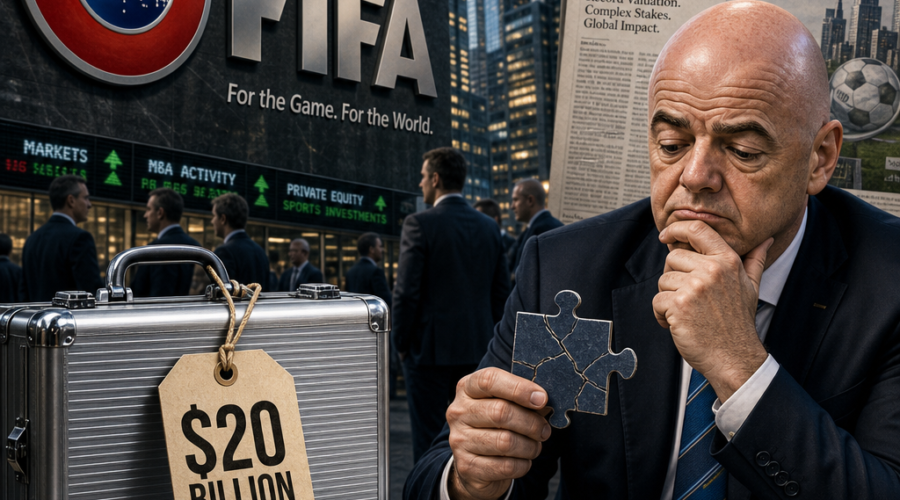
In a watershed moment for the governance of global soccer, UEFA has officially declared it has lost confidence in FIFA President Gianni Infantino following the spectacular collapse of a controversial plan to sell a minority stake in the FIFA World Cup to private equity investors. The move, which has plunged the sport into what observers are calling a “civil war,” marks a definitive breakdown in the relationship between soccer’s most powerful regional body and its global regulator.
Most “AI for Diligence” tools are lying to you. The truth is, they are just ChatGPT wrappers. Experience Kai – a Fortune-100 proven AI harness for M&A/ PE Diligence

💼 Purpose-built harness for Due Diligence
The Failed $20 Billion “FIFA Forward Enterprise”
The crisis was ignited by the unveiling of “FIFA Forward Enterprise” (FFE), a proposed commercial subsidiary intended to manage the commercial and event operations of the FIFA World Cup, the Women’s World Cup, and the expanded Club World Cup. The strategic rationale presented by Zurich was to “unleash the commercial potential” of the game, valuing the new entity at $20 billion and seeking up to $4.2 billion from external investors in exchange for a 20% stake.
According to sources familiar with the matter, Joshua Kushner’s Thrive Capital, through its permanent-capital vehicle Thrive Eternal, was positioned as the anchor investor. JPMorgan served as the lead financial advisor on the deal. The capital infusion was intended to fund a massive expansion of FIFA’s development programs, offering a “sweetener” of $20 million in immediate funding to each of FIFA’s 211 member associations to secure their support.
Strategic Backlash and the “Threat of Boycott”
The proposal met immediate and fierce resistance from UEFA and other major confederations. Critics, including UEFA President Aleksander Čeferin, argued that the plan would effectively “sell the soul of the game” to private interests, prioritizing shareholder returns over sporting integrity and player welfare.
- UEFA’s Ultimatum: All 55 member nations of UEFA unanimously agreed to boycott the World Cup and all FIFA competitions if the plan proceeded.
- Global Opposition: North America’s CONCACAF and the Asian Football Confederation (AFC) joined the dissent, citing a lack of due process and accusing FIFA of “secret schemes” conducted without proper consultation.
- Internal Resignations: Carlos Cordeiro, a senior advisor to Infantino and former Goldman Sachs banker, resigned in protest, stating he could not stand by while FIFA considered selling stakes in its crown jewel.
Deal Framework: The Aborted FFE Transaction
| Metric | Details |
|---|---|
| Entity Name | FIFA Forward Enterprise (FFE) |
| Target Valuation | $20 Billion |
| Equity Stake Offered | 20% – 21% (Minority Interest) |
| Target Capital Raise | $4.2 Billion |
| Lead Investor | Thrive Eternal (Thrive Capital) |
| Financial Advisor | JPMorgan |
Institutional Fallout and Leadership Crisis
While Infantino officially scrapped the private equity plan on August 1, 2026, the damage to his leadership appear structural. UEFA’s blistering statement hours after the withdrawal emphasized that “no option should be off the table” regarding a review of the current FIFA leadership. The European body accused the administration of failing its fiduciary duty and acting as a private enterprise rather than a trust held for the game’s members.
Industry analysts from top-tier firms note that this conflict reflects a broader trend of private equity exit strategies in sports and the increasing commercialization of media rights. While firms like CVC Capital Partners and Silver Lake have successfully entered league-level deals (e.g., La Liga, UFC), the attempt to privatize a global non-profit regulator’s primary asset proved a bridge too far for the established soccer hierarchy.
Historical Context: A Pattern of Friction
This is not the first time Infantino has clashed with UEFA over radical financial shifts. Previous tensions include:
- The proposal for a biennial World Cup (defeated in 2021).
- The unilateral expansion of the 2025 Club World Cup to 32 teams.
- Shifts in the international match calendar to maximize broadcast inventory.
Implications for the 2030 and 2034 World Cups
The collapse of FFE creates an immediate vacuum in FIFA’s commercial strategy. The organization had hoped to use the new vehicle to go to market for the 2030 and 2034 World Cup broadcast rights. Without the private equity-backed structure, FIFA must now navigate a fractured political landscape while attempting to meet the revenue expectations of its smaller member associations, who rely heavily on Zurich’s development grants.
For C-level executives in the sports media and investment sectors, the message is clear: while the capitalization of sports IP remains a dominant theme, the governance structures of “mega-properties” like the World Cup remain resistant to traditional private equity models. The risk of cross-border M&A trends in 2026 being derailed by regional regulatory and political bodies remains the primary hurdle for institutional capital entering the global sports arena.
As of August 3, 2026, Infantino remains in office, but with a mandate that has been severely compromised by the very confederation that provides the bulk of the sport’s commercial value. The “second half” of this political match, as UEFA described it, has only just begun.