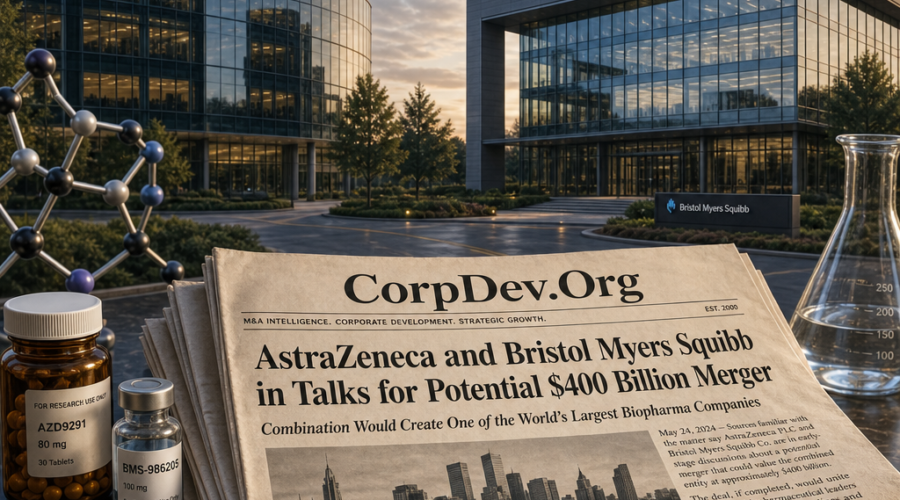
AstraZeneca PLC (LON: AZN) shares fell as much as 7% in London trading on Monday, August 3, 2026, following reports that the British pharmaceutical giant has held preliminary discussions regarding a transformative merger with U.S. rival Bristol Myers Squibb (BMS). The potential tie-up, first reported by the Financial Times, would create a global life sciences titan with a combined market capitalization nearing $400 billion, marking the largest pharmaceutical M&A transaction in history.
Most “AI for Diligence” tools are lying to you. The truth is, they are just ChatGPT wrappers. Experience Kai – a Fortune-100 proven AI harness for M&A/ PE Diligence

💼 Purpose-built harness for Due Diligence
The market response was sharply asymmetric. While AstraZeneca’s valuation retracted—wiping out billions in market cap as investors balked at the integration risks—Bristol Myers Squibb shares climbed approximately 6% in New York pre-market trading. The divergent movement underscores institutional skepticism regarding the strategic necessity for AstraZeneca, which has recently outperformed peers through organic pipeline delivery.
Strategic Rationale: Seeking U.S. Dominance Amid Patent Cliffs
For AstraZeneca CEO Pascal Soriot, the move appears to be a play for absolute scale in the U.S. market. AstraZeneca has aggressively expanded its American footprint, including a direct listing on the New York Stock Exchange in June 2026 and a commitment to invest $50 billion in U.S. manufacturing by 2030. Acquiring BMS would instantly grant AstraZeneca a dominant position in American oncology and cardiovascular markets.
- Oncology Powerhouse: A combined entity would control an unrivaled portfolio of cancer immunotherapies, uniting AstraZeneca’s Imfinzi with BMS’s blockbuster Opdivo.
- Revenue Acceleration: The merger would assist AstraZeneca in reaching its ambitious 2030 revenue target of $80 billion, a goal Soriot recently insisted could be met without major M&A.
- Complementary Pipelines: Beyond oncology, the deal would merge AstraZeneca’s rare disease expertise (bolstered by the 2021 Alexion acquisition) with BMS’s strong cardiovascular and hematology franchise.
Financial Comparison: The Proposed Giants
| Metric (Est. Aug 2026) | AstraZeneca | Bristol Myers Squibb | Combined Entity |
|---|---|---|---|
| Market Capitalization | ~$264 Billion | ~$133 Billion | ~$397 Billion |
| Annual Revenue (2025) | ~$59 Billion | ~$48 Billion | ~$107 Billion |
| Primary Focus | Oncology, Rare Disease, CV | Oncology, Hematology, CV | Global Biopharma Leader |
Institutional Skepticism and Regulatory Red Flags
Despite the potential for massive cost synergies, the “mega-merger” narrative is facing significant headwinds from Wall Street and the City of London. Analysts at Jefferies described the talks as “perplexing,” noting that AstraZeneca’s current growth profile is among the strongest in the sector, making a high-risk integration with a “patent-challenged” BMS seem unnecessary.
The deal faces three primary obstacles:
1. Antitrust Hurdles
The overlap in oncology is substantial. Under the current U.S. administration, the Federal Trade Commission (FTC) has shown a renewed appetite for challenging “killer acquisitions” and consolidations that reduce competition in life-saving drug categories. Regulators would likely demand significant divestitures of blockbuster immunotherapies before approving the deal.
2. The “Patent Cliff” Risk
While AstraZeneca boasts a “best-in-class” pipeline, Bristol Myers Squibb is approaching a significant loss-of-exclusivity (LOE) period for its top earners, Eliquis and Opdivo, toward the end of the decade. Critics argue that AstraZeneca would be buying a revenue stream that is destined to decline, potentially diluting its long-term growth rate.
3. Cultural and Integration Headwinds
Historically, mega-mergers in pharma (such as Pfizer-Warner Lambert or Bristol Myers-Celgene) have been criticized for disrupting R&D productivity. “A merger of this scale would deeply disrupt a well-run company,” noted one major AstraZeneca shareholder, echoing fears that the integration would distract from the 20 high-value clinical readouts due over the next 18 months.
Market Context: The 2026 M&A Supercycle
The reported talks arrive amidst a broader 2026 M&A trend in life sciences characterized by “platform acquisitions.” As interest rates stabilize and large-cap firms seek to refill pipelines ahead of the $300 billion in industry-wide revenue exposed to patent expirations this decade, the appetite for transformative deals has returned. However, the move represents a “role reversal” for AstraZeneca, which famously spent years fighting off a hostile takeover bid from Pfizer in 2014. Now, as the predator rather than the prey, the firm must convince its own shareholders that bigger truly is better.
Executive Summary for Deal Advisors: The AstraZeneca-BMS talks signal a potential shift toward cross-border pharmaceutical consolidation at the highest level. While the deal offers clear pathways for U.S. market dominance, the share price reaction indicates a preference for targeted biotech acquisitions over massive consolidation. Investors should monitor for a formal “Expression of Interest” or a pivot toward smaller bolt-on deals if the backlash intensifies.