
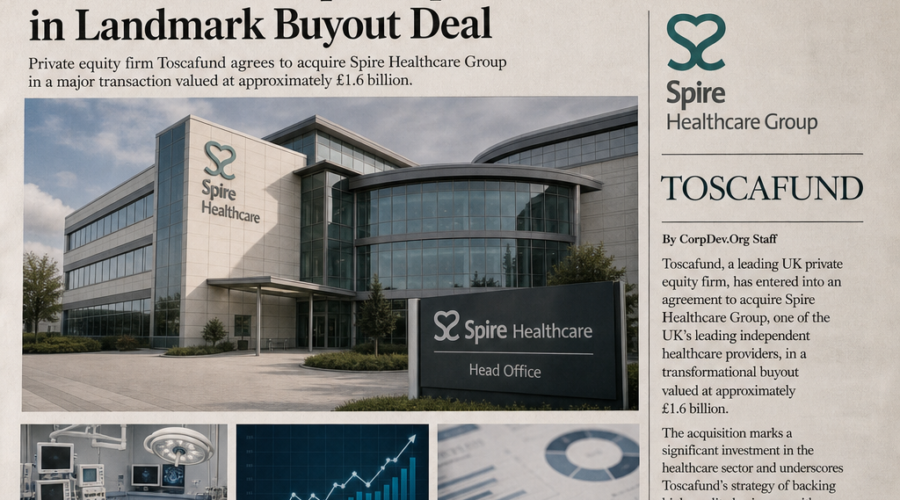
Spire Healthcare Group agreed on September 5, 2026, to a £1.03 billion cash takeover by Tulip UK Bidco, an investment consortium led by hedge fund manager Toscafund Asset Management alongside THCP Advisory and Ares Management. The agreed offer of 250 pence per share delivers an enterprise valuation of £2.31 billion including debt and delivers a 66 percent premium over Spire Healthcare’s undisturbed share price of 150.4 pence on May 13. The transaction takes Britain’s largest independent acute hospital provider off the London Stock Exchange following a formal twelve-month strategic review, ending public ownership for a network running 38 hospitals and more than 55 clinics across England, Wales, and Scotland.
The acquisition illustrates how persistent operational cost inflation and public market equity discounts in London are accelerating sponsor-led de-listings of capital-intensive real asset operators. While record National Health Service waiting lists continue to channel self-pay and private medical insurance admissions into independent hospital facilities, equity markets heavily discounted operators burdened by statutory wage revisions and rising employer payroll taxes. By transferring freehold property assets and clinical operations into private hands, the consortium seeks to execute restructuring measures away from quarterly reporting constraints, reflecting current private equity exit strategies and public-to-private buyout tactics in the healthcare services sector.

Consortium members secured binding irrevocable undertakings and letters of intent representing 53.4 percent of Spire Healthcare’s existing issued share capital prior to announcement, ensuring immediate control over the vote. Concurrently, Spire Healthcare disclosed the departures of chief executive Justin Ash and chairman Sir Ian Cheshire, appointing former Co-op chair Debbie White as interim chair and former NHS regional director Sir David Sloman as interim chief executive. The consortium will now initiate an operational review targeting Spire Healthcare’s primary care and occupational health divisions, raising questions over whether private equity ownership will divest non-core clinical units to extract value from the underlying real estate.
Financial mechanics and transaction architecture
Tulip UK Bidco structured the deal through a court-sanctioned scheme of arrangement under Part 26 of the Companies Act 2006. The cash consideration of 250 pence per share matches the bid rejected by Spire Healthcare shareholders in 2021 when Mediclinic International sought full control. Toscafund, which has held an equity stake in Spire Healthcare since 2021, joined forces with London-based private credit and equity specialist Three Hills Capital Partners (THCP Advisory) and Los Angeles-headquartered Ares Management to finance the purchase.
Spire Healthcare turned to financial advisers Rothschild & Co, Perella Weinberg Partners, J.P. Morgan Cazenove, Lazard, and Berenberg to run the sale process. Legal counsel to Spire Healthcare was provided by Freshfields Bruckhaus Deringer, led by corporate partners Claire Wills, Tamara Young, and Meredith Bayley. The consortium received financial advice from Darblay Capital. Dickson Minto advised Tulip UK Bidco and Toscafund, while Proskauer Rose represented THCP Advisory and Ares Management across consortium equity arrangements and debt financing.
| Metric | Spire Healthcare Takeover Details |
|---|---|
| Cash Offer Price | 250 pence per ordinary share |
| Implied Fully Diluted Equity Value | £1.03 billion ($1.39 billion) |
| Implied Enterprise Value | £2.31 billion |
| Premium to Undisturbed Price (May 13, 2026) | 66.2 percent |
| Consortium Backing Acquired at Announcement | 53.4 percent of share capital |
| Hospital and Clinic Network | 38 acute hospitals, 55+ secondary clinics |
Operational inflation and the London valuation divide
Spire Healthcare initiated its strategic review in September 2025 after buyout houses Bridgepoint and Triton held preliminary approach talks but subsequently abandoned negotiations in March 2026. Management screened more than 60 potential buyers before determining that the consortium’s offer was the sole cash proposal capable of execution.
Chair-designate Debbie White noted that Spire Healthcare faced compounding headwinds from employer National Insurance rate changes, National Living Wage statutory increases, and clinical supply chain inflation. Even though Spire Healthcare treated 1.36 million patients across its network in 2025, operating margins narrowed under wage expenses, preventing the public stock price from rerating. Public market participants maintained steep valuation discounts on London-listed small-cap and mid-cap listings relative to international peers, creating an opening for alternative asset managers to acquire asset-rich operating companies at depressed multiples.
Property assets and portfolio separation strategies
A core investment thesis for Martin Hughes, founder of Toscafund, rests on Spire Healthcare’s commercial real estate portfolio. Spire Healthcare retains substantial freehold title across its hospital locations, including flagship assets such as Claremont Hospital in Sheffield and St Anthony’s Hospital in south London. Public markets previously valued the consolidated healthcare business at a discount to the replacement cost of its underlying brick-and-mortar property.
Tulip UK Bidco confirmed plans for a comprehensive twelve-month review following completion. That review will examine Spire Healthcare’s primary care division, occupational health contracts serving 1,400 corporate employers, and its walk-in private GP network. The consortium signaled that non-hospital units may undergo divestment, which would focus company resources strictly on acute surgical procedures while potentially freeing up capital via hospital property sale-and-leaseback transactions.
Private equity scrutiny in UK healthcare delivery
The transaction returns Spire Healthcare to private ownership twelve years after private equity sponsor Cinven completed an initial public offering of the business in 2014. Public oversight of private equity capital in British healthcare delivery has heightened following reports that independent sector contractors generated £1.6 billion in profits across recent operating cycles from NHS outsourcing contracts.
With Sir David Sloman assuming executive leadership, Spire Healthcare places a prominent public-sector administrator at the helm to manage NHS commissioner relations. The transition allows the group to renegotiate NHS elective capacity contracts while the consortium reorganizes corporate operations, balances property liabilities against healthcare revenues, and restructures staff allocations across secondary care clinics.