
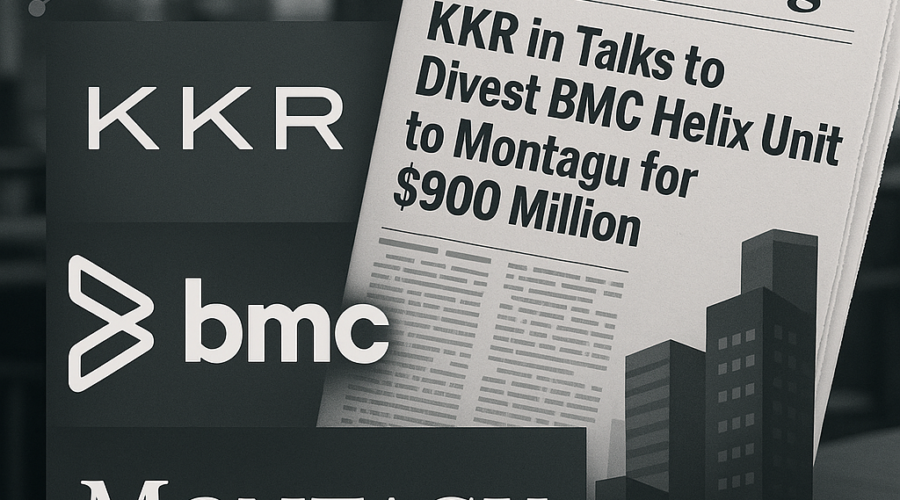
KKR & Co. is in advanced discussions to sell its BMC Helix software unit to Montagu Private Equity for approximately $900 million. For KKR, the divestiture represents a strategic portfolio rationalization to streamline its larger BMC Software asset and realize liquidity. For Montagu, the acquisition provides immediate scale in the IT Service Management (ITSM) market, aligning with its 'buy-and-build' strategy. This sponsor-to-sponsor transaction signals a key private equity exit trend: the unbundling of large software platforms into specialized, operationally-focused assets for mid-market funds.
- Target
- BMC Helix (a unit of BMC Software)
- Seller
- KKR & Co.
- Acquirer
- Montagu Private Equity
- Transaction Type
- Divestiture / Carve-out
- Reported Value
- Approximately $900 million
- Seller's Rationale
- Portfolio rationalization and reducing complexity in the parent BMC structure.
- Acquirer's Strategy
- Consolidation in the IT Service Management (ITSM) sector via a 'buy-and-build' approach.
- Exit Channel
- Sponsor-to-sponsor transaction
- Broader Trend
- The 'unbundling' of massive software conglomerates created in the early 2020s.
In a move that signals ongoing portfolio rationalization among mega-cap private equity firms, KKR & Co. is reportedly in advanced discussions to sell its BMC Helix operations to mid-market firm Montagu Private Equity. The transaction, valued at approximately $900 million, highlights a shift toward streamlining enterprise software assets to favor specialized, high-growth verticals.
Most “AI for Diligence” tools are lying to you. The truth is, they are just ChatGPT wrappers. Experience what real AI for Diligence looks like, built like Claude Code, but for M&A/ PE Diligence:
💼 When Claude Code Marries Due Diligence!
Strategic Rationale: The Pivot Toward Core Focus
For KKR, the divestiture of BMC Helix—a key component of the broader BMC Software ecosystem—represents a classic example of private equity portfolio rationalization. Since acquiring BMC Software in a multi-billion dollar take-private deal years prior, KKR has focused on digital transformation and operational efficiency. Offloading specific SaaS units allows the firm to sharpen its focus on its primary platforms while realizing liquidity for its limited partners.
Historically, when large-cap sponsors carve out assets from major technology platforms, the goal is often to decouple mature software units from the parent entity’s cost structure. This enables these units to operate with greater agility, often positioning them for a secondary buyout or a strategic trade sale.
Deal Economics and Market Context
| Metric | Projected Impact/Rationale |
|---|---|
| Valuation | $900 million price tag implies a steady-state valuation reflective of stable, recurring revenue models. |
| Seller Motivation | Portfolio optimization; reducing complexity in the parent BMC structure. |
| Buyer Strategy | Montagu typically pursues “buy-and-build” strategies, likely integrating Helix into a broader tech portfolio. |
Montagu’s Play: Consolidation in IT Service Management
For Montagu, the acquisition of a well-established brand like BMC Helix offers immediate scale in the competitive IT Service Management (ITSM) and automation landscape. In the 2026 enterprise software M&A market, scale is increasingly critical to defend against hyperscalers and agile cloud-native startups.
Montagu is expected to leverage its deep operational bench to optimize the unit’s margin profile. By transitioning Helix into a focused, independent entity, the firm can drive operational improvements without the overhead of the KKR-owned parent corporation. This tactical approach is a common trend among European-headquartered firms looking to capture value in the US mid-market software space.
Broader Implications for Private Equity Exit Strategies
The deal reflects broader shifts in private equity exit strategies in 2026. With IPO markets remaining selective and strategic trade buyers facing heightened regulatory scrutiny, the “sponsor-to-sponsor” pipeline has become a vital exit channel.
- Focus on Recurring Revenue: Despite valuation compressions in some growth sectors, assets with high retention and mission-critical SaaS contracts continue to command premium multiples.
- Operational De-risking: As interest rates remain stabilized but elevated, PE firms are prioritizing assets that can demonstrate immediate cash flow improvement over speculative growth.
- The Rise of Specialized Carve-outs: Large PE firms are increasingly willing to sell “non-core” sub-units to mid-market funds, creating a robust ecosystem for asset recycling.
Looking Ahead
If the deal reaches closure, it underscores a wider trend: the “unbundling” of massive software conglomerates created during the low-interest-rate era of the early 2020s. For deal advisors, the KKR-Montagu transaction is a bellwether for similar cross-border M&A trends, where global asset managers increasingly view mid-sized, specialized software firms as the ideal targets for specialized, hands-on investment firms.
The industry will be watching to see how Montagu positions the Helix unit post-acquisition, particularly regarding its integration with existing automation tools and its ability to maintain its enterprise client base during the ownership transition.