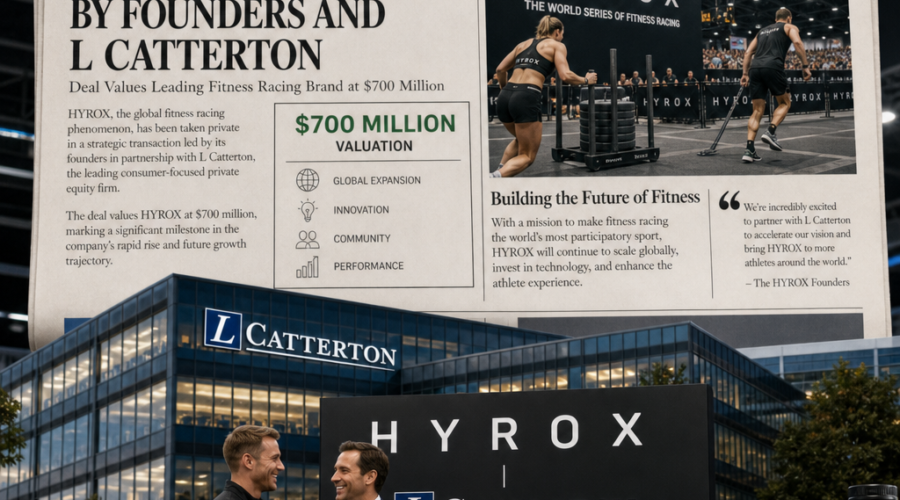
Private equity firm L Catterton teamed with Hyrox co-founders Christian Toetzke and Moritz Fürste to acquire control of the fitness racing enterprise from Infront Sports & Media in a transaction valuing the business at €600 million, or roughly $700 million (R11.6 billion). Infront, the Swiss sports marketing entity controlled by Dalian Wanda Group, divested its roughly 60% controlling interest after a four-year run as majority owner. Jeffrey Katzenberg’s venture investment firm WndrCo joined the transaction as an equity partner. The deal, completed on September 8, 2026, returns a 51% operating majority to Toetzke and Fürste while providing institutional growth equity to expand the company’s footprint across North America and Asia.
The deal establishes a valuation yardstick for experiential mass-participation assets, demonstrating how hybrid fitness formats evade the capital overhead and membership churn that challenge standard health club operators. Traditional gym chains absorb substantial lease liabilities and equipment depreciation, but Hyrox operates an asset-light competition model centered on convention halls, affiliate licensing fees, and merchandise sales. By generating repeat athlete entries and licensing training regimens to more than 13,000 affiliated gyms worldwide, Hyrox monetizes the existing infrastructure of brick-and-mortar health clubs rather than competing against them. Consumer sponsors, active lifestyle investors, and institutional dealmakers now view functional competition circuits not as temporary fads, but as scalable media properties.
Financial disclosures reported during the sales process show Hyrox generated approximately €135 million in gross revenue and roughly €30 million in earnings before interest, taxes, depreciation, and amortization during 2025, representing an EBITDA margin near 22%. The buyout values the company at approximately 20 times trailing EBITDA, an earnings multiple driven by an absence of direct paid customer acquisition costs. Over 1.4 million athletes and 1.5 million spectators participated across more than 100 events in the 2025–2026 season, up from 3,000 athletes when Infront first invested in 2019. The incoming owners now face the operational task of defending those entry fees and expanding into Asia without diluting brand equity or hitting capacity caps at municipal convention centers.
Financial mechanics and capital structure of the buyout
Infront realized approximately €360 million ($420 million) in cash proceeds by exiting its 60% controlling interest. The Swiss agency acquired its original stake in 2019 and assumed majority control in late 2022 before initiating a strategic review with financial advisors in early 2026. The ultimate equity structure leaves Toetzke and Fürste with 51% of the equity, funded through rolled equity and senior debt arrangements. L Catterton and WndrCo hold the remaining 49% through a joint investment consortium, establishing a minority governance position that supplies institutional balance-sheet support while preserving founder leadership.
Capital efficiency in functional fitness
Private equity sponsors spent the past decade evaluating boutique fitness concepts, yet many franchisors collapsed under store-level rent obligations and consumer attrition. Hyrox bypassed physical site exposure through a standardized mass-participation event series. Every race weekend follows an unyielding blueprint: eight one-kilometer running intervals, each interspersed with an identical functional station such as sled pushes, rowing, burpee broad jumps, and wall balls. Because participants receive a comparable finish time logged in a single global database, the event functions like an indoor marathon for gym members.
| Financial Metric | Hyrox (2025 Actual) | Hyrox (2026 Forecast) | CrossFit (2020 Buyout Context) |
|---|---|---|---|
| Enterprise Valuation | €600M (~$700M / R11.6B) | Undisclosed | ~$200M |
| Annual Gross Revenue | €135M (~$157M) | €270M–€300M | ~$50M–$60M |
| EBITDA | ~€30M | Undisclosed | ~$15M–$20M |
| Implied Trailing Multiple | 20.0x EBITDA | N/A | 10.0x–13.0x EBITDA |
| Total Competitors | 1.4 Million | 2.0 Million+ | ~300,000 (Open Entrants) |
The operational leverage stems from gym affiliations. Rather than constructing dedicated studios, Hyrox licenses its name and training programming to 13,000 independent fitness facilities and large operators like Fitness First and Equinox. Gym owners pay recurring annual licensing fees to hold official preparation classes, which converts gym members into ticket buyers for regional tour events. This ecosystem allows Hyrox to scale without paying standard consumer acquisition costs, as gym trainers and peer racers recruit new participants through routine gym visits and social networks.
L Catterton investment logic and portfolio integration
L Catterton, which manages more than $35 billion in consumer-focused assets and retains strategic backing from French luxury conglomerate LVMH, structured the deal to expand Hyrox into new consumer categories. The private equity firm holds investments across the health spectrum, including luxury gym chain Equinox, home equipment maker Peloton, Pilates operator Solidcore, and connected fitness platform EGYM. By aligning Hyrox with high-traffic health brands, L Catterton can direct cross-promotions across its broader gym footprint.
Corporate partnerships also form a major part of the cash-generation strategy. Hyrox holds multiyear global commercial deals with athletic footwear brand Puma, energy drink maker Red Bull, and Amazon. It signed a three-year wearable technology contract with Amazfit in April 2026. By leveraging WndrCo’s media connections, the partnership intends to expand direct event broadcasts, corporate hospitality packaging, and regional merchandise sales to convert one-day ticket holders into year-round content consumers.
Geographic expansion and venue capacity constraints
The next earnings growth cycle depends on market penetration in the Asia-Pacific region. Participation at race weekends in mainland China escalated rapidly between 2024 and 2026, expanding from 1,700 competitors at a Beijing race to more than 10,000 racers during an August 2026 weekend in Shenzhen. The organization will stage the 2027 Hyrox World Championships in Hong Kong, marking the first time the title race will take place outside Europe or North America.
This expansion presents venue challenges. Hyrox requires massive exhibition halls spanning 15,000 to 30,000 square meters to stage its running tracks and weighted functional zones. High-tier metropolitan convention centers in London, Frankfurt, Chicago, and Singapore maintain packed booking calendars and rising rent schedules. Hyrox operational teams must optimize start-wave logistics to funnel thousands of racers safely through stations while preserving safety protocols and athlete satisfaction.
Strategic risks and competitor responses
Rapid growth in the functional fitness sector has drawn direct market competition. Regional rivals such as Athx in Europe and BetterWe in China run hybrid race series designed to attract Hyrox finishers seeking shorter wait times and cheaper entry tickets. Ticket prices for standard Hyrox events exceed €100 ($115) per division, leaving room for budget competitors to target cost-conscious athletes.
Brand endurance represents another risk for the ownership group. Rival fitness organization CrossFit suffered leadership controversies and organizational fractures that eroded its enterprise value ahead of its 2020 buyout by Berkshire Partners. To protect against community burnout, Toetzke stated that management will pursue recognition with international sports federations to build long-term Olympic eligibility. For L Catterton and WndrCo, maintaining founder alignment at a 51% ownership level ensures the original creators preserve race integrity while institutional capital accelerates international execution.