
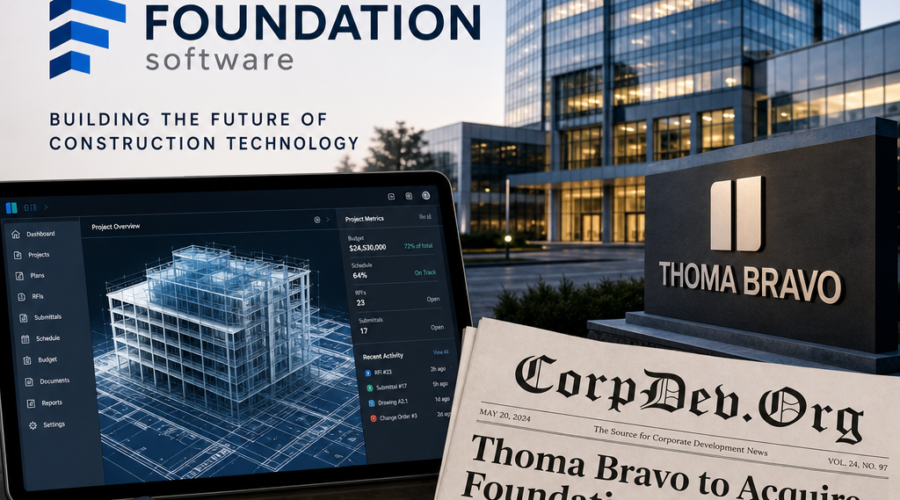
Thoma Bravo, the software-focused private equity powerhouse, is exploring a sale of Foundation Software in a transaction that could value the Ohio-based company at more than $2 billion. According to reports first detailed by Reuters on September 2, 2026, the firm is working with investment bank William Blair to solicit interest from both strategic buyers and financial sponsors.
Most “AI for Diligence” tools are lying to you. The truth is, they are just ChatGPT wrappers. Experience Kai – a Fortune-100 proven AI harness for M&A/ PE Diligence

💼 Purpose-built harness for Due Diligence
The potential exit follows a six-year holding period for Thoma Bravo, which first made a strategic growth investment in Foundation Software in 2020. Since then, the firm has transformed the company from a family-run accounting provider into a comprehensive construction technology platform. Today, Foundation Software is a leader in construction accounting software for contractors, reporting more than $200 million in annual revenue and over $100 million in EBITDA—a high-margin profile that highlights the recurring revenue and stickiness typical of mission-critical vertical SaaS.
The Strategic Rationale: From Accounting to All-in-One Platform
When Thoma Bravo acquired Foundation Software, the business primarily served small and mid-sized specialty contractors with accounting and payroll solutions. Under private equity ownership, the company aggressively expanded its product footprint through both organic R&D and targeted M&A. Notable acquisitions during Thoma Bravo’s tenure include:
- Harness (2022): Integrated safety management and compliance tools into the platform.
- AboutTime Technologies (2023): Bolstered mobile field data collection and labor tracking capabilities.
- Vendrix (2025): Added construction-specific spend management and card solutions to the suite.
This “buy-and-build” strategy has enabled Foundation to offer a full lifecycle solution—from job cost accounting and estimating to project management and field operations—making it a prime target for private equity exit strategies in SaaS and strategic consolidators looking to dominate the “built world” ecosystem.
Financial Framing and Valuation Metrics
The rumored $2 billion price tag implies a valuation multiple exceeding 20x EBITDA. While aggressive by traditional standards, such premiums reflect the current “SaaS-pocalypse” recovery where investors are prioritizing Rule of 40 performance and defensive vertical applications. Foundation’s reported 50% EBITDA margin places it in the top tier of profitable software assets.
Key Financial Profile: Foundation Software (Estimated 2026)
| Metric | Estimated Figure | Context |
|---|---|---|
| Annual Revenue | $200M+ | Significant growth from ~$50M at entry in 2020. |
| Annual EBITDA | $100M+ | Implies a best-in-class 50% margin profile. |
| Reported Valuation | $2B+ | Reflects ~20x EBITDA / 10x Revenue multiple. |
| Customer Base | 12,000+ | Concentrated in mid-market specialty contractors. |
Broadening Market Trends: The Construction Tech Gold Rush
The timing of the sale coincides with a broader resurgence in cross-border M&A trends 2025-2026. Strategic buyers like Procore, Autodesk, and Sage have been active in acquiring specialized tools to prevent platform churn. Procore’s 2026 acquisition of Datagrid and Autodesk’s purchase of Rhumbix signal a high appetite for data-rich assets that provide “single source of truth” visibility on the job site.
Furthermore, the private equity construction investment wave remains resilient despite higher interest rates. Firms like KKR and Blackstone have recently doubled down on “built world” infrastructure, recognizing that as labor shortages persist, contractors are forced to adopt automation. For Thoma Bravo, a successful sale of Foundation would represent a hallmark “middle-market to platform” success story, validating its playbook of professionalizing family-owned software firms.
Potential Suitors
Industry analysts anticipate a competitive bidding process. Potential strategic acquirers include:
- Sage Group: Seeking to defend its dominant position in construction accounting against modern cloud-native challengers.
- Procore: Looking to deepen its financial and payroll capabilities to offer a more holistic ERP alternative.
- Roper Technologies: Known for acquiring high-margin, niche software leaders with limited cyclicality.
Regulatory and Execution Risks
While the demand for profitable vertical software is high, any deal exceeding $2 billion will face scrutiny. Regulatory bodies have become more sensitive to consolidation in niche software markets where a single vendor might control critical infrastructure for small businesses. However, given the fragmented nature of the construction tech landscape—where many contractors still use generic tools like QuickBooks or even paper-based systems—the path to clearance remains relatively clear compared to mega-mergers in big tech.
As Thoma Bravo and William Blair move toward a formal auction, the result will serve as a bellwether for software valuations in the latter half of 2026. A $2 billion-plus exit would confirm that for mission-critical, high-margin assets, the “SaaS premium” is alive and well.