
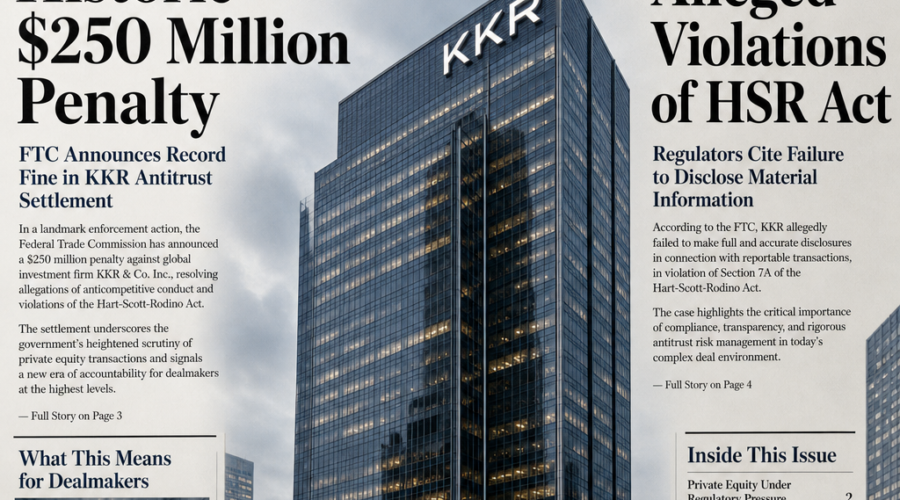
On August 26, 2026, the U.S. Department of Justice (DOJ) announced a landmark settlement with KKR & Co. Inc., under which the private equity titan will pay a record $250 million civil penalty to resolve allegations of systemic violations of the Hart-Scott-Rodino (HSR) Antitrust Improvements Act. The DOJ’s complaint, filed in the Southern District of New York, alleged that KKR repeatedly flouted premerger notification requirements across at least 16 separate transactions during 2021 and 2022. This settlement, which is more than 20 times larger than any previous HSR-related penalty, marks a decisive escalation in federal oversight of the private equity sector’s rapid-fire dealmaking and “roll-up” strategies.
Beyond the sheer size of the fine, the KKR settlement serves as a critical bellwether for the “rinse-and-repeat” acquisition models that have become the hallmark of modern alternative asset management. The DOJ’s aggressive posture indicates that regulators are no longer viewing filing deficiencies as mere administrative oversights; instead, they are being framed as intentional efforts to evade antitrust scrutiny. By targeting the integrity of the premerger review process itself, the government is signaling that even if a specific deal does not trigger immediate competitive concerns, the failure to provide a transparent “Item 4” paper trail—internal documents analyzing competition and market share—will carry a prohibitive cost that outweighs the speed of execution.

In a remarkable twist that underscores the complexity of modern deal advisory, KKR disclosed that the $250 million penalty will have zero financial impact on the firm, its funds, or its limited partners. The entire sum is slated to be reimbursed by the firm’s outside legal counsel, an admission that suggests systemic failures within the internal and external compliance workflows that managed over 100 HSR filings for KKR since 2021. This “pass-through” penalty raises significant questions for the legal industry regarding professional liability insurance and the future of “best practices” in the high-stakes preparation of antitrust disclosures for serial acquirers.
The Allegations: A Culture of “Less is More”
The DOJ’s complaint painted a picture of a sophisticated investment firm that intentionally systematically undermined the premerger review process. The government identified three primary categories of misconduct that led to the record-breaking fine:
- Document Alteration: In at least eight transactions, KKR allegedly altered or removed critical content and pages from “Item 4” documents—internal analyses typically prepared for the board or investment committee—before submitting them to regulators.
- Systemic Omissions: For at least ten transactions, the firm was accused of withholding responsive business documents that discussed competitive effects, market shares, and potential synergies.
- Failure to File: In at least two instances, KKR allegedly completed reportable acquisitions without making any HSR filing whatsoever, effectively bypassing the mandatory 30-day waiting period.
Associate Attorney General Stanley E. Woodward Jr. stated that the historic penalty was intended to send a “powerful message” to the industry. The DOJ argued that KKR’s internal communications showed a deliberate “less is more” approach, with emails allegedly directing that documents be revised or withheld specifically “for HSR purposes” to avoid attracting regulatory eyes.
Strategic Implications for Private Equity Exit Strategies
For C-level executives and deal advisors, the KKR settlement necessitates a fundamental shift in how private equity exit strategies and acquisition pipelines are managed. The era of treating HSR filings as a checkbox exercise is over. The DOJ’s focus on “serial acquisitions” and “roll-up strategies” means that mid-market consolidations, which previously might have flown under the radar, are now subject to retroactive scrutiny if the initial filings were deficient.
Comparison of Recent HSR Penalties
| Entity | Date | Penalty Amount | Nature of Violation |
|---|---|---|---|
| KKR & Co. Inc. | Aug 2026 | $250 Million | Serial omissions and document alterations (16 deals) |
| Edwards Lifesciences | July 2026 | $12 Million | Structuring deal to avoid HSR filing thresholds |
| Genesis MedTech | July 2026 | $2 Million | Failure to file as an acquired party |
| Historical Average | Pre-2025 | < $5 Million | Isolated administrative errors or missed filings |
Regulatory Risks and Interlocking Directorates
The KKR settlement also arrives amid broader scrutiny of Section 8 of the Clayton Act, which prohibits interlocking directorates. Regulators are increasingly concerned that private equity firms, by placing the same partners on the boards of competing portfolio companies, can facilitate anticompetitive coordination without ever merging the entities. The DOJ’s successful pursuit of a $250 million penalty for paperwork violations suggests they are emboldened to use every tool in the antitrust toolkit to disrupt the private equity “playbook.”
Furthermore, the 2026 updates to HSR jurisdictional thresholds—now requiring reporting for transactions valued at $133.9 million or more—combined with more rigorous “Item 4” requirements, mean that the margin for error has narrowed. Firms must now account for cross-border M&A trends and differing notification regimes in the EU and UK, where “killer acquisitions” in the tech and life sciences sectors are being met with similar skepticism.
The “Counsel-Pay” Precedent
The most non-obvious fallout from this case is the potential restructuring of engagement letters between sponsors and their antitrust counsel. With KKR’s outside law firms—reputed to be among the elite “Magic Circle” and White Shoe firms—reimbursing the quarter-billion-dollar penalty, the industry is entering uncharted territory regarding professional indemnity and M&A compliance workflows.
Investment professionals must now evaluate whether their internal document retention and “clean room” protocols are robust enough to withstand a DOJ audit. As KKR’s spokesperson noted, the firm chose to settle to avoid the “distraction of continued litigation,” but the reputational and regulatory “black mark” of being a serial violator may result in longer waiting periods and more frequent “Second Requests” for KKR’s future deals, regardless of their competitive merit.
Conclusion: A New Standard for Diligence
The $250 million penalty is a watershed moment that redefines regulatory risk in private equity. For institutional investors, the “nonevent” financial impact (thanks to law firm reimbursement) should not obscure the underlying shift in the enforcement climate. The message from Washington is clear: the process is the product. Any firm attempting to “engineer” its way around HSR transparency faces not just a fine, but a systemic challenge to its ability to deploy its dry powder effectively in an increasingly hostile antitrust environment.