
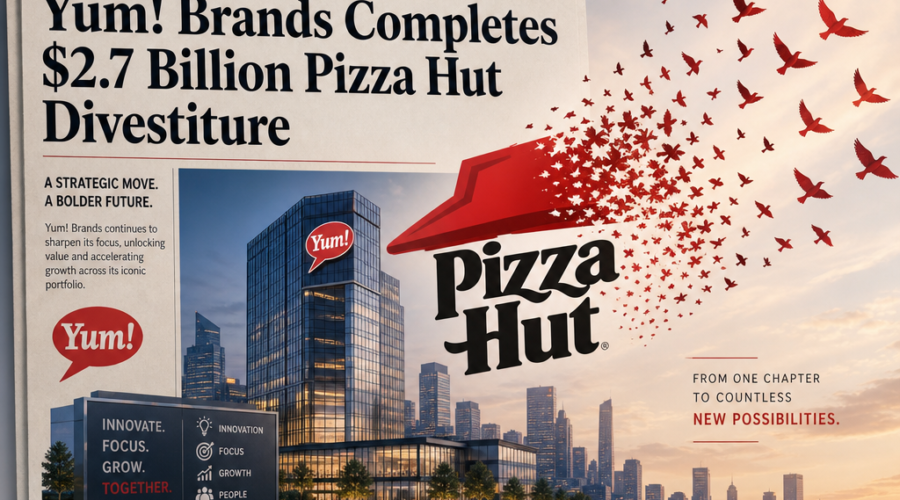
LOUISVILLE, Ky. — Yum! Brands, Inc. (NYSE: YUM) has officially concluded its exit from the Pizza Hut business, completing a two-stage divestiture valued at approximately $2.7 billion. The final leg of the transaction, a $1.5 billion sale of Pizza Hut’s operations outside of Mainland China to private equity firm LongRange Capital, closed on September 1, 2026. This follows the $1.2 billion sale of the brand’s Mainland China business to Yum China Holdings, Inc. (NYSE: YUMC), which was finalized on August 7, 2026.
Most “AI for Diligence” tools are lying to you. The truth is, they are just ChatGPT wrappers. Experience Kai – a Fortune-100 proven AI harness for M&A/ PE Diligence
💼 Purpose-built harness for Due Diligence
The deal marks a pivotal moment for Yum! Brands as it streamlines its portfolio to focus on its most resilient and high-growth assets: KFC, Taco Bell, and Habit Burger & Grill. For Pizza Hut, a legacy brand founded in 1958, the move provides a transition into private ownership—a structure increasingly favored by “legacy brands going private” to execute long-term turnarounds away from the volatility of public markets.
Deal Architecture and Financial Terms
The divestiture was structured to maximize value through geographic segmentation, reflecting the divergent performance of the brand in domestic versus emerging markets. Key financial components of the deal include:
- Aggregate Value: $2.7 billion in cash proceeds, subject to customary closing adjustments.
- Earn-out Provision: Yum! maintains an opportunity to receive an additional $75 million by 2030, contingent on Pizza Hut’s performance under LongRange Capital’s management.
- Net Proceeds: Yum! expects approximately $2.3 billion in net proceeds after taxes and transaction-contingent fees.
- Advisory: Goldman Sachs and Barclays served as lead financial advisors to Yum! Brands, with legal counsel from Weil, Gotshal & Manges LLP and Baker McKenzie.
Pizza Hut Divestiture Summary (2026)
| Segment | Acquirer | Valuation | Closing Date |
|---|---|---|---|
| Pizza Hut Ex-China | LongRange Capital | ~$1.5 Billion | Sept 1, 2026 |
| Pizza Hut Mainland China | Yum China Holdings | ~$1.2 Billion | Aug 7, 2026 |
| Total | — | $2.7 Billion | — |
The Rationale: Why Yum! Sliced the Hut
Despite Pizza Hut’s status as a global icon with nearly $10 billion in system-wide sales, the brand has perennially struggled to maintain market share against agile competitors like Domino’s and Papa John’s. In 2025, Pizza Hut’s revenue and profit figures declined while sister brands KFC and Taco Bell reported robust growth. Analysts from BTIG noted that the “digitalization and customer experience” gap in the QSR pizza segment has widened, as third-party delivery aggregators eroded Pizza Hut’s historical delivery advantage.
CEO Chris Turner emphasized that the exit allows Yum! to become a more focused entity. The company plans to double down on its “Byte by Yum!” proprietary technology platform and scale its chicken and Mexican-inspired categories, which currently offer superior unit economics and “sustainable long-term value for shareholders.”
Leadership Transition and Operational Outlook
The sale has triggered immediate changes in leadership. Aaron Powell, who served as Global CEO of Pizza Hut since 2021, resigned effective September 1. Eduardo Luz, the former CEO of P.F. Chang’s and a veteran of Kraft Heinz, has been named Interim CEO under the new ownership.
LongRange Capital’s strategy centers on a “customer-centric and operationally oriented” turnaround. Managing Partner Bob Berlin indicated that the firm would prioritize support for franchise operators and capital investment in digital engagement. This comes at a critical time as the brand is projected to close approximately 250 U.S. locations by the end of 2026 to optimize its footprint.
Broad Market Implications for Restaurant M&A
The Pizza Hut sale reflects broader “cross-border M&A trends 2026” and a “bifurcated M&A market” in the food and beverage sector. As institutional investors and private equity firms sit on record dry powder, there is a clear “flight to better-for-you” and high-growth categories. However, for legacy assets, the “private equity exit strategies in SaaS” and tech-enabled sectors are now being mirrored in retail: taking underperforming brands private to “shackle them from quarterly earnings pressure” and execute multi-year restructuring.
Strategic Takeaways for C-Level Executives:
- Portfolio Optimization: Large-cap conglomerates are increasingly shedding “laggard” brands to reallocate capital toward technology-driven operating models.
- Divestiture Structuring: Split-deal structures (China vs. Ex-China) allow sellers to navigate complex regulatory environments and tap into different buyer pools.
- The “Tech Moat”: In the 2026 landscape, a brand’s value is increasingly tied to its proprietary digital infrastructure rather than just physical footprint.
For Yum! Brands, the exit from pizza marks the end of a 30-year chapter, but for LongRange Capital, the hard work of “reversing the slide” through targeted operational discipline has only just begun.