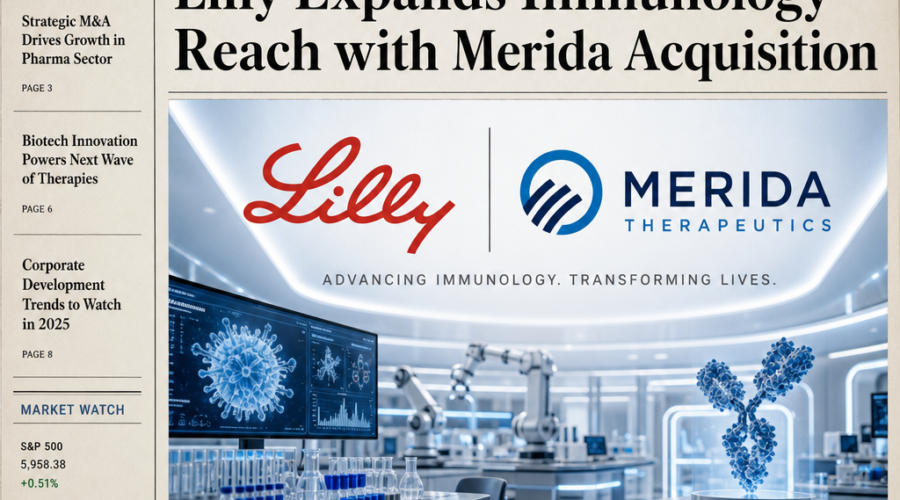
In a strategic maneuver to solidify its presence beyond the metabolic health sector, Eli Lilly and Company (NYSE: LLY) announced on August 31, 2026, a definitive agreement to acquire Merida Biosciences. The deal, valued at up to $2.875 billion, marks Lilly’s 13th acquisition of the year, signaling an aggressive pivot toward high-growth immunology and precision biotechnology.
Most “AI for Diligence” tools are lying to you. The truth is, they are just ChatGPT wrappers. Experience Kai – a Fortune-100 proven AI harness for M&A/ PE Diligence

💼 Purpose-built harness for Due Diligence
The Strategic Pivot: Moving Beyond GLP-1 Dominance
While Eli Lilly has enjoyed unprecedented success with its GLP-1 franchise, including Mounjaro and Zepbound, the Merida acquisition underscores a “string-of-pearls” M&A strategy designed to diversify its long-term revenue streams. By leveraging the massive cash reserves generated from its diabetes and obesity portfolio, Lilly is systematically targeting unmet needs in autoimmune disease management.
Merida Biosciences, a Cambridge-based startup backed by Third Rock Ventures and Bain Capital Life Sciences, specializes in a novel class of precision therapeutics. Unlike traditional treatments that broadly suppress the immune system, Merida’s platform is designed to selectively degrade pathogenic autoantibodies—the specific agents responsible for various immune-mediated conditions—while preserving healthy immune function.
Deal Structure and Financial Terms
The $2.875 billion price tag includes an upfront cash payment and subsequent milestone-based considerations. While the exact breakdown of the upfront fee remains undisclosed, the deal follows a pattern established by Lilly’s other recent immunology-focused acquisitions, such as its $1.2 billion buyout of Ventyx Biosciences and the $2.4 billion purchase of Orna Therapeutics.
Deal at a Glance: Merida Biosciences Acquisition
- Total Consideration: Up to $2.875 Billion
- Acquisition Target: Merida Biosciences, Inc. (Private)
- Key Asset: MER511 (Phase 1 clinical stage)
- Strategic Focus: Precision autoantibody degradation
- Expected Close: Q4 2026
Pipeline Depth: Targeting Graves’ Disease and Allergic Conditions
The centerpiece of the Merida acquisition is MER511, a clinical-stage biologic currently in Phase 1 development for Graves’ disease and thyroid eye disease (TED). These conditions affect approximately 3 million people in the U.S. alone, with many patients facing severe complications like cardiovascular risk or vision loss. Initial Phase 1 data has shown MER511’s ability to achieve robust reductions in thyroid-stimulating antibodies with a favorable safety profile.
Beyond its lead candidate, the acquisition grants Lilly access to:
- MER769: A preclinical antibody targeting IgE-mediated allergic diseases, including asthma and food allergies.
- MER683: An early-stage program focused on primary membranous nephropathy and other autoimmune kidney diseases.
- The Precision Degradation Platform: A technology capable of generating targeted biologics for a wide range of antibody-driven diseases.
The Broader Market Context: Pharmaceutical M&A Trends 2026
The pharmaceutical industry is currently witnessing a significant resurgence in deal activity. As of August 2026, global pharma M&A value has surpassed $190 billion, driven by the need to replenish pipelines ahead of looming patent cliffs and “Loss of Exclusivity” (LOE) events. Analysts from PwC and Goldman Sachs note that cross-border M&A trends 2026 are increasingly focused on next-generation modalities, including protein degraders and RNA-based therapies.
Competitive Landscape in Immunology
Lilly’s move into the TED space places it in direct competition with Amgen’s Tepezza. However, by targeting the autoantibodies directly rather than the downstream receptors, Lilly hopes to offer a more fundamental “disease-modifying” treatment. This reflects a broader industry shift where C-level executives are prioritizing “first-in-class” precision medicines over incremental improvements to existing drug classes.
| Recent Lilly Acquisitions (2026) | Estimated Value | Therapeutic Focus |
|---|---|---|
| Merida Biosciences | $2.9 Billion | Immunology / Autoimmune |
| AtaiBeckley | $3.8 Billion | CNS / Psychedelics |
| Kelonia Therapeutics | $7.0 Billion | Oncology (In vivo CAR-T) |
| Centessa Pharmaceuticals | $6.3 Billion | Sleep Disorders |
Execution Risks and Regulatory Outlook
The deal is expected to close in the fourth quarter of 2026, subject to customary closing conditions and regulatory approvals. While Lilly’s size often invites antitrust scrutiny, the early-stage nature of Merida’s pipeline suggests a lower risk of HSR (Hart-Scott-Rodino) intervention compared to larger “mega-mergers.” For institutional investors, the primary risk remains clinical execution: the transition from Phase 1 safety data to Phase 2/3 efficacy in a competitive immunology landscape.
As the “GLP-1 King” looks to the future, the Merida buyout serves as a clear signal that Lilly is no longer content with metabolic dominance. By aggressively building private equity-backed biotech exit strategies into its corporate development roadmap, Lilly is positioning itself as the most active and diversified player in the 2026 biopharma ecosystem.
Sources
 biopharmadive.com
 biospace.com
 biopharmadive.com
 biopharmadive.com
 prnewswire.com
 prnewswire.com
 biospace.com
 drug-dev.com
 beckershospitalreview.com
 fool.com
 fool.com
 pharmexec.com
 pharmexec.com
 pharmexec.com
 tradingview.com
 biospace.com
 fiercebiotech.com
 fiercebiotech.com
 fiercebiotech.com
 pharmaceutical-technology.com
 biopharmadive.com
 endpoints.news
 endpoints.news
 bioprocessintl.com
 pharmaphorum.com
 fiercepharma.com
 hsfkramer.com
 pwc.com