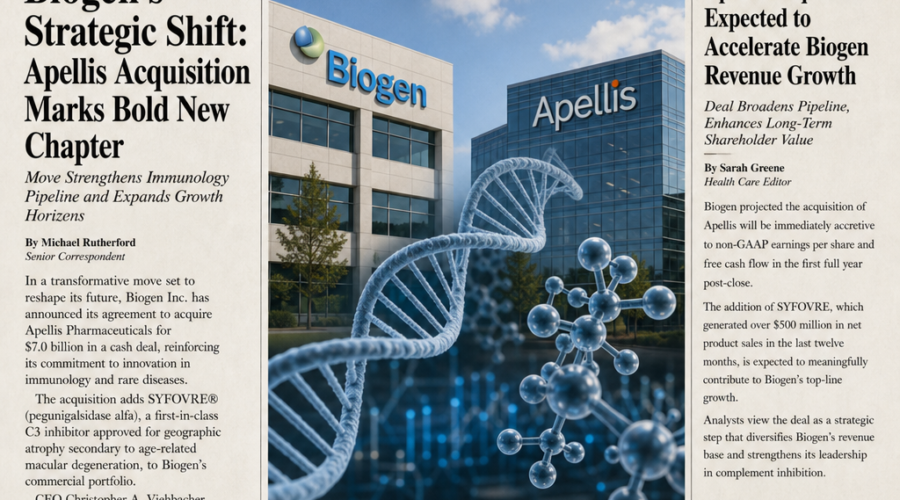
CAMBRIDGE, Mass. — Biogen Inc. (NASDAQ: BIIB) has signaled a definitive pivot in its capital allocation strategy following a blockbuster second quarter that saw the company swing from a projected revenue decline to a “growth story.” The catalyst for this reversal—the $5.6 billion acquisition of Apellis Pharmaceuticals—has not only fortified Biogen’s top line but also provided the “substrate for growth” necessary to move the company into a more selective, “opportunistic” M&A phase.
Most “AI for Diligence” tools are lying to you. The truth is, they are just ChatGPT wrappers. Experience what real AI for Diligence looks like, built like Claude Code, but for M&A/ PE Diligence:
💼 When Claude Code Marries Due Diligence!
The Financial Inflection Point
On July 29, 2026, Biogen reported second-quarter revenue of $2.74 billion, a 3% year-over-year increase that comfortably exceeded the analyst consensus of $2.46 billion. This performance marks Biogen’s highest quarterly revenue since late 2021, driven largely by the integration of Apellis’ complement-mediated therapy portfolio.
The company has subsequently revised its full-year 2026 guidance, flipping an earlier forecast of a mid-single-digit revenue decline to a mid-single-digit increase. Non-GAAP diluted earnings per share (EPS) are now projected to land between $12.00 and $13.00.
Table 1: Biogen Q2 2026 Financial Highlights
| Metric | Q2 2026 Actual | Analyst Consensus | YoY Change |
|---|---|---|---|
| Total Revenue | $2.74 Billion | $2.46 Billion | +3% |
| Non-GAAP EPS | $3.60 | $2.94 | (34%)* |
| Growth Portfolio Revenue | $1.0+ Billion | N/A | +24% |
*EPS decline reflects $153 million in Apellis integration costs and higher interest expense from acquisition financing.
Strategic Pivot: From Aggressive Acquisition to Clinical Execution
With the successful absorption of Apellis and the smaller $1.1 billion acquisition of RayThera, CEO Chris Viehbacher indicated that the “heavy lifting” of portfolio reconstruction is largely complete. In a call with investment professionals, Viehbacher noted that the company will now be “less intentional” and more “opportunistic” regarding future M&A.
The new strategy focuses on cross-border M&A trends 2026 toward early-stage, high-science assets. Biogen’s business development team is shifting its gaze toward targets between the development candidate and Investigational New Drug (IND) stages. This shift signals a move away from the high-premium, commercial-stage deals that characterized the past 24 months, aimed at mitigating “patent cliff” risks in the legacy multiple sclerosis (MS) franchise.
Key Growth Drivers and Synergies
- Syfovre & Empaveli: These two commercialized assets, acquired from Apellis, contributed $128 million in the partial quarter following the May 14 close. Biogen expects these products to maintain mid-to-high teens growth through 2028.
- Nephrology Expansion: The Apellis deal provided a ready-made commercial infrastructure in nephrology, which Biogen intends to leverage for the upcoming launch of felzartamab, currently in Phase 3 trials for kidney transplant rejection.
- Synergy Targets: Management has committed to achieving at least $250 million in annual run-rate synergies by the end of 2027, primarily through the optimization of shared commercial and R&D functions.
Industry Implications and Private Equity Sentiment
Biogen’s successful integration of a multi-billion dollar biotech asset serves as a bellwether for the broader biotech M&A 2026 outlook. As large-cap pharmaceutical firms face looming patent expirations, the “Biogen model”—buying commercial-stage rare disease assets to fund early-stage pipeline expansion—is gaining traction.
Investment advisors from firms like Goldman Sachs and J.P. Morgan have noted that while the cost of capital remains a consideration, the premium paid for Apellis (representing an 86% premium over its 90-day average) underscores the intense competition for de-risked assets. For private equity firms operating in the life sciences space, Biogen’s pivot suggests that “bolt-on” acquisitions and early-stage licensing may offer more fertile ground for private equity exit strategies in biotechnology as strategic buyers cool their appetite for mid-cap takeovers.
The Path Ahead
While the legacy MS portfolio continues to face biosimilar pressure, the “new Biogen” is increasingly defined by its leadership in rare diseases, ophthalmology, and immunology. The company faces five registrational readouts over the next four quarters, including critical data in lupus and antibody-mediated rejection. For C-level executives and deal advisors, Biogen’s trajectory offers a masterclass in using strategic M&A to fundamentally re-engineer a corporate growth profile in a high-stakes regulatory environment.
As of late July 2026, Biogen is positioned to fully de-lever by the end of 2027, using the robust cash flows from its expanded “growth portfolio” to fund a more disciplined, science-first approach to innovation.