
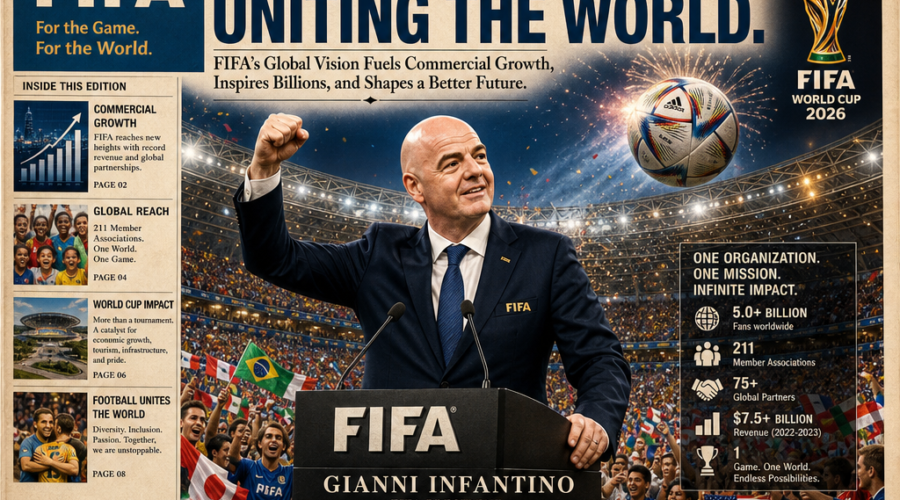
In a move that signals a fundamental restructuring of global sports governance, FIFA has moved to carve out its commercial operations into a new, for-profit entity valued at $20 billion. The initiative, spearheaded by President Gianni Infantino, aims to sell a minority stake of approximately 20% to private investors, raising an estimated $4.2 billion in immediate capital. This strategic maneuver, branded as FIFA Forward Enterprise (FFE), represents the most significant institutional play in sports media rights since the entry of private equity into European league structures.
Most “AI for Diligence” tools are lying to you. The truth is, they are just ChatGPT wrappers. Experience what real AI for Diligence looks like, built like Claude Code, but for M&A/ PE Diligence:
💼 When Claude Code Marries Due Diligence!
The Deal Architecture: Valuation and Capital Raise
According to internal documents revealed by The Athletic and confirmed by financial advisors, the proposed FFE subsidiary will consolidate FIFA’s primary revenue engines, including broadcast rights, sponsorship, ticketing, and licensing for the Men’s and Women’s World Cups and the newly expanded Club World Cup. This restructuring mirrors the “media-co” models successfully deployed by CVC Capital Partners in La Liga and Ligue 1, but on a vastly larger global scale.
Key Transaction Metrics
| Metric | Details |
|---|---|
| Enterprise Value (Target) | $20 Billion |
| Equity Stake Offered | ~20% to 21% (Minority, Non-controlling) |
| Capital Target | $4.2 Billion |
| Lead Financial Advisor | J.P. Morgan |
| Strategic Consultant | Greg Maffei (Former Liberty Media CEO) |
| Prospective Lead Investor | Thrive Eternal (Joshua Kushner / Thrive Capital) |
The Rationale: Why Now?
The timing follows the conclusion of the 2026 World Cup in North America, which reportedly generated record revenues exceeding $15 billion. Infantino’s move is driven by a dual objective: capitalizing on peak valuation and securing political loyalty through massive liquidity distributions to FIFA’s 211 member associations. For institutional investors, the allure lies in the “recession-proof” nature of World Cup media rights and the untapped potential for digital-first monetization strategies in emerging markets.
Under the proposal, member associations that approve the deal by September 19, 2026, are promised an immediate funding windfall of $40 million. Projections suggest that per-cycle payouts for national federations could climb from the current $8 million to $24 million by 2038, provided the private equity infusion materializes.
Strategic Implications: The “Americanization” of Global Soccer
The involvement of Thrive Capital and former Liberty Media leadership highlights a distinct shift toward American-style commercial management. By housing operational delivery and commercial rights under FFE, FIFA seeks to professionalize its revenue generation, moving away from its traditional non-profit administrative roots. This “private equity investment in sports” trend highlights a broader sector shift where governing bodies are increasingly viewed as undervalued intellectual property assets.
Leadership and Governance Shifts
- The Commissionership: Reports indicate Infantino is positioned to serve as the inaugural Commissioner of FFE after his current presidential term, effectively retaining control over the commercial arm while insulating it from the political volatility of the FIFA Congress.
- Consolidation of Rights: FFE will centralize the “operational delivery” of tournaments, potentially streamlining costs and optimizing sports media rights monetization across the four-year cycle.
Regulatory and Competitive Risks
The plan has met fierce resistance from UEFA, European football’s governing body, which has termed the move an attempt to “sell the soul of football.” Critics argue that the prioritization of commercial returns will lead to further calendar congestion and marginalize player welfare. Legal analysts from firms like Kirkland & Ellis suggest that any attempt to include club competitions in the FFE perimeter could spark prolonged litigation with domestic leagues and the European Club Association (ECA).
Furthermore, the high-profile involvement of investors with ties to the U.S. political landscape—specifically Joshua Kushner—has introduced a layer of geopolitical scrutiny that could complicate regulatory approvals in Europe and the Middle East.
The Road Ahead: September 19 Deadline
The success of the FFE depends on a majority vote from the 211 member associations. While the financial “sweetener” of $40 million per nation is likely to secure the support of smaller federations, the opposition from the “Big Five” European leagues poses a existential threat to the World Cup’s prestige. For the dealmakers at J.P. Morgan and Thrive Capital, the challenge will be to prove that a for-profit FFE can maintain the sport’s integrity while delivering the projected 15-20% IRR expected by institutional backers.
As the September deadline approaches, the global soccer landscape stands on the precipice of a definitive transition: from a sport governed by a non-profit cartel to a global entertainment product managed by private capital. For C-level executives in the media and betting sectors, this shift marks the beginning of a new era in cross-border M&A trends within the multi-billion dollar sports economy.