
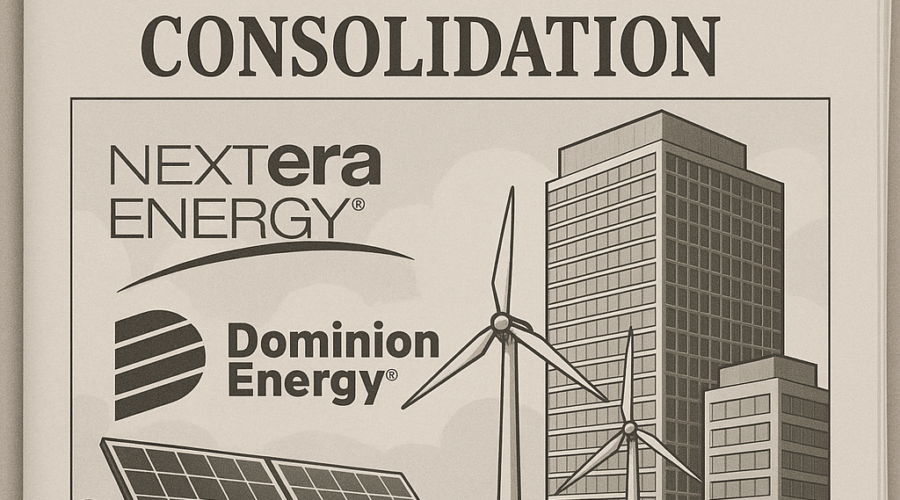
NextEra Energy is in advanced discussions to acquire Dominion Energy in a stock-for-stock transaction creating a combined enterprise valued at approximately $400 billion, including debt. The deal is strategically driven by the unprecedented power demand from AI data centers located in Dominion's Virginia territory, which has a queue for over 47 gigawatts of new capacity. By merging, NextEra provides the balance sheet and renewable development expertise to fund this massive capital expenditure. This transaction signals a fundamental shift in the utility sector, where scale and integrated clean energy infrastructure are now the primary competitive advantages for powering the 21st-century digital economy.
- Acquirer
- NextEra Energy Inc.
- Target
- Dominion Energy Inc.
- Projected Enterprise Value
- ~$400 Billion (including debt)
- Projected Market Capitalization
- ~$250 Billion
- Transaction Type
- Primarily stock-for-stock
- Strategic Driver
- Meeting escalating power demand from AI data centers in Virginia's 'Data Center Alley'.
- Key Asset
- Dominion's grid with a queue for over 47 GW of additional capacity for hyperscalers.
- Expected Close
- Late 2026 or early 2027
- Key Date
- Formal announcement expected on May 18
- Regulatory Hurdles
- Scrutiny from FERC and state regulators in Virginia and Florida.
In a move that signals the beginning of a new era of utility consolidation, NextEra Energy Inc. is in advanced discussions to acquire Dominion Energy Inc. The proposed transaction, structured primarily as a stock-for-stock deal, would create a $400 billion enterprise (including debt), marking one of the largest corporate marriages in the history of the U.S. power sector. For C-suite executives and institutional investors, this is not merely a scale play; it is a calculated response to the escalating AI data center power infrastructure investment requirements currently reshaping the American economy.
Most “AI for Diligence” tools are lying to you. The truth is, they are just ChatGPT wrappers. Experience what real AI for Diligence looks like, built like Claude Code, but for M&A/ PE Diligence:
💼 When Claude Code Marries Due Diligence!
The Strategic Rationale: Securing the “Data Center Alley”
The primary catalyst for this merger is the unprecedented demand for electricity driven by artificial intelligence, industrial reshoring, and the electrification of transportation. Dominion Energy sits at the epicenter of this surge. Its Virginia territory encompasses “Data Center Alley,” the largest concentration of data centers in the world. With hyperscalers like Amazon Web Services, Google, and Microsoft projecting a 300% increase in power needs over the next decade, Dominion’s queue for over 47 gigawatts (GW) of additional capacity represents a massive, yet capital-intensive, growth opportunity.
NextEra Energy, the world’s largest renewable energy developer, possesses the balance sheet and technical expertise to accelerate Dominion’s transition. By integrating NextEra’s renewable energy integration for hyperscalers with Dominion’s established grid in high-growth tech corridors, the combined entity aims to solve the “power crunch” that currently threatens to bottleneck AI development.
Table 1: Strategic Profile of the Combined Entity
| Metric | NextEra Energy (Pre-Merger) | Dominion Energy (Pre-Merger) | Combined Entity (Projected) |
|---|---|---|---|
| Market Capitalization | ~$195 Billion | ~$54 Billion | ~$250 Billion |
| Enterprise Value (inc. Debt) | ~$280 Billion | ~$110 Billion | ~$400 Billion |
| Primary Markets | Florida, National (Renewables) | VA, NC, SC | Southeast & Mid-Atlantic Powerhouse |
| Core Growth Driver | Solar/Wind Expansion | AI Data Center Demand | Integrated Clean Energy Infrastructure |
Financial Framing and Shareholder Implications
From an investment perspective, the deal reflects a shift toward regulated utility consolidation risks and rewards. NextEra has historically traded at a premium due to its best-in-class operational efficiency and its “dividend aristocrat” status, targeting mid-to-high single-digit annual growth. Dominion, which recently underwent a strategic review to de-lever its balance sheet, offers a higher current yield but has faced challenges in funding the massive capital expenditures required by Virginia’s load growth.
Analysts from top-tier firms like Goldman Sachs and Morgan Stanley have noted that the utility dividend growth strategies of the future will depend on the ability to finance “mega-capex” projects. This merger provides the combined company with a lower cost of capital, allowing for more aggressive investment in transmission and sub-stations without over-leveraging. For Dominion shareholders, the stock-based deal offers a premium and an equity stake in a more diversified, growth-oriented platform.
The Consumer Perspective: Rates vs. Reliability
While the merger offers significant synergies, it faces intense scrutiny from state public service commissions. For ratepayers in Florida and Virginia, the central question is whether the “economies of scale” promised by NextEra will translate to lower bills or if the cost of the AI power play will be passed down to residential customers.
- Infrastructure Costs: Modernizing the grid to support 47 GW of new demand requires billions in capital. Regulators will be tasked with ensuring that data center operators pay their fair share through large-load tariffs, rather than shifting the burden to households.
- Renewable Acceleration: NextEra’s ability to deploy solar and battery storage at scale could mitigate the long-term volatility of fossil fuel prices, potentially stabilizing rates over a 10-year horizon.
- Operational Synergies: By consolidating back-office operations and supply chain procurement, the merged company could realize hundreds of millions in annual savings.
Regulatory Hurdles and Antitrust Climate
The path to closing, anticipated for late 2026 or early 2027, will be arduous. The Federal Energy Regulatory Commission (FERC) and state regulators in Virginia and Florida will scrutinize the deal for market manipulation and impacts on competition. Historically, cross-border M&A trends in utilities have required significant concessions, including “rate freezes” for a set number of years and guaranteed investments in local community programs.
Furthermore, the concentration of power—literally and figuratively—in the hands of a single entity serving the world’s data capital will likely draw attention from federal lawmakers concerned about the resilience of the national grid. The companies must prove that this combination is in the “public interest” by demonstrating that a larger entity is better equipped to defend against cyber threats and extreme weather events.
The WSJ Take: A Watershed Moment for Infrastructure
This potential acquisition is a definitive signal that the “quiet” world of regulated utilities is over. As AI demand forces a massive expansion of the U.S. electrical footprint, scale has become the ultimate competitive advantage. If NextEra successfully absorbs Dominion, it will not just be a utility company; it will be the primary infrastructure provider for the 21st-century digital economy. Investors should watch for the formal announcement on May 18, focusing specifically on the “premium” offered to Dominion and the projected “rate base growth” targets for the 2026–2030 period.
The deal reinforces a broader market trend: in the race to power AI, the winners will be those who own the “pipes” and the “plants.” NextEra is betting $400 billion that it can own both.