
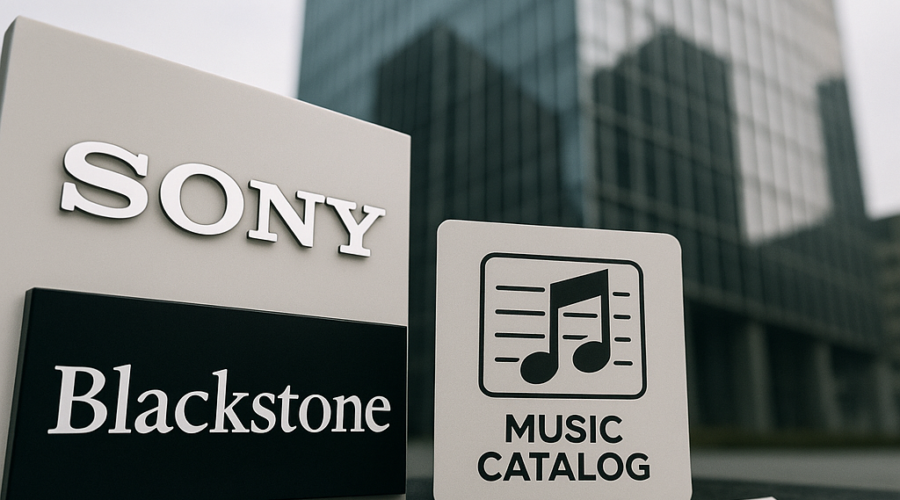
Sony Music Group, in a joint venture with Singapore's sovereign wealth fund GIC, is in advanced negotiations to acquire Recognition Music Group from Blackstone Inc. for up to $4 billion. The transaction covers a portfolio of approximately 45,000 songs, including catalogs from artists like Justin Bieber and Neil Young, at an implied multiple of 14x to 18x Net Publisher Share (NPS). This deal signals a significant market shift from private equity's yield-focused aggregation strategy to operational consolidation by strategic majors seeking synergies and control over intellectual property for AI training.
- Target
- Recognition Music Group
- Acquirer
- Sony Music Group / GIC (Joint Venture)
- Seller
- Blackstone Inc.
- Transaction Type
- Acquisition / Private Equity Exit
- Enterprise Value
- $3.5 Billion – $4.0 Billion (Estimated)
- Asset Portfolio
- Approximately 45,000 songs/recordings
- Implied Multiple
- 14x – 18x Net Publisher Share (NPS)
- Key Catalogs
- Justin Bieber, Neil Young, Shakira, Fleetwood Mac, Red Hot Chili Peppers, Journey
- Strategic Driver
- Operational synergy and control over rights for AI training data
- Joint Venture Partner
- GIC (Singapore Sovereign Wealth Fund)
Sony Music Group is in advanced negotiations to acquire Recognition Music Group from Blackstone Inc. for a total consideration of up to $4 billion. The transaction, reported by Bloomberg, would represent one of the largest music rights deals in industry history and underscores a major shift in the institutional ownership of intellectual property.
Most “AI for Diligence” tools are lying to you. The truth is, they are just ChatGPT wrappers. Experience what real AI for Diligence looks like, built like Claude Code, but for M&A/ PE Diligence:
💼 When Claude Code Marries Due Diligence!
The acquisition is being structured through a joint venture between Sony and Singapore’s sovereign wealth fund, GIC. This partnership allows Sony to leverage GIC’s massive capital reserves while integrating the assets into Sony’s existing administrative and global distribution infrastructure. Recognition Music currently manages or owns rights to approximately 45,000 songs, including blue-chip catalogs from artists such as Justin Bieber, Neil Young, Shakira, and Fleetwood Mac.
Strategic Rationale: From Yield Play to Operating Synergy
For Blackstone, the sale of Recognition Music—rebranded in early 2025 after consolidating its Hipgnosis-sourced holdings—marks a significant private equity exit strategy in the media sector. Blackstone spent years aggregating these assets through vehicles like Hipgnosis Songs Capital and the later take-private of the London-listed Hipgnosis Songs Fund for $1.58 billion in 2024. This exit suggests that Blackstone is moving to realize gains as the market for music IP shifts from a pure financial yield play into a phase of corporate consolidation.
Sony, under the leadership of Rob Stringer, is pursuing a “total rights” strategy. By acquiring the catalog, Sony eliminates the administrative leakage of third-party management fees. Sony Music Publishing already administers much of the Recognition portfolio, making the acquisition a seamless operational merger with high synergy potential.
Transaction Overview and Financial Terms
| Parameter | Details |
|---|---|
| Enterprise Value | $3.5 Billion – $4.0 Billion (Estimated) |
| Joint Venture Partner | GIC (Singapore Sovereign Wealth Fund) |
| Asset Count | ~45,000 Songs/Recordings |
| Implied Multiple | 14x – 18x Net Publisher Share (NPS) |
| Key Catalogs | Justin Bieber, Neil Young, Red Hot Chili Peppers, Journey |
The 2026 M&A Landscape for Music IP
The deal comes at a time when music catalog valuation multiples 2026 have stabilized following the volatility of 2023-2024. While the peak “frenzy” of 2021 saw multiples reach north of 20x NPS, current market standards for “trophy” assets sit between 14x and 18x. According to insights from McKinsey and Citrin Cooperman, institutional investors now prioritize assets with “dollar age”—a metric measuring the stability and predictability of royalty streams over time.
This transaction is indicative of a broader trend: cross-border M&A trends 2026 where sovereign wealth funds (SWFs) provide the “heavy lifting” capital for strategic majors. GIC’s involvement mirrors recent moves by the Saudi Public Investment Fund (PIF) and Abu Dhabi’s Mubadala, which have increasingly sought uncorrelated, long-duration cash flows like those found in publishing royalties.
Market Implications and Regulatory Outlook
- Consolidation Risk: The concentration of rights under the “Big Three” (Sony, Universal, Warner) may attract further scrutiny from regulatory bodies in the EU and the US regarding streaming royalty distribution and licensing dominance.
- AI Training Rights: A critical valuation driver in 2026 is the control over “primary” rights for AI training data. Sony’s ownership of these masters and compositions provides a defensive moat against unauthorized generative AI usage.
- Exit Environment: As Blackstone nears a final agreement, other PE firms like KKR (via Chord Music) and Apollo may look to test the market for their own aggregated music portfolios.
Comparison of Recent Major Music Rights Transactions
The Recognition deal follows a series of multi-billion dollar maneuvers that have reshaped the sector:
| Year | Acquirer | Target/Asset | Deal Value |
|---|---|---|---|
| 2026 (Pending) | Sony / GIC | Recognition Music Group | ~$4.0B |
| 2025 | Concord (supported by Apollo) | BMG (Select Rights) | ~$2.2B |
| 2024 | Blackstone | Hipgnosis Songs Fund | $1.58B |
| 2024 | Sony | Queen (Catalog Stake) | ~$1.2B |
Final terms are expected within the coming days, provided exclusive negotiations do not collapse. While Bloomberg reports unsolicited higher bids from rival entities, Blackstone’s long-standing relationship with Sony as a primary administrator likely positions the Sony/GIC bid as the most probable path to closing.
Sources
 investing.com
 biggo.com
 thestandard.com.hk
 mk.co.kr
 tipranks.com
 musicbusinessworldwide.com
 morningstar.com
 themiddlemarket.com
 musicbusinessworldwide.com
 kjwl.com
 chartlex.com
 chartlex.com
 spacemusic.io
 royaltyexchange.com
 trysignalbase.com