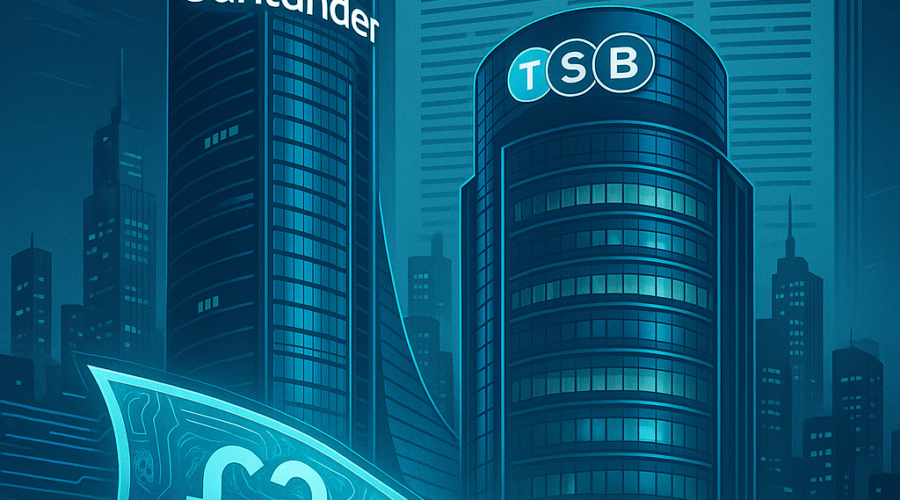
Santander UK has acquired TSB from Spain’s Banco Sabadell for approximately £2.86 billion (€3.3 billion), creating the UK's third-largest provider of personal current accounts. The deal adds TSB's 5 million customers and is driven by a strategy to achieve £400 million in annual cost synergies and a 16% Return on Tangible Equity (RoTE) by 2028. This transaction establishes a new benchmark for mid-tier bank M&A valuations and signals an acceleration of consolidation in the UK retail banking sector, pressuring competitors to seek scale to remain competitive.
- Acquirer
- Santander UK
- Target
- TSB
- Seller
- Banco Sabadell
- Transaction Value
- £2.86 billion (€3.3 billion)
- Strategic Driver
- Achieve operational efficiency, scale digital platform, and reduce cost-to-income ratio.
- Targeted Cost Synergies
- £400 million annually
- Targeted RoTE
- 16% by 2028
- Combined Customers
- 28 Million
- Post-Merger Mortgage Rank
- 4th in UK
- Brand Integration
- The TSB brand will be retired within 12 months.
- Regulatory Clearance
- Approved by the Competition and Markets Authority (CMA) and the Prudential Regulation Authority (PRA).
In a move that signals a definitive acceleration of UK retail banking consolidation trends 2026, Santander UK has finalized its acquisition of TSB from Spain’s Banco Sabadell. The transaction, valued at approximately £2.86 billion (€3.3 billion) following final adjustments to net asset value, marks the largest investment in the British banking sector since the 2008 financial crisis. By absorbing TSB’s operations, Santander UK secures its position as the third-largest provider of personal current accounts and the fourth-largest mortgage lender in the United Kingdom.
Most “AI for Diligence” tools are lying to you. The truth is, they are just ChatGPT wrappers. Experience what real AI for Diligence looks like, built like Claude Code, but for M&A/ PE Diligence:
💼 When Claude Code Marries Due Diligence!
Strategic Rationale: Driving Operational Efficiency and Scale
The takeover is a centerpiece of Santander UK’s strategy to optimize its cost-to-income ratio in banking, aiming for a reduction toward 36% by 2028. For CEO Mahesh Aditya, the transaction is less about simple expansion and more about high-velocity digital transformation. Santander intends to leverage TSB’s 5 million customer base to scale its “One Transformation” global technology platform, which seeks to unify disparate legacy systems into a streamlined, digital-first infrastructure.
Financial leadership at Santander has identified at least £400 million in annual cost synergies, with some analysts at firms like Goldman Sachs and UBS suggesting that further efficiency gains of £100 million could be unlocked post-2028. These savings are expected to underpin a target Return on Tangible Equity (RoTE) of 16% by 2028, positioning Santander UK among the most profitable mid-tier banks in the European theatre.
Key Deal Metrics and Combined Market Position
The following data reflects the institutional scale achieved through the completion of this UK retail banking M&A event:
| Metric | TSB Contribution | Combined Entity (Est.) |
|---|---|---|
| Total Customers | 5 Million | 28 Million |
| Gross Customer Assets | £71.5 Billion | ~£280 Billion |
| Mortgage Market Rank | N/A | 4th in UK |
| Annual Cost Synergies | N/A | £400M – £500M |
The Sabadell Exit: Refocusing on the Iberian Core
For Banco Sabadell, the sale represents the conclusion of a decade-long UK journey that began with its £1.7 billion acquisition of TSB in 2015. After a period of cross-border M&A strategy volatility—most notably the 2018 IT migration failure that cost TSB hundreds of millions in penalties—Sabadell has prioritized capital repatriation. The divestment generates approximately 400 basis points of capital for the Spanish lender, which it plans to distribute via a “macro-dividend” of €0.50 per share scheduled for late May 2026.
This exit aligns with broader European financial services divestiture trends, as mid-sized lenders increasingly retrench to their home markets to defend against domestic “challenger” neobanks and rising regulatory capital requirements.
Integration Risks and Brand Retirement
Historical precedent dictates that financial services post-merger integration in the UK is fraught with technical and cultural hurdles. Santander has confirmed it will retire the TSB brand within 12 months, rebranding the entire network under the Santander UK banner. While this simplifies marketing, it necessitates a delicate handling of TSB’s distinct branch footprint, particularly in Scotland.
Leadership and Workforce Impact
- Nicola Bannister, formerly a TSB executive, assumed the role of TSB CEO on May 1st to oversee the transition phase.
- Branch Consolidation: Santander has already announced the closure of dozens of branches in early 2026, a move aimed at reducing physical overhead as digital adoption surpasses 52% of the UK retail market.
- Regulatory Oversight: The Competition and Markets Authority (CMA) and the Prudential Regulation Authority (PRA) cleared the deal after determining that the merger would not substantially lessen competition in the presence of dominant players like Lloyds and NatWest.
Conclusion: A New Benchmark for Consolidation
The Santander-TSB deal is likely to serve as a blueprint for mid-tier bank M&A valuations in the coming years. As interest rates stabilize and banks seek “capital-light” revenue streams through wealth management and digital fees, the pressure to consolidate remains high. For deal advisors at firms like Kirkland & Ellis and Macfarlanes, the focus now shifts to whether other mid-tier players, such as Metro Bank or Virgin Money, will follow suit in an effort to reach the critical mass required to compete in a mobile-first banking era.
Sources
 crowdfundinsider.com
 santander.co.uk
 retailbankerinternational.com
 scottishfinancialnews.com
 santander.com
 thestreet.com
 democrata.es
 grupbancsabadell.com
 apd.cat