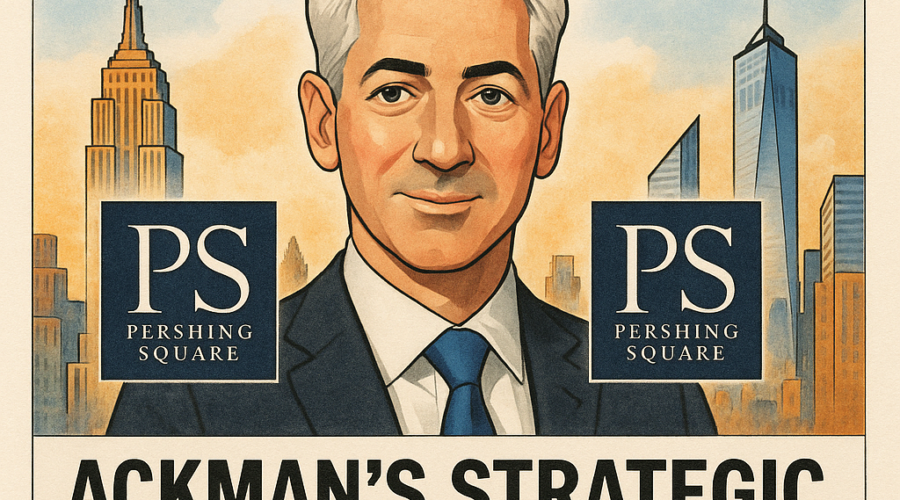
Bill Ackman’s Pershing Square Capital Management has filed for an IPO on the NYSE, aiming to raise $5 billion to $10 billion. The transaction features a novel dual-listing structure, offering shares in a new closed-end fund, Pershing Square USA (PSUS), alongside free shares in the management company, Pershing Square Inc., as an ‘equity sweetener’. The offering has already secured $2.8 billion in pre-commitments. This structure represents a significant evolution in creating a permanent capital vehicle for an alternative asset manager, directly addressing the classic hedge fund constraint of investor redemptions.
- Company
- Pershing Square Capital Management
- Transaction Type
- Initial Public Offering (IPO) with Dual-Listing
- Target Raise
- $5 billion to $10 billion
- Proposed Exchange
- New York Stock Exchange (NYSE)
- Entity 1 (Fund)
- Pershing Square USA (PSUS)
- Entity 2 (Manager)
- Pershing Square Inc. (PS)
- Fund Share Price
- $50
- Incentive Structure
- IPO investors receive 20 shares of Pershing Square Inc. for every 100 shares of PSUS purchased
- Pre-Commitments
- $2.8 billion
- Assets Under Management
- $30.7 billion (as of year-end 2025)
- Strategic Driver
- Create a permanent capital vehicle modeled after Berkshire Hathaway to avoid investor redemptions
Billionaire investor Bill Ackman has initiated his long-anticipated move to bring his activist investment firm, Pershing Square Capital Management, onto public markets via a filing with the U.S. Securities and Exchange Commission on Tuesday. The proposed initial public offering (IPO) is structured as a novel, dual-listing transaction aimed at creating a permanent capital vehicle modeled after Warren Buffett’s Berkshire Hathaway.
Most “AI for Diligence” tools are lying to you. The truth is, they are just ChatGPT wrappers. Experience what real AI for Diligence looks like, built like Claude Code, but for M&A/ PE Diligence:
💼 When Claude Code Marries Due Diligence!
The offering is set to raise between $5 billion and $10 billion in aggregate proceeds, anchored by a substantial pre-commitment that signals strong institutional confidence in the strategy. For C-level executives and deal advisors, this structure represents a significant evolution in how established alternative asset managers seek both growth capital and enhanced public market relevance.
The Dual Structure: Asset Manager Meets Permanent Capital Fund
The core of the proposal involves two distinct, yet bundled, public entities listing on the New York Stock Exchange (NYSE):
| Entity | Purpose | Expected Ticker |
|---|---|---|
| Pershing Square USA (PSUS) | A new closed-end investment company that will deploy capital into the firm’s concentrated, long-horizon investment strategy. | PSUS |
| Pershing Square Inc. | The prospective parent entity of Pershing Square Capital Management, offering investors a direct stake in the asset management business. | PS |
The shares of PSUS are priced at $50 each, with the closed-end fund targeting an aggregate offering size between $5 billion and $10 billion. This structure directly addresses the traditional constraint of hedge funds—investor redemptions—by creating a permanent capital base for Pershing Square USA.
The Equity Sweetener: Incentivizing the Vehicle
A key differentiator in this hedge fund IPO structure is the inclusion of an equity “sweetener” designed to drive demand for the PSUS fund. Under the current terms, IPO investors purchasing 100 shares of PSUS will receive 20 shares of the management company, Pershing Square Inc., at no additional cost. For institutional participants in the private placement component, this incentive is even greater, netting 30 shares of Pershing Square Inc. for every 100 shares of PSUS acquired.
This dual-exposure mechanism is intended to align the interests of the public investor base with the long-term success of the management firm, a crucial element in optimizing valuation for an asset manager public listing. Prior to the filing, the transaction had already secured $2.8 billion in commitments from a mix of family offices, pension funds, and insurance companies.
Strategic Rationale and Market Implications
The move is the latest iteration of Ackman’s ambition to build a vehicle with patient capital. As stated in the prospectus, permanent capital allows the firm to maintain a long-term perspective and capitalize on market volatility without facing forced asset sales to meet redemption requests. This stability is cited as a primary benefit for attracting capital and retaining key personnel.
As of year-end 2025, Pershing Square managed $30.7 billion in assets, generating $762.5 million in revenue against nearly $250 million in profit. This financial scale positions the offering as a major event in the alternative investment space.
Comparison to Market Trends
The push toward publicly traded investment management companies is part of a broader trend where investors seek alternatives to traditional, lower-yielding fixed-income products and are drawn to concentrated, actively managed strategies. However, the closed-end fund format can present liquidity challenges compared to the increasingly popular Exchange-Traded Funds (ETFs). Ackman’s structure attempts to bridge this gap by offering a public listing for the management enterprise itself, a rare feat outside of a few large asset management peers.
This offering follows a previous, withdrawn attempt in 2024, indicating a refined approach to the private equity exit strategies and permanent capital model. The success of this dual-listing, particularly its valuation premium, will be closely watched by peers considering ways to monetize management fees and gain an enhanced public capital structure for future growth initiatives.
Sources
 invezz.com
 forbes.com
 intellectia.ai
 investmentnews.com
 tradingview.com
 morningstar.com
 marketscreener.com
 nationaltoday.com
 coresignal.com
 youtube.com
 visionarycios.com