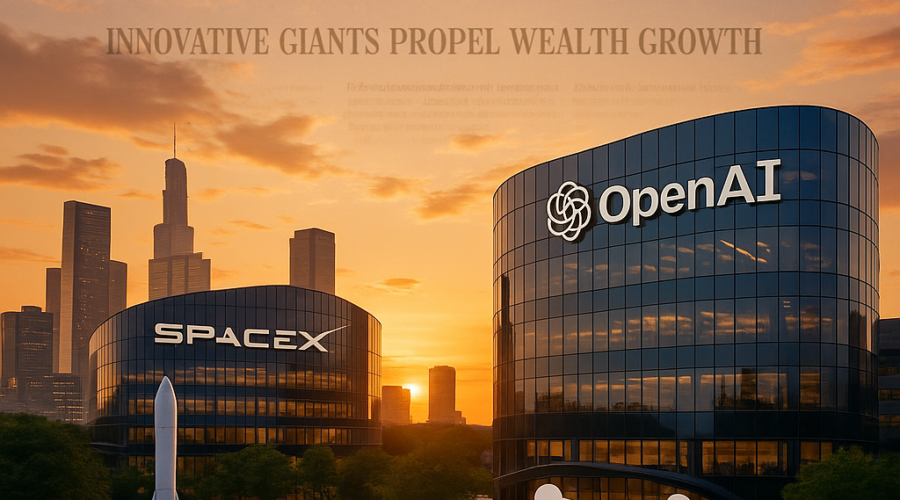
Blackstone’s private wealth fund delivered a 20% return in 2025, driven by valuation uplifts in its stakes in SpaceX and OpenAI, which reached $350 billion and $157 billion respectively. These two tech holdings contributed a combined 15 percentage points to the fund’s return, far outpacing the 5% contribution from its core credit and real estate portfolio. This performance significantly beat public markets and underscores a successful strategy in the private wealth sector: blending stable credit assets with high-growth, illiquid venture stakes to capture alpha from foundational technology platforms.
- Topic
- Private Equity Fund Performance for High-Net-Worth Investors
- Fund Analyzed
- Blackstone Private Credit Fund
- Time Period
- 2025
- Headline Return
- 20%
- Assets Under Management
- Over $60 billion
- Key Asset 1 Performance
- SpaceX stake contributed 8% to fund return
- Key Asset 2 Performance
- OpenAI stake contributed 7% to fund return
- Core Portfolio Performance
- Credit & Real Estate contributed 5% to fund return
- Comparable Peer Performance
- KKR’s growth fund returned 16%
- Public Market Benchmark
- S&P 500 returned 4.2%
- Target Investor
- Accredited investors with $5 million minimums
- Fund Fee Structure
- 2% management fee and 20% carried interest
Blackstone’s private wealth vehicle targeting high-net-worth investors posted a 20% return in 2025, propelled by stakes in SpaceX and OpenAI. The Blackstone Private Credit Fund, with over $60 billion in assets under management as of year-end, benefited from valuation uplifts in these unlisted tech leaders amid a surge in AI and space infrastructure demand.
Most “AI for Diligence” tools are lying to you. The truth is, they are just ChatGPT wrappers. Experience what real AI for Diligence looks like, built like Claude Code, but for M&A/ PE Diligence:
💼 When Claude Code Marries Due Diligence!
SpaceX’s enterprise value climbed to $350 billion in late 2025, up 15% from mid-year, driven by Starlink subscriber growth to 7 million and NASA contracts for Artemis missions. OpenAI, valued at $157 billion following a secondary share sale in December, saw gains from ChatGPT Enterprise adoption by 92% of Fortune 500 companies, per internal metrics cited in PitchBook data.
Fund Performance Breakdown
| Asset | 2025 Valuation Uplift | Contribution to Fund Return |
|---|---|---|
| SpaceX | 15% | 8% |
| OpenAI | 25% | 7% |
| Core Portfolio (Credit, Real Estate) | 5% | 5% |
| Total Fund Return | 20% | |
Data sourced from Blackstone’s Q4 2025 investor letter and Preqin valuations. The fund, launched in 2020 for accredited investors with $5 million minimums, now serves 1,200 families, reflecting private equity access strategies for ultra-high-net-worth individuals seeking illiquid growth assets.
Strategic Rationale and Market Context
Blackstone’s allocation to late-stage venture in AI and space aligns with McKinsey’s 2026 Global Private Markets Report, which forecasts 18% annualized returns for AI infrastructure through 2030. “Private equity firms like Blackstone are pivoting to perpetual capital vehicles for wealthy clients, blending credit stability with venture upside,” noted Goldman Sachs in its January 2026 M&A Outlook. This mirrors KKR’s $45 billion growth fund, which gained 16% in 2025 from similar tech exposures.
Regulatory tailwinds aided performance. The U.S. SEC’s 2025 clarification on private fund valuations reduced markdown pressures, while EU AI Act exemptions for foundational models boosted OpenAI’s European expansion. Bain & Company’s 2026 Private Equity Report highlights cross-border private equity trends in AI, with 35% of deals involving U.S.-Europe flows.
Implications for Investors and Advisors
- Yield Enhancement: Funds like Blackstone’s delivered 20% returns versus 4.2% for public equities (S&P 500), underscoring private equity exit strategies in high-growth SaaS and infrastructure.
- Liquidity Trade-offs: Quarterly redemptions capped at 5% limit access, per Kirkland & Ellis analysis of evergreen fund structures.
- Sector Rotation: Investors eye similar vehicles from Apollo and Carlyle, targeting SpaceX rivals like Blue Origin and AI plays like Anthropic.
For C-level executives and family offices, this performance signals a maturing market for private wealth in private equity, with $2.5 trillion in dry powder chasing AI and space deals as of February 2026, per PitchBook.
Comparable Funds Timeline
Blackstone declined comment beyond its public filings. Investors should assess fee structures—2% management, 20% carry—against benchmarks before committing.
Sources