
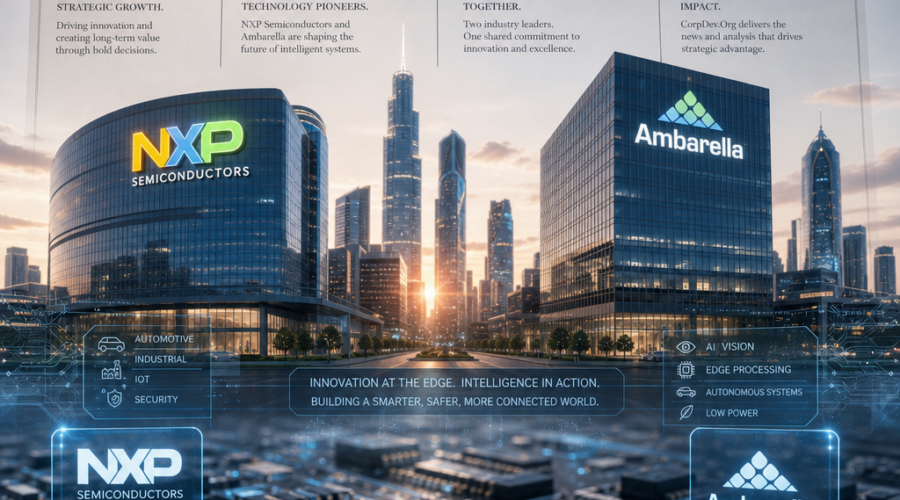
NXP Semiconductors N.V. (NASDAQ: NXPI) is in preliminary discussions to acquire Ambarella, Inc. (NASDAQ: AMBA) for approximately $3.3 billion, according to sources familiar with the matter. The potential transaction represents a significant consolidation in the automotive semiconductor landscape, specifically targeting the high-growth “edge AI” and computer vision sectors essential for the next generation of autonomous mobility.
Most “AI for Diligence” tools are lying to you. The truth is, they are just ChatGPT wrappers. Experience Kai – a Fortune-100 proven AI harness for M&A/ PE Diligence

💼 Purpose-built harness for Due Diligence
As of July 31, 2026, the market reaction has been swift: Ambarella shares surged nearly 19% following the initial report by the Financial Times, while NXP’s stock dipped by over 3.8% as investors weighed the premium and integration risks. The deal would unite NXP’s dominant position in automotive microcontrollers and networking with Ambarella’s specialized low-power AI systems-on-chip (SoCs), creating a formidable competitor against rivals like Qualcomm and NVIDIA in the software-defined vehicle (SDV) era.
The Strategic Rationale: Beyond Control to Perception
For NXP, the acquisition is a pivot from “control” to “perception.” While the Dutch chipmaker already leads the industry in automotive secure connectivity and radar processing, it has lacked a dedicated, high-performance vision processing stack. Ambarella’s computer vision technology allows vehicles to “see” and make real-time decisions at the edge—meaning data is processed locally within the camera or sensor rather than at a central computer or in the cloud.
- Complementary Portfolios: NXP’s expertise in radar and vehicle networking pairs with Ambarella’s CV3-AD domain controllers to offer a full-stack sensor fusion solution.
- Expansion into Physical AI: NXP CEO Rafael Sotomayor recently highlighted “Physical AI” as a core growth driver. Ambarella’s presence in robotics and security cameras extends NXP’s reach into industrial edge AI.
- Accelerated Time-to-Market: Acquiring Ambarella provides NXP with immediate access to a mature software ecosystem and an installed base of over 46 million AI SoC units.
Financial Framing and Market Dynamics
The reported $3.3 billion valuation reflects a significant premium over Ambarella’s unaffected market cap, signaling the scarcity of independent, scaled assets in the edge AI silicon space. Despite Ambarella being GAAP unprofitable, its financial trajectory has improved; in its most recent fiscal results, the company reported revenue of $390.7 million, with edge AI SoCs accounting for 80% of total sales.
Key Financial Snapshot (Projected 2026)
| Metric | NXP Semiconductors (NXPI) | Ambarella (AMBA) |
|---|---|---|
| Estimated Annual Revenue | $15.1 Billion | $420 – $450 Million |
| Automotive Contribution | ~50% of Total Revenue | Record Highs (via ADAS & Fleet) |
| Strategic Focus | Secure Connectivity & MCUs | Edge AI & Computer Vision |
| Market Position | Tier 1 Automotive Leader | Niche High-Performance Specialist |
Industry Implications: The Consolidation of Edge AI
This potential merger follows a broader 2026 trend of semiconductor consolidation driven by the “AI vs. Auto” chip war. Major players are moving away from general-purpose hardware toward specialized, energy-efficient designs. Similar to onsemi’s recent acquisitions, NXP is looking to secure intellectual property that reduces power consumption—a critical factor for electric vehicle (EV) range and thermal management.
Strategic advisors at firms like McKinsey and Goldman Sachs have noted that cross-border M&A trends in 2026 are increasingly centered on “on-device AI” capabilities. For NXP, bringing Ambarella’s technology in-house avoids the risks of reliance on third-party vision partners and allows for deeper integration into their S32 automotive platform.
Potential Roadblocks: Regulatory and Competitive Risks
While the strategic logic is sound, the path to a definitive agreement faces hurdles:
- Regulatory Scrutiny: NXP has historically faced challenges with global regulators, most notably in its collapsed $47 billion bid for Qualcomm years prior. Given the strategic nature of AI chips, antitrust authorities in the EU and U.S. will likely examine the deal’s impact on the ADAS market.
- Alternative Bidders: Industry analysts suggest that other automotive heavyweights or even cloud hyperscalers looking to move into edge hardware could emerge as competing suitors.
- Integration Costs: Integrating a specialized design house into NXP’s massive manufacturing and sales machine often results in short-term margin compression and potential talent attrition.
Conclusion for Investment Professionals
If successful, the acquisition would solidify NXP’s role as the indispensable backbone of the autonomous future. For investment professionals, the deal underscores the high premium currently placed on edge AI hardware. While the 3.8% drop in NXP shares indicates near-term caution regarding the acquisition cost, the long-term potential of owning the perception layer in a $100 billion automotive semiconductor market remains a compelling narrative for C-level executives and dealmaking advisors.
The negotiations are reportedly active but not finalized. Neither NXP nor Ambarella has issued an official comment on the discussions.