
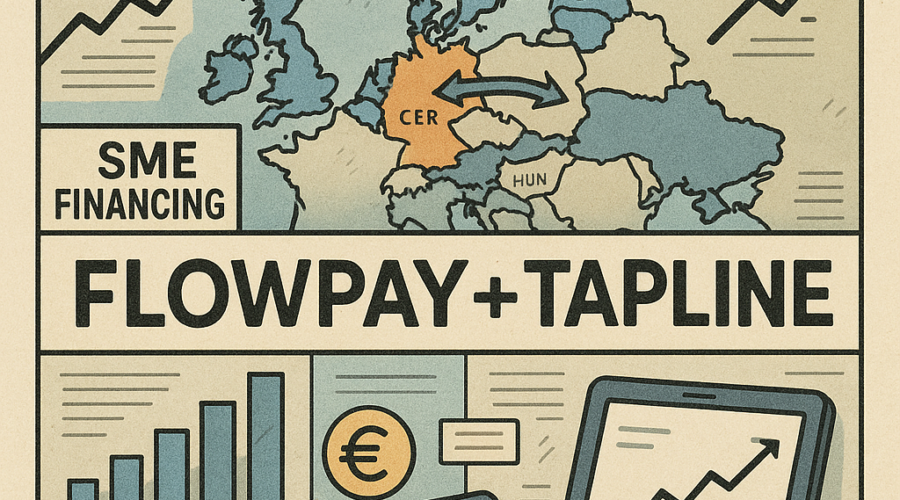
Prague-based Flowpay announced its acquisition of Berlin’s Tapline on March 3, 2026, for undisclosed financial terms. The deal integrates Flowpay’s traditional SME lending with Tapline’s specialized revenue-based financing for SaaS companies, aiming to capture a larger share of the European non-bank lending market. This move allows Flowpay to leverage Tapline’s regulated presence in Germany and the UK to bolster its platform ahead of a new investment round. The transaction exemplifies the fintech M&A trend of acquiring specialized technology and market licenses to accelerate product roadmaps and strengthen competitive positioning.
- Acquirer
- Flowpay
- Target
- Tapline
- Announced Date
- March 3, 2026
- Transaction Type
- Strategic Acquisition
- Financial Terms
- Undisclosed
- Strategic Driver
- Product diversification and expansion into regulated European markets
- Acquirer’s Business
- Flexible short/medium-term financing for traditional SMEs
- Target’s Business
- Non-dilutive, revenue-based financing for SaaS/subscription companies
- Target Geographic Strength
- Regulated presence in Germany and UK
- Acquirer Pre-Deal Financing
- €30 million in debt financing from Fasanara Capital (2025)
Prague-headquartered small business lender Flowpay has executed a strategic acquisition of Berlin-based fintech Tapline, signaling an aggressive expansion strategy across key regulated European markets. The deal, announced on March 3, 2026, consolidates two distinct but complementary financing models under one roof, aiming to capture a larger share of the rapidly expanding SME non-bank financing sector.
Most “AI for Diligence” tools are lying to you. The truth is, they are just chatGPT wrappers. Experience what real AI for Diligence looks like, built like Claude Code, but for M&A/ PE Diligence:
💼 When Claude Code Marries Due Diligence!
While the specific financial terms of the transaction remain undisclosed, the strategic rationale centers on integrating Tapline’s specialized technology and market access with Flowpay’s existing operational capital base. This acquisition is positioned to bolster Flowpay’s platform ahead of an anticipated new investment round.
Integrating Revenue-Based Financing into SME Toolkit
The core value proposition of this merger lies in the product diversification. Flowpay has historically concentrated on providing flexible, short- and medium-term financing, often up to CZK 2.5 million, to traditional SMEs to manage operational needs and seasonality.
Tapline, conversely, specializes in non-dilutive financing for Software-as-a-Service (SaaS) and other subscription-based companies. This model advances capital against future recurring revenues, with repayments dynamically tied to ongoing cash flow—a structure increasingly favored by high-growth, tech-enabled enterprises.
William Jalloul, founder and CEO of Flowpay, stated that the acquisition allows the combined entity to “better address the specific needs of fast-paced, high growth companies.” The plan is for Tapline to initially operate as a standalone product before a gradual integration into the broader Flowpay portfolio, creating a comprehensive offering for the European SME financing ecosystem.
Market Context: Scale in Alternative Lending
The timing of this M&A activity aligns with significant structural shifts in European lending. The German market for SME financing is valued at an annual volume of approximately EUR 100 billion, while the UK market approaches £65 to £90 billion. Alternative, non-bank financing is already capturing between 20 to 30 percent of this total volume, suggesting substantial headroom for scaled fintech players.
For Flowpay, which secured €30 million in debt financing from Fasanara Capital in 2025 to fuel its initial European expansion, this acquisition is a critical step in achieving its scale ambitions. Flowpay has also been recognized for its technology, notably winning Deloitte Technology Fast 50 Central Europe awards for Impact Star and AI Value Driver.
Table 1: Profile Comparison: Flowpay vs. Tapline Strategy
| Feature | Flowpay (Acquirer) | Tapline (Acquired) |
|---|---|---|
| Primary Focus | Short/Medium-term capital for traditional SMEs | Non-dilutive financing for SaaS/Subscription models |
| Financing Basis | Flexible capital based on operational needs | Advancing capital against future recurring revenues |
| Geographic Strength | Czech Republic, initial EU expansion | Strong regulated presence in Germany and UK |
Implications for Deal Advisors and Strategy
This transaction underscores a growing trend in fintech M&A: the acquisition of specialized technology and market licenses over pure asset accumulation. As private equity continues to target the fintech sector—driven by the broader trend of seeking platforms with recurring revenue and potential for digital enablement—strategic acquisitions that immediately plug product gaps, such as revenue-based lending capabilities, become premium assets.
For investment professionals, the deal highlights the value of securing a foothold in highly regulated markets like Germany, where Tapline has established a compliance footing. As general partners in private markets look toward 2026, value creation is increasingly dependent on operating improvements and revenue growth rather than just multiple expansion, making the immediate revenue synergy potential of this combination attractive.
The acquisition of Tapline’s team and technology platform is seen as an immediate enabler for Flowpay to solidify its position before negotiating its next major capital injection, suggesting an astute use of M&A as a bridge to better private equity exit strategies in embedded lending.