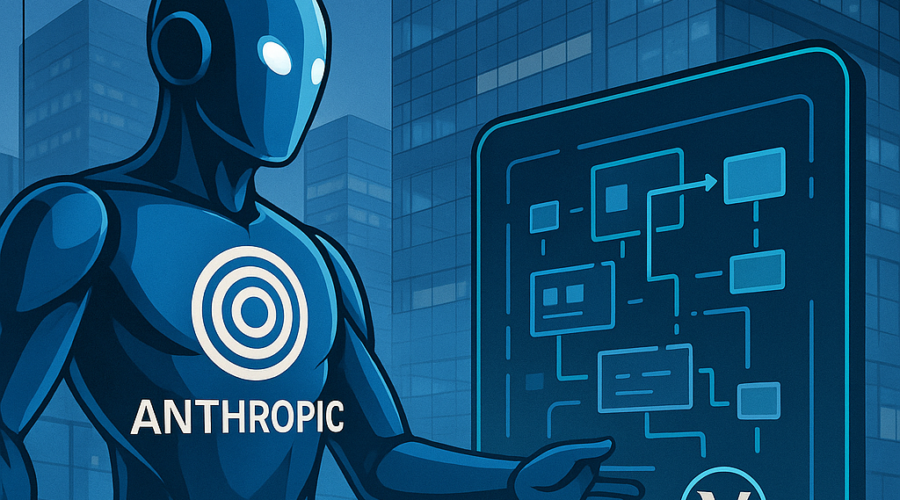
Anthropic acquired Vercept, an AI startup specializing in agentic task automation, with the deal announced on February 26, 2026. While financial terms remain undisclosed, Anthropic secured Vercept’s full team and technology to bolster its Claude model’s capabilities in computer use and autonomous workflows. This acquisition positions Anthropic as a leader in the rapidly evolving AI agent development space, indicating a significant acceleration in enterprise AI agent integration and potential disruption to traditional SaaS and RPA providers.
- Acquirer
- Anthropic
- Target
- Vercept
- Transaction Type
- Acquisition
- Announced Date
- February 26, 2026
- Strategic Driver
- Bolster Claude model’s capabilities in computer use and task automation; advance agentic AI capabilities
- Acquirer Valuation (Post-Funding)
- $380 billion
- Industry Impact (Gartner Forecast 2026)
- 40% of enterprise apps will incorporate AI agents (up from 5% in 2025)
- Key Partners Seeing Stock Gains
- Salesforce, FactSet, DocuSign (4-6%)
- Competitive Landscape
- Intensifying competition in AI agent development; OpenAI partners with BCG and McKinsey; Nvidia eyes $30B stake in OpenAI
- Workforce Impact
- Accenture ties senior promotions to AI tool adoption, 11,000 job cuts linked to AI transitions
Anthropic has acquired Vercept, an AI startup specializing in tools for complex agentic tasks, to bolster its Claude model’s capabilities in computer use and task automation.[1][5][7] The deal, announced February 26, 2026, positions Anthropic amid intensifying competition in **AI agent development** and raises questions about disruptions to traditional software providers.
Most “AI for Diligence” tools are lying to you. The truth is, they are just ChatGPT wrappers. Experience what real AI for Diligence looks like, built like Claude Code, but for M&A/ PE Diligence:
💼 When Claude Code Marries Due Diligence!
Deal Details and Strategic Rationale
Financial terms remain undisclosed, but the acquisition follows Meta’s poaching of a Vercept co-founder, with Anthropic securing the full team and technology.[3] Vercept’s expertise in enabling AI agents to handle multi-step, autonomous workflows aligns with Anthropic’s recent launch of 10 new plugins for Claude, targeting sectors like investment banking, wealth management, and human resources.[2] Partners such as Salesforce, FactSet, and DocuSign saw stock gains of 4-6% on the news, signaling investor optimism for **enterprise AI agent integration**.[2]
Anthropic, valued at $380 billion following recent funding, views the purchase as key to advancing **agentic AI capabilities**—systems that execute actions independently rather than merely advising.[2][5] Gartner forecasts that 40% of enterprise apps will incorporate AI agents by year-end 2026, up from 5% in 2025, underscoring the market shift.[2]
Industry Implications: SaaS Disruption and Workforce Shifts
The move has triggered volatility in automation stocks. UiPath shares fell on the announcement, as investors weigh threats to robotic process automation from agentic AI.[9] Broader concerns label this a potential “SaaSpocalypse,” with Anthropic’s Claude Cowork agent automating tasks traditionally handled by SaaS platforms.[4] Consulting firms like Accenture now tie senior promotions to AI tool adoption, monitoring weekly logins amid 11,000 job cuts linked to AI transitions.[4]
| Sector | Projected Agent Adoption | Reported ROI Lift |
|---|---|---|
| Investment Banking | 35% | 20-40% faster decisions |
| Wealth Management | 30% | 25% higher on initiatives |
| Human Resources | 28% | 15-30% efficiency gains |
[2]
CEOs deploying AI agents report 20-40% faster decisions and up to 25% higher ROI on strategic initiatives, treating agents as decision partners.[2] However, risks loom: insurers highlight errors, cybersecurity gaps, and liability in autonomous systems, while a Cambridge study notes developers under-disclose safety issues.[2]
Competitive Landscape and M&A Trends
Anthropic’s purchase fits a pattern of **AI talent and technology acquisitions**. OpenAI partners with BCG and McKinsey for enterprise AI scaling, while Nvidia eyes a $30 billion stake in OpenAI’s funding round.[1][4] In private equity, AI disruptions threaten software business models, prompting reevaluation of **private equity exit strategies in SaaS** amid valuation pressures.[10] Cross-border M&A trends in 2025-2026 favor AI infrastructure, with Amazon’s $12 billion Louisiana data center expansion exemplifying capital flows.[1]
- Historical Parallels: Gilead’s $7.8 billion Arcellx buy for oncology parallels AI tuck-ins strengthening core tech pipelines.[1]
- Regulatory Risks: U.S. Defense Secretary’s ultimatum to Anthropic signals heightened scrutiny on AI firms.[1]
- Talent War: OpenAI hires Meta’s Ruoming Pang, mirroring Vercept dynamics.[1]
For C-level executives and deal advisors, the Vercept deal accelerates **cross-border M&A trends 2025** in AI agents, demanding governance frameworks to mitigate risks while capturing productivity gains. Enterprise leaders should prioritize agentic AI pilots with robust safety protocols.
Sources
https://americanbazaaronline.com/author/nileena/, https://aiagentstore.ai/ai-agent-news/this-week, https://www.tipranks.com/compare-stocks/amzn-vs-googl, https://economictimes.indiatimes.com/topic/accenture, https://www.newsbytesapp.com/news/business, https://responsiblestatecraft.org/selective-service-draft-2668635702/, https://www.tipranks.com/news/topic/crwv, https://yourstory.com/ai-story/aws-ai-startups-looking-beyond-one-size-fits-all-business-model, https://www.marketbeat.com/stocks/NYSE/PATH/news/, https://www.aol.com/articles/ai-disruption-threat-booming-private-101501032.html, https://intellectia.ai/stock/TSLA, https://news.co.za/science-tech/page/5/, https://internshala.com/jobs/deep-learning-jobs/