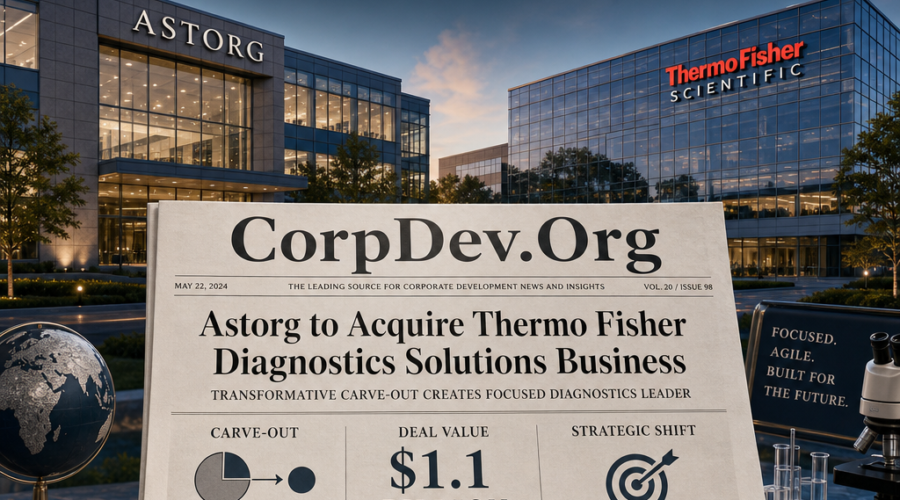
In a definitive move to capitalize on the resilient demand for specialized laboratory testing, European private equity powerhouse Astorg has finalized its acquisition of Thermo Fisher Scientific’s global microbiology business. The $1.075 billion transaction marks the birth of a standalone diagnostics titan, positioned to disrupt the clinical, pharmaceutical, and food safety sectors. This carve-out exemplifies the current cross-border healthcare M&A trends where large-cap life sciences firms shed non-core assets to sharpen their strategic focus.
Most “AI for Diligence” tools are lying to you. The truth is, they are just ChatGPT wrappers. Experience Kai – a Fortune-100 proven AI harness for M&A/ PE Diligence

💼 Purpose-built harness for Due Diligence
The Financial Blueprint: Valuation and Structure
The deal, valued at approximately $1.075 billion, consists of a $1.025 billion cash payment and a $50 million seller note. This valuation represents a significant multiple of the unit’s 2025 revenue, which reached $645 million. For Astorg, the acquisition is a high-conviction bet on a business that already maintains a dominant global footprint, including 13 manufacturing and R&D sites and a workforce of 2,400 professionals.
Table 1: Transaction and Asset Overview
| Metric | Detail |
|---|---|
| Total Enterprise Value | $1.075 Billion |
| 2025 Revenue | $645 Million |
| Global Presence | 100+ Countries; 15,000+ Customers |
| CEO | Dirk Bontridder (Ex-PerkinElmer, Eurofins) |
| Strategic Focus | Microbiology Consumables & Equipment |
Strategic Rationale: From Corporate Division to Agile Independent
The transition from a division within Thermo Fisher—a conglomerate with over $45 billion in annual revenue—to a focused independent platform is the centerpiece of Astorg’s investment thesis. Industry analysts from Bain & Company and Goldman Sachs have noted that private equity healthcare carve-out strategies in 2026 are increasingly targeting “orphaned” divisions that can thrive with dedicated capital and a specialized management team.
By operating independently, the new entity avoids the internal competition for resources common in large-cap firms. Astorg plans to accelerate R&D cycles and expand the company’s presence in emerging markets, where food safety and clinical diagnostic infrastructure are seeing rapid investment. The “entrepreneurial and hands-on partnership model” cited by Judith Charpentier, Astorg’s Head of Healthcare, suggests a period of aggressive buy-and-build activity likely to follow in 2027.
Leadership and Governance
The appointment of Dirk Bontridder as CEO signals a “safe pair of hands” for institutional investors. Bontridder’s background is a pedigree in diagnostics management, having previously led PerkinElmer through a similar transformation and held executive roles at Eurofins Scientific. His McKinsey-honed strategic rigor is expected to guide the company through the complex operational separation from Thermo Fisher’s legacy systems.
A new corporate identity and brand launch are slated for late 2026, a move intended to decouple the business from the Thermo Fisher umbrella and establish a distinct market position. This rebranding is critical for client retention in life sciences M&A, as the company seeks to maintain continuity for its 15,000-strong customer base while signaling a new era of innovation.
Market Outlook: The Resurgence of Diagnostics
The global microbiology market is entering a phase of renewed growth, driven by the increasing complexity of antimicrobial resistance (AMR) and stringent food safety regulations. As pharmaceutical companies increase their focus on biologics, the demand for sterile manufacturing and microbiological testing has reached an inflection point.
For deal advisors and C-level executives, this transaction underscores a broader diagnostics M&A outlook where scale is being traded for specialization. Strategic acquirers like Thermo Fisher are refining their portfolios to focus on high-margin digital workflows and proteomics, leaving a vacuum in traditional laboratory tools that private equity is eager to fill. The life sciences carve-out valuation seen here suggests that even in a disciplined interest rate environment, high-quality, cash-flow-positive diagnostic assets command a premium.
Key Implications for Industry Stakeholders:
- For Competitors: Expect the new Astorg-backed entity to be more nimble in product development and customer acquisition, potentially challenging the market share of established players like bioMérieux.
- For Investors: This deal highlights the viability of mid-market carve-outs as a primary source of alpha in healthcare, provided there is a clear path to technological modernization.
- For Customers: The immediate priority remains operational continuity, but the injection of Astorg’s capital suggests a modernized product pipeline in the medium term.
As the new company moves toward its formal brand reveal later this year, the industry will watch closely to see if this independent platform can outpace its former parent’s growth trajectory. In the high-stakes world of private equity exit strategies in healthcare, the success of this carve-out will likely serve as a blueprint for future divestitures in the specialty diagnostics space.