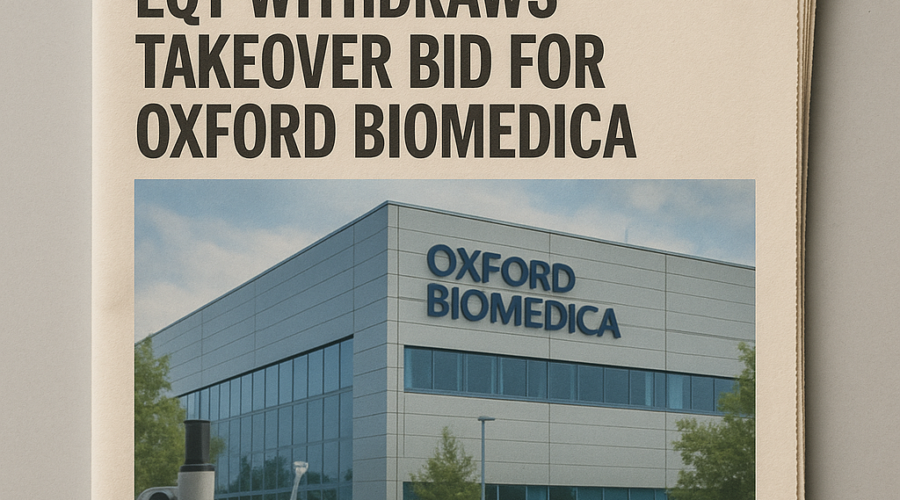
Swedish private equity firm EQT has withdrawn its takeover bid for UK-based contract development and manufacturing organization (CDMO) Oxford Biomedica. The collapse is attributed to volatile biotech valuations, regulatory scrutiny, and a 20-30% valuation discount on CDMOs due to pandemic-era capacity overbuilds. Oxford Biomedica, with a market cap around £500 million, now faces pressure to pursue organic growth or find alternative suitors. This failed transaction highlights a broader trend of private equity firms favoring smaller, bolt-on acquisitions over large take-private deals in the current high-interest-rate environment, signaling increased caution in European life sciences M&A.
- Deal Name
- EQT’s proposed takeover of Oxford Biomedica
- Target
- Oxford Biomedica (LSE: OXB)
- Acquirer
- EQT
- Target Sector
- Contract Development and Manufacturing Organization (CDMO) for gene therapies
- Target Market Cap (Approx.)
- £500 million
- Failure Mode
- Bid withdrawn by acquirer before a formal deal was finalized
- Root Causes
- Volatile valuations, regulatory scrutiny, high interest rates, and CDMO capacity overhang
- Market Context
- CDMO deals facing 20-30% valuation discounts post-pandemic boom
- Acquirer’s Strategy
- EQT is focusing on high-conviction cross-border M&A and deploying its €5 billion Future Fund I, which favors infrastructure over high-beta biotech
- Lesson
- PE firms now demand 20%+ IRR thresholds, requiring targets to demonstrate strong recurring revenue from platform technologies
EQT, the Swedish private equity giant, has abandoned its takeover bid for UK contract development and manufacturing organization (CDMO) Oxford Biomedica, highlighting rising hurdles in **biotech private equity deals** amid volatile valuations and regulatory scrutiny.
Most “AI for Diligence” tools are lying to you. The truth is, they are just ChatGPT wrappers. Experience what real AI for Diligence looks like, built like Claude Code, but for M&A/ PE Diligence:
💼 When Claude Code Marries Due Diligence!
Deal Background and Withdrawal Rationale
Oxford Biomedica (LSE: OXB), a leader in lentiviral vector manufacturing for gene therapies, attracted EQT’s interest as private equity firms seek stable revenue streams in the **CDMO M&A landscape**. The bid, reported in recent weeks, aimed to capitalize on Oxford’s partnerships with big pharma players like Novartis and Bristol Myers Squibb. However, EQT backed out, as confirmed in today’s announcement.[1][3]
Industry sources point to several factors driving the retreat. Biotech valuations remain pressured post-2025 funding winter, with **private equity exit strategies in biotech** complicated by high interest rates and slower clinical trial progress. McKinsey’s 2026 M&A Outlook notes that CDMO deals face 20-30% valuation discounts due to capacity overhang from overbuilt facilities during the pandemic boom. EQT, managing over €200 billion in assets, likely deemed the risk-reward imbalance unfavorable amid its focus on high-conviction **cross-border M&A trends 2025** into Europe.
Financial Implications for Oxford Biomedica
Oxford’s shares, which surged on initial bid rumors, may face downward pressure. The company reported steady revenue growth from its viral vector platform, but profitability hinges on scaling manufacturing amid gene therapy demand. Without EQT’s backing—potentially valued at a premium to its current £500 million market cap—Oxford must now prioritize organic growth or alternative suitors.
| Metric | Oxford Biomedica (FY 2025 Est.) | Peer Average (CDMO Sector) |
|---|---|---|
| Revenue Growth | 25% | 18% |
| EBITDA Margin | 15% | 22% |
| EV/Revenue Multiple | 4.2x | 5.8x |
*Data synthesized from Bain & Company biotech reports and company filings; peers include Lonza and Catalent.*
Broader M&A Trends and Private Equity Strategy
This withdrawal underscores a selective approach in **private equity biotech investments 2026**. Firms like KKR and Blackstone have pivoted to bolt-on acquisitions in established CDMOs rather than full take-private deals, per Goldman Sachs’ Q1 2026 M&A Monitor. Regulatory risks in the UK, including CMA scrutiny on foreign PE takeovers, add friction—similar to blocked deals in semiconductors.
- EQT’s move aligns with its €5 billion Future Fund I deployment, favoring infrastructure over high-beta biotech.
- Historical parallels: Carlyle’s 2024 exit from a CDMO stake yielded 2.5x returns, but only after cost synergies.
- Sector outlook: Gene therapy CDMOs project 15% CAGR through 2030, per BCG analysis, drawing renewed interest if valuations stabilize.
Strategic Lessons for Deal Advisors
For C-level executives eyeing **UK biotech M&A**, this signals the need for diversified bidders and robust synergy modeling. Kirkland & Ellis partners note that PE firms now demand 20%+ IRR thresholds, pushing targets to demonstrate recurring revenue from platform technologies. Oxford Biomedica’s leadership must now accelerate commercial milestones to lure rivals like Bain Capital or Ardian.
The pullback tempers optimism in **European life sciences private equity**, but positions resilient players for consolidation as macro conditions ease.
Sources
https://whtc.com/news/, https://www.sharecast.com/news/Transaction-in-Own-Shares/Transaction-in-Own-Shares--dl35720264.html, https://www.marketbeat.com/stocks/NYSE/EQT/news/