
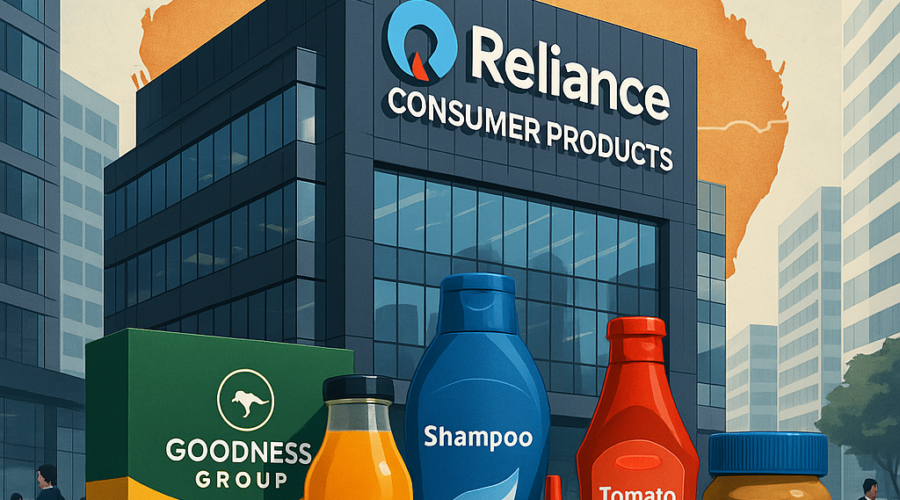
Reliance Consumer Products Limited (RCPL) has acquired a majority stake in Australia’s Goodness Group Global, marking a significant cross-border expansion into the Asia-Pacific beverage and consumer goods sector. This acquisition aligns with Reliance Industries’ broader strategy to diversify its consumer portfolio beyond India, leveraging Goodness Group’s established market access and distribution in a developed economy. RCPL plans to expand the acquired brands’ reach across new channels and geographies, applying a proven playbook of scaling local champions internationally. The transaction underscores the continued appetite among large conglomerates for strategic consumer goods acquisitions in developed markets, signaling a trend towards global diversification and competition with multinational players.
- Acquirer
- Reliance Consumer Products Limited (RCPL)
- Target
- Goodness Group Global (Australia)
- Transaction Type
- Majority Stake Acquisition
- Strategic Driver
- International expansion into Asia-Pacific beverage and consumer goods; diversification beyond India
- Acquirer Parent Company
- Reliance Industries
- Market Entered
- Australian beverage and consumer products market
- Acquirer’s Capital Increase
- Reliance Consumer Products’ authorized share capital raised to Rs 10,000 crore
- Acquirer’s Domestic Strategy
- Acquiring regional and niche brands (e.g., Udhaiyams Agro Foods) and scaling them
- Acquirer’s Domestic Success Example
- Campa Cola achieving double-digit market share in many Indian states
null
Reliance Consumer Products Limited (RCPL) has acquired a majority stake in Australia’s Goodness Group Global, marking the Indian conglomerate’s strategic expansion into the Asia-Pacific beverage and consumer goods sector.[1][2][3] The deal represents RCPL’s latest move to diversify its consumer portfolio beyond India’s domestic market and compete with established multinational players in international markets.
Most “AI for Diligence” tools are lying to you. The truth is, they are just ChatGPT wrappers. Experience what real AI for Diligence looks like, built like Claude Code, but for M&A/ PE Diligence:
💼 When Claude Code Marries Due Diligence!
Strategic Rationale and Market Positioning
The acquisition aligns with Reliance Industries’ broader consumer goods expansion strategy. Parent company Reliance Industries has significantly increased its focus on the FMCG sector, raising Reliance Consumer Products’ authorized share capital to Rs 10,000 crore to fund aggressive expansion initiatives.[3] This cross-border M&A activity reflects a deliberate shift toward building a globally competitive consumer portfolio.
Goodness Group Global operates in the Australian beverage and consumer products market, where RCPL previously had limited presence. By acquiring the company, Reliance gains immediate market access, established distribution networks, and recognized brand equity in a developed economy with high consumer spending power. The move positions RCPL to leverage Goodness Group’s regional expertise while applying Reliance’s operational scale and capital resources.
Expansion of RCPL’s International Footprint
This Australian acquisition follows RCPL’s recent domestic acquisitions, including a majority stake in Udhaiyams Agro Foods, a 30-year-old player in staples, pulses, and breakfast products.[3] The company’s strategy centers on acquiring regional and niche brands with established market positions, then scaling them through Reliance’s distribution and manufacturing infrastructure.
As part of the partnership, Reliance Consumer plans to expand the reach of Goodness Group’s brands across new channels and geographies.[7] This playbook—acquiring local champions and then amplifying their distribution—has proven effective in India’s fragmented FMCG market and is now being applied internationally.
Broader Context: Reliance’s Consumer Ambitions
The Goodness Group acquisition occurs within a period of significant leadership and strategic evolution at Reliance. In her first major public appearance as Executive Director, Isha Ambani highlighted the company’s expansion plans across petrochemicals, bioenergy, and green hydrogen, signaling a multi-pronged growth strategy across consumer and industrial segments.[5] Reliance Retail, the group’s retail arm, has also committed to passing on benefits of lower tax rates to customers across all consumption baskets, indicating aggressive market share capture in consumer categories.
Reliance’s consumer strategy extends beyond traditional FMCG. The company has achieved notable success with Campa Cola, which now holds double-digit market share across many Indian states, breaking a 30-year multinational duopoly.[5] This domestic success provides a template for international expansion, where Reliance can apply similar playbooks to acquired brands.
Implications for Private Equity and M&A in Consumer Goods
The deal signals continued appetite among large conglomerates for consumer goods acquisitions in developed markets. Cross-border M&A in the FMCG sector has accelerated as Indian companies seek to diversify revenue streams and reduce domestic market concentration risk. The Australian market, with its mature consumer base and regulatory stability, represents an attractive entry point for Indian acquirers seeking international expansion.
For deal advisors and investment professionals, the transaction underscores the strategic value of regional consumer brands with established distribution networks. Goodness Group’s market position in Australia likely commanded a premium valuation, reflecting the cost of acquiring immediate market access versus organic entry. This acquisition model—buying established players rather than building from scratch—has become standard practice for Indian conglomerates pursuing international consumer goods strategies.
Operational Integration and Synergy Potential
Integration of Goodness Group into RCPL’s operations will likely focus on three areas: leveraging Reliance’s manufacturing and supply chain capabilities to improve margins; applying digital and e-commerce expertise to expand direct-to-consumer channels; and potentially introducing Indian consumer products to Australian consumers through Goodness Group’s distribution network.
The acquisition also positions RCPL to benefit from India-Australia trade dynamics. As bilateral trade relationships strengthen and tariff frameworks evolve, Reliance may explore opportunities to source products from India or export Australian-made goods to Asian markets, creating additional synergy value.
Market Context and Timing
The acquisition arrives as RCPL accelerates its transformation into a diversified consumer goods conglomerate. Recent GST rate reductions in India have driven FMCG volume growth of 9-10% in the October-December period, signaling renewed consumer demand.[3] However, this domestic momentum alone does not explain Reliance’s international push; the company is clearly pursuing a long-term strategy to build a globally scaled consumer business capable of competing with multinational giants like Procter & Gamble and Unilever.
For institutional investors and deal professionals tracking private equity exit strategies in consumer goods and cross-border M&A trends in 2026, the Goodness Group acquisition demonstrates that large conglomerates remain active acquirers in the sector, willing to pay for established market positions and brand equity in developed economies.
“`
Sources
https://www.aninews.in/topic/australia/, https://www.business-standard.com, https://economictimes.indiatimes.com/topic/fmcg, https://www.post-gazette.com, https://www.business-standard.com/markets/reliance-industries-ltd-share-price-476/news, https://money.rediff.com/news/source/pti, https://www.thestatesman.com, https://www.axs.com, https://money.rediff.com/news/latest, https://ground.news/interest/zurich