
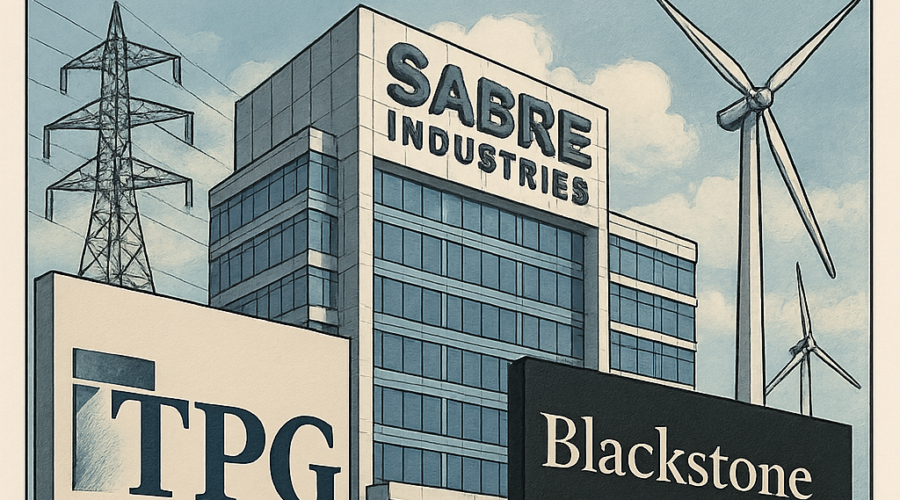
TPG Rise Climate has signed definitive agreements to acquire a majority stake in Sabre Industries, Inc., a provider of steel structures for utility, telecommunications, and renewable energy infrastructure, from Blackstone Energy Transition Partners. Blackstone will retain a minority stake in the company. This transaction underscores a strategic shift in private equity energy transition strategies towards scalable industrial platforms, driven by federal incentives like the Inflation Reduction Act. TPG’s investment bolsters its sustainable infrastructure M&A portfolio, capitalizing on projected global clean energy capital expenditures through 2030.
- Acquirer
- TPG (via TPG Rise Climate)
- Target
- Sabre Industries, Inc.
- Seller
- Blackstone Energy Transition Partners
- Transaction Type
- Majority Stake Acquisition
- Seller’s Retained Stake
- Minority stake
- Target’s Business
- Provider of steel structures for utility, telecommunications, and renewable energy infrastructure
- Target Headquarters
- Alvarado, Texas
- Strategic Driver
- Energy transition, grid modernization, renewable energy infrastructure, U.S. electrification trends
- Deal Terms
- Undisclosed
TPG has signed definitive agreements to acquire a majority stake in Sabre Industries, Inc., a provider of steel structures for utility, telecommunications, and renewable energy infrastructure, from funds managed by Blackstone Energy Transition Partners.[2] Blackstone, which first invested in Sabre in 2021, will retain a minority stake in the company.[2]
Most “AI for Diligence” tools are lying to you. The truth is, they are just ChatGPT wrappers. Experience what real AI for Diligence looks like, built like Claude Code, but for M&A/ PE Diligence:
💼 When Claude Code Marries Due Diligence!
Deal Rationale and Climate Investment Focus
TPG will deploy capital through TPG Rise Climate, its dedicated climate investing platform targeting energy transition opportunities.[2] Sabre supports critical infrastructure for renewables, including wind, solar, and battery storage projects, aligning with rising demand for **grid modernization** and **renewable energy infrastructure** amid U.S. electrification trends.[2] The transaction reflects **private equity energy transition strategies** shifting toward scalable industrial platforms as federal incentives like the Inflation Reduction Act drive utility-scale deployments.
Company Background and Market Position
Headquartered in Alvarado, Texas, Sabre manufactures steel poles, towers, and structures essential for transmission lines, cell sites, and clean energy facilities.[2] Since Blackstone’s 2021 entry, Sabre has expanded capacity to meet surging orders from data center buildouts and offshore wind farms, positioning it within **cross-border M&A trends 2025** favoring North American supply chain resilience.[1][2] TPG’s involvement signals continued rotation into **private equity infrastructure investments** as valuations stabilize post-2024 volatility.
Financial Terms and Strategic Implications
Deal terms, including valuation, remain undisclosed, consistent with private **energy transition PE deals** where enterprise values often range 10-15x EBITDA for high-growth industrials.[1] Blackstone’s exit via secondary sale allows partial liquidity while maintaining exposure, a common tactic in **private equity exit strategies** for climate assets.[1][2] For TPG, the acquisition bolsters its Rise Climate portfolio, which emphasizes **sustainable infrastructure M&A** amid projections for $2 trillion in global clean energy capex through 2030.
| Metric | 2025 | 2026* |
|---|---|---|
| Net Sales | 15.85B | 21.69B |
| Enterprise Value | 108B | 148B |
| P/E Ratio | 27.7x | 20x |
| Yield | 3.08% | 4.31% |
[1]
Industry Context and Comparable Deals
The deal underscores **M&A trends in renewable infrastructure 2026**, with PE firms like KKR and Blackstone doubling down on energy transition via partnerships and stake rotations.[3] Comparable transactions include KKR’s A$600m energy transition partnership with HMC, targeting similar grid and renewables exposure.[3] Regulatory tailwinds, including FERC transmission reforms, favor Sabre’s positioning, though supply chain bottlenecks pose execution risks for **utility infrastructure private equity** plays.
- Blackstone’s retained stake ensures alignment on growth execution.[2]
- TPG gains entree into **steel structures for EV charging networks** and 5G rollout.[2]
- Broader implications for **PE secondaries in climate tech**, recycling capital into higher-beta assets.[1]
Completion is subject to customary closing conditions, with announcements from Alvarado, San Francisco, Fort Worth, and New York highlighting cross-regional momentum in **U.S. energy transition M&A**.[2]
Sources
https://www.marketscreener.com/quote/stock/BLACKSTONE-INC-60951400/, https://www.businesswire.com/newsroom/industry/professional-services/asset-management, https://www.businesswire.com/newsroom?industry=1778680, https://www.actian.com/databases/vector-ai-db/, https://internshala.com/jobs/hospitality-jobs/