
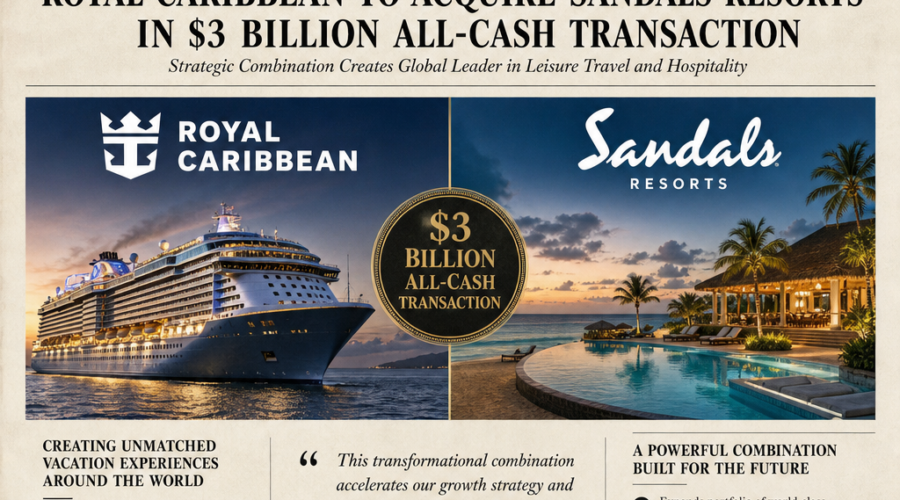
Royal Caribbean Group agreed on September 23, 2026, to purchase a 50% equity stake in Sandals Resorts International for $3 billion, creating a joint venture that values the all-inclusive resort company at $6 billion. The transaction represents the largest deal in Royal Caribbean history, exceeding its 2020 full buyout of Silversea Cruises. The agreement establishes shared ownership of Sandals Resorts and Beaches Resorts alongside the heirs of founder Gordon “Butch” Stewart, transferring 20 luxury resort properties across eight island nations into a combined ecosystem linking open-sea passenger itineraries directly to land assets.
The transaction reveals how operators at the top of the global leisure sector are dismantling the historical division between maritime cruising and fixed terrestrial hospitality. Cruise lines face rigid drydock delivery timetables, constrained berth slots at popular ports, and intensifying local environmental fees in marquee Caribbean stops. By securing physical territory across St. Lucia, Jamaica, Barbados, and the Bahamas, Royal Caribbean secures captive destinations that eliminate cruise terminal docking dependencies, converting sea travelers into year-round resort guests while insulating the parent company from regional port restrictions.

The acquisition values Sandals Resorts International at approximately 10 times forward earnings before interest, taxes, depreciation, and amortization, bringing roughly 20,000 regional resort staff and 7,400 rooms under partial corporate governance from Miami. Royal Caribbean shares fell 6.1% on the New York Stock Exchange following reports of the transaction, reflecting investor calculation over corporate debt absorption. Wall Street faces the immediate question of whether capital allocated toward fixed hotel assets yields returns that match the 20% return on invested capital generated by modern mega-class cruise vessels.
Financial structure and family estate resolution
Under the definitive purchase agreement, Royal Caribbean will contribute $3 billion in cash and debt financing into a newly formed operating vehicle. The Stewart family, led by executive chairman Adam Stewart, will retain the remaining 50% equity interest. The transaction brings resolution to five years of succession and estate uncertainty following the 2021 death of Gordon “Butch” Stewart. The founder’s death triggered intra-family litigation across Caribbean and European trust jurisdictions regarding dividend distributions, voting trust structures, and eventual liquidity for separate branches of heirs.
Advisory teams from JPMorgan Chase and Goldman Sachs structured the transaction to leave property-level operations in the hands of current Sandals management. The structure includes reciprocal governance rights, equally apportioned board representation, and defined buyout triggers that permit Royal Caribbean to purchase the remaining 50% equity stake after a multi-year performance period.
Balance sheet impact and debt absorption
Royal Caribbean entered the deal from a position of relative post-pandemic operational strength, backed by a market capitalization of $62 billion. Even so, the cash outlay adds financial leverage to a corporate ledger that carries $19.8 billion in long-term debt stemming from pandemic survival loans and fleet expansion programs. Jason Liberty, chief executive officer of Royal Caribbean, stated that cash generated from record 2025 and 2026 passenger ticket yields will service transaction liabilities without delaying future ship construction schedules.
Credit rating agencies noted that the capital deployment targets unencumbered land real estate. Unlike cruise ships, which depreciate over 30-year operational cycles and require costly propulsion modernizations, beachfront hotel land holdings in Antigua, Grenada, and Jamaica retain long-term salvage and balance-sheet terminal values.
| Metric | Royal Caribbean Group | Sandals Resorts International | Combined Entity Pro Forma |
|---|---|---|---|
| Enterprise Valuation | $81.8 Billion | $6.0 Billion | $87.8 Billion |
| Annual Guest Capacity | 8.7 Million Passengers | 1.1 Million Guests | 9.8 Million Customers |
| Operating Inventory | 71 Vessels | 20 Luxury Resorts | 91 Sea and Land Assets |
| Workforce Count | 102,000 Employees | 20,000 Employees | 122,000 Employees |
Fleet saturation drives landward consolidation
The deal reflects broader cross-border hospitality M&A trends where ocean-going capacity faces practical geographic limits. Cruise passenger traffic to Nassau, Cozumel, and Roatan reached record volumes between 2023 and 2025, driving local governments to pass daytime head taxes and consider hourly limits on cruise debarkation. Royal Caribbean responded initially by building self-contained private destinations, such as Perfect Day at CocoCay in the Bahamas and its upcoming Royal Beach Club developments.
Acquiring a joint ownership position in Sandals accelerates that landward movement. Bain & Company hospitality data shows that 38% of all cruise passengers subsequently book an all-inclusive resort stay within 36 months of a maritime vacation. Retaining those travelers inside the same operating perimeter recaptures marketing expenditures that Royal Caribbean historically forfeited to land-based resort chains like Hyatt Hotels and Melia Hotels International.
Corporate governance and commercial operations
The joint venture will preserve separate operating footprints for cruise operations and resort management. Adam Stewart remains executive chairman of Sandals Resorts International, supervising day-to-day resort service, guest culinary programs, and local Caribbean vendor contracting. Royal Caribbean will integrate resort reservations into its proprietary digital booking engine and passenger app, which handles millions of vacation transactions each quarter.
Commercial priorities center on two initiatives:
- Direct integration between the Royal Caribbean Club Royale loyalty program and Sandals Select Rewards, linking 40 million combined traveler profiles.
- Hybrid vacation packages bundling four-night voyages out of PortMiami or Port Everglades with three-night stays at Jamaican or Bahamian Sandals properties.
- Joint procurement programs for aviation charters, maritime food distribution, and regional Caribbean fuel supplies.
- Co-development of new all-inclusive properties under the family-focused Beaches brand on undeveloped parcels already owned by Sandals in Saint Ann Parish, Jamaica.
Antitrust and regulatory approvals
The transaction requires review from antitrust regulators and government investment boards in five Caribbean jurisdictions, including the Jamaican Fair Trading Commission and the Eastern Caribbean Competition Commission. Regulators will examine regional labor retention and local vendor market access. Royal Caribbean confirmed it will maintain existing local employment agreements, preserving hotel staff operational autonomy. Closing procedures and regulatory filings will extend into the first half of 2027.