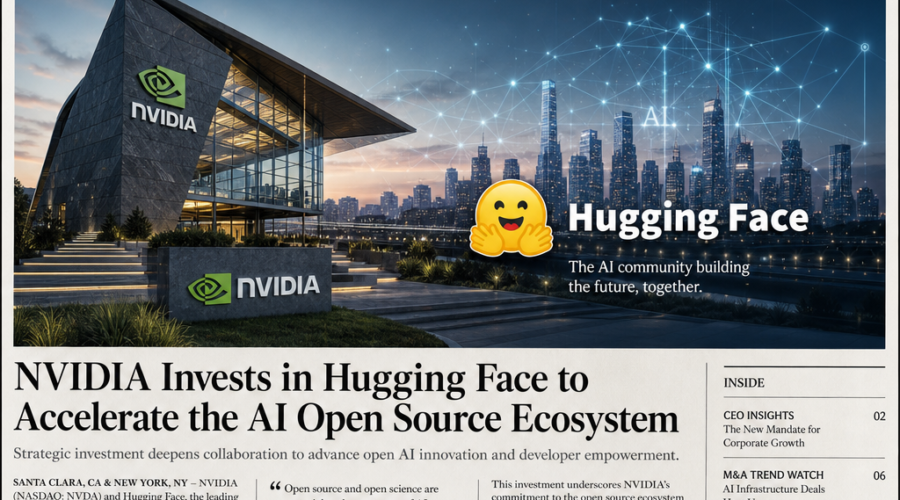
Nvidia Corp. has reached a definitive agreement to acquire Hugging Face, the preeminent platform for open-source artificial intelligence development, in a deal valued at $12.9 billion. Announced on September 3, 2026, the transaction represents a pivotal expansion of Nvidia’s strategy to transition from a merchant silicon provider to a vertically integrated sovereign of the global AI stack. By absorbing the “GitHub of AI,” Nvidia secures control over the primary repository where millions of developers build, share, and deploy machine learning models, effectively capturing the top of the funnel for hardware demand and software implementation across the enterprise landscape.
The strategic thesis behind this acquisition reflects a fundamental shift in the AI industry from raw model performance toward distribution and workflow orchestration. For years, Hugging Face maintained a position as the neutral ground of the AI community, facilitating model interoperability across various hardware architectures, including those of Nvidia’s rivals like AMD, Intel, and Google. By bringing this community under its corporate umbrella, Nvidia aims to create a “frictionless loop” where software development on the Hugging Face platform is natively optimized for Nvidia’s proprietary CUDA architecture, further widening its competitive moat and complicating the efforts of competitors to gain a foothold in the developer ecosystem.
Financial analysts point to the aggressive valuation—nearly triple the target’s 2023 private market assessment—as a clear signal of the premium placed on community-driven “platform plays” in the current high-interest-rate environment. Hugging Face currently hosts over 1.8 million models and datasets, but the true value lies in the 65 million monthly library downloads that dictate how global compute resources are utilized. This transaction raises a critical question for the industry: can Nvidia preserve the agnostic spirit of open-source collaboration that fueled Hugging Face’s growth, or will this deal spark a mass migration of developers toward decentralized alternatives to avoid vendor lock-in?
The Shift to Vertical Integration in AI Infrastructure
Nvidia’s acquisition of Hugging Face is the clearest evidence yet that the semiconductor industry is moving toward a software-first approach. In the 2026 market, selling H100 or B200 chips is no longer sufficient; the goal is to control the software environments where those chips are utilized. By integrating Hugging Face with its own AI Enterprise software suite, Nvidia is positioning itself to manage the entire lifecycle of AI development, from data ingestion to model inference.
This move mirrors historic software-hardware integrations, such as Apple’s control over the iOS ecosystem to drive iPhone sales. For Nvidia, the priority is ensuring that the “Transformers” library—the backbone of modern LLMs—is always one step ahead in terms of performance on Nvidia hardware. This strategy of AI infrastructure consolidation ensures that even as hardware becomes more commoditized, the software layer remains a proprietary gateway.
Strategic Rationale: Beyond the GPU
The deal addresses several core strategic needs for Nvidia as it faces increasing pressure from hyperscalers (Amazon, Google, and Microsoft) developing their own custom silicon. By owning the community platform, Nvidia gains:
- Unmatched Telemetry: Real-time data on which model architectures are gaining traction, allowing Nvidia to tailor future chip designs to the specific mathematical requirements of next-generation AI.
- Developer Lock-in: Direct integration of Nvidia’s NIM (Nvidia Inference Microservices) into the Hugging Face workflow, making it the default choice for enterprise AI deployment strategies.
- Monetization of Open Source: Converting the massive, free user base of Hugging Face into paid subscribers for high-performance hosted compute and “Enterprise Hub” features.
Comparative Valuation: The Premium for Ecosystem Control
At $12.9 billion, the acquisition is priced for perfection, reflecting the scarcity of platforms that command significant developer mindshare. The following table illustrates how this transaction compares to other landmark acquisitions in the developer and infrastructure space:
| Acquirer | Target | Deal Value | Strategic Objective |
|---|---|---|---|
| Microsoft | GitHub (2018) | $7.5 Billion | Developer Mindshare / Cloud Pull-through |
| IBM | Red Hat (2019) | $34.0 Billion | Hybrid Cloud Dominance |
| Nvidia | Hugging Face (2026) | $12.9 Billion | AI Workflow Sovereignty |
Regulatory Hurdles and Competition Risks
The deal is expected to face intense scrutiny from the Federal Trade Commission (FTC) and the European Commission. Regulators have expressed growing concern regarding vertical integration in the semiconductor industry, particularly when a dominant hardware player acquires a critical software bottleneck. The central concern will be “foreclosure”—the possibility that Nvidia could degrade the performance of Hugging Face libraries when used with non-Nvidia hardware, such as AMD’s MI300 series or Google’s TPUs.
Competitors are already reacting. Industry insiders suggest that a consortium led by Intel, AMD, and Meta may increase funding for the “PyTorch Foundation” and other decentralized model hubs to ensure that open-source AI remains truly hardware-agnostic. The risk for Nvidia is that a “walled garden” approach could alienate the very developers who made Hugging Face valuable in the first place.
Implications for Private Equity and Venture Capital
For the broader investment community, this exit marks a milestone in private equity exit strategies in SaaS and AI. It validates the high-growth, high-burn model of community-first platforms that prioritize user adoption over immediate profitability. Deal advisors expect this to trigger a wave of “catch-up” M&A, with second-tier chipmakers and cloud providers looking to acquire remaining independent AI software layers to avoid being boxed out of the developer workflow.
As cross-border M&A trends 2026 continue to favor platforms with deep integrated moats, the Nvidia-Hugging Face deal will likely be remembered as the moment the AI industry matured from an era of experimental openness to one of strategic consolidation and corporate control. For C-level executives, the message is clear: the value in AI is migrating from the model itself to the platform that hosts it and the hardware that runs it.