
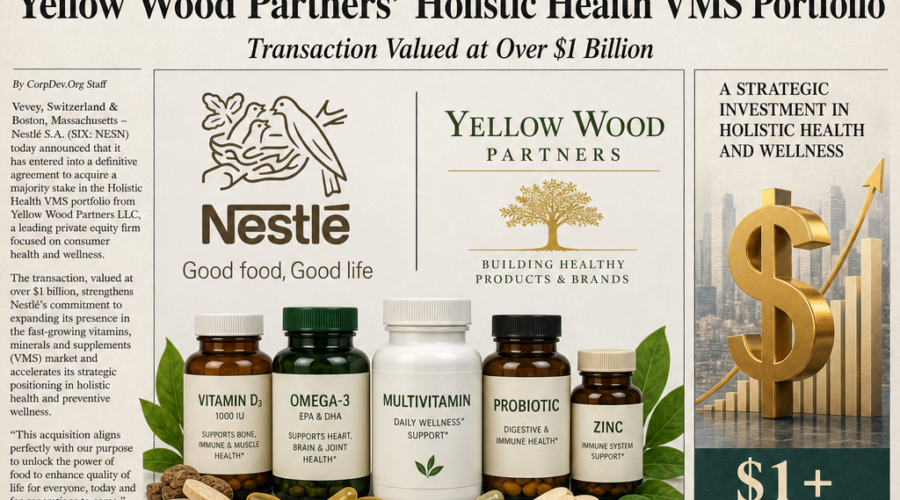
In a decisive move to refine its high-growth health science strategy, Nestlé S.A. has entered into a definitive agreement to divest its mainstream vitamins, minerals, and supplements (VMS) business to Boston-based private equity firm Yellow Wood Partners for $1.0 billion. Announced on September 1, 2026, the transaction signals a significant pivot for the Swiss consumer giant as it retreats from the mass-market nutrition segment to prioritize premium, science-led health platforms.
Most “AI for Diligence” tools are lying to you. The truth is, they are just ChatGPT wrappers. Experience Kai – a Fortune-100 proven AI harness for M&A/ PE Diligence

💼 Purpose-built harness for Due Diligence
Strategic Rationale: Portfolio Coherence and the ‘Better Owner’ Principle
The divestiture, expected to close in the first half of 2027, marks a major step in the structural overhaul led by Nestlé CEO Philipp Navratil. Since taking the helm in late 2025, Navratil has aggressively pruned the company’s portfolio—including high-profile joint ventures for its water and ice cream businesses—to focus on four global powerhouses: Coffee, Petcare, Nutrition, and Food & Snacks.
For Nestlé, the sale of the “Holistic Health” portfolio resolves a strategic mismatch. While the mainstream VMS brands—including Nature’s Bounty and Puritan’s Pride—remain household names, their reliance on mass retail and price-sensitive consumers clashed with Nestlé Health Science’s objective of leading in clinical, high-margin, and science-backed medical nutrition. By offloading these assets, Nestlé retains its “crown jewel” premium brands, Solgar and Pure Encapsulations, which continue to see robust demand among healthcare professionals and high-end wellness consumers.
Key Deal Terms and Portfolio Scope
The $1.0 billion deal covers seven established brands and a substantial operational footprint in the United States, Canada, and China. In 2025, this business segment generated approximately $1.2 billion in sales, suggesting a valuation multiple of roughly 0.8x revenue—a reflection of the mature, competitive nature of mainstream VMS compared to the 3.1x sales multiple Nestlé paid when it originally acquired these brands as part of the $5.75 billion Bountiful Company deal in 2021.
- Divested Brands: Nature’s Bounty, Osteo Bi-Flex, Ester-C, Gard, Nuun, Puritan’s Pride, and Sisu.
- Infrastructure: The sale includes Nestlé’s U.S. private-label supplements business and dedicated manufacturing, packaging, and distribution facilities.
- Financials: $1.0 billion cash consideration for operations that generated $1.2 billion in 2025 revenue.
The Yellow Wood Playbook: Mastering the Corporate Carve-Out
For Yellow Wood Partners, this acquisition reinforces its reputation as a preferred partner for global conglomerates looking to shed non-core assets. This marks the firm’s sixth significant carve-out since 2019, following successful deals for ChapStick (from Haleon) and Elida Beauty (from Unilever). Yellow Wood’s “Consumer Operating DNA” model is designed specifically to reinvigorate brands that have historically lacked internal prioritization within larger corporate structures.
“The Holistic Health portfolio provides a group of specialty category leaders in various high-growth sectors, including hydration, gut health, and immunity,” said Dana Schmaltz, Partner at Yellow Wood. The firm intends to operate the platform as a standalone entity, leveraging its functional expertise to accelerate product innovation and strengthen retailer relationships in an increasingly fragmented wellness market.
Market Context: 2026 Trends in Consumer Health M&A
The transaction occurs amidst a broader reconfiguration of the nutraceutical and supplement M&A market. As we move through the second half of 2026, several key trends are driving deal activity:
| Market Driver | Strategic Impact |
|---|---|
| Premiumization | Corporates are divesting “value” brands to invest in science-led VMS and personalized nutrition. |
| Functional Convergence | Rising demand for multi-benefit solutions (e.g., gut health + immunity) is favoring focused, agile owners. |
| GLP-1 Influence | The rise of weight-loss medications is shifting demand toward targeted nutritional support, a niche Nestlé aims to lead. |
| PE Exit Strategies in SaaS & CPG | Private equity is increasingly seeking “defensive” consumer brands with high household penetration to anchor larger platforms. |
Industry Implications and Future Outlook
This divestiture sends a clear signal to the market: the era of “conglomerate premium” is fading. To drive Real Internal Growth (RIG), CEOs are being forced to choose between scale and specialization. Nestlé’s retreat from the #2 VMS brand in the U.S. (Nature’s Bounty) suggests that even market leadership is secondary to strategic fit in the eyes of modern institutional investors.
As 2027 approaches, industry observers expect further consolidation in the cross-border M&A trends of the consumer health sector. With Yellow Wood now controlling a massive mainstream platform, the stage is set for a new wave of roll-up acquisitions and brand refreshes that could redefine the “value” tier of the global supplement industry.
For C-level executives, the Nestlé-Yellow Wood deal serves as a case study in strategic transformation: the value of a business is often found not in who owns it now, but in who can provide the dedicated focus necessary to win in its specific category.
Sources
 dairybusinessmea.com
 nestle.com
 nestle.com
 just-food.com
 prnewswire.com
 prnewswire.com
 prnewswire.com
 nutraceuticalbusinessreview.com
 wholefoodsmagazine.com
 nutraceuticalbusinessreview.com
 foodbev.com
 dairybusinessmea.com
 foodnavigator.com
 euronext.com
 privateequitywire.co.uk
 privateequitywire.co.uk
 just-food.com
 massmarketretailers.com
 nutraceuticalbusinessreview.com
 clarkstonconsulting.com
 skema.edu
 economy.ac
 facebook.com
 rwbaird.com
 fooddive.com