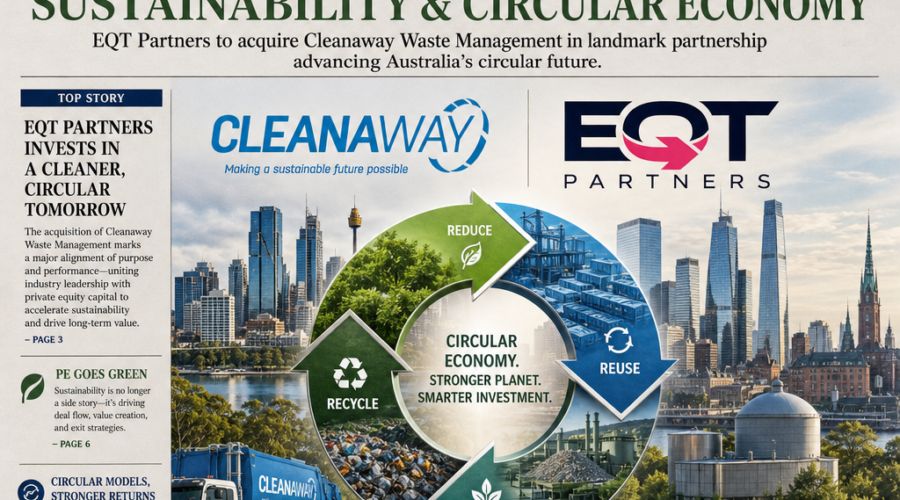
In a move that underscores the intensifying institutional appetite for essential services and “green” infrastructure, Swedish private equity titan EQT Infrastructure has launched a conditional, non-binding A$9.4 billion ($6.6 billion USD) takeover bid for Cleanaway Waste Management Ltd (ASX: CWY). The proposal, announced August 13, 2026, marks one of the largest environmental services transactions in the Asia-Pacific region to date, positioning EQT to take control of Australia’s leading waste and resource recovery platform.
Most “AI for Diligence” tools are lying to you. The truth is, they are just ChatGPT wrappers. Experience Kai – a Fortune-100 proven AI harness for M&A/ PE Diligence
💼 Purpose-built harness for Due Diligence
The Deal Mechanics: Premium and Valuation
EQT’s offer of A$3.13 per share represents a 32.1% premium to Cleanaway’s last closing price of A$2.37. The bid values the company at an enterprise valuation of approximately A$9.4 billion, implying a robust multiple of 20x FY2026 estimated EBIT. Cleanaway’s board, following an earlier unsolicited approach at A$3.00, has granted EQT a nine-week period of exclusive due diligence, signaling a high probability of a recommendation to shareholders.
Table 1: Transaction Summary & Premium Analysis
| Metric | Value (AUD) | Value (USD) |
|---|---|---|
| Offer Price per Share | $3.13 | $2.20 |
| Enterprise Value (EV) | ~$9.4 Billion | ~$6.6 Billion |
| Premium to Undisturbed Price | 32.1% | — |
| Implied EV/EBIT Multiple (FY26) | 20x | — |
| Exclusivity Period | 9 Weeks | — |
Strategic Rationale: Waste as Core Infrastructure
The acquisition is expected to be funded via the EQT Infrastructure VI fund, which closed in early 2025 with €21.5 billion in commitments. For EQT, the Australian waste management M&A landscape represents a textbook “value-add infrastructure” play. Cleanaway operates a vertically integrated network of collection, landfill, and recycling assets that are increasingly viewed as “core” infrastructure due to their inflation-linked cash flows and high barriers to entry.
Beyond the defensive nature of waste collection, the deal is a bet on the circular economy infrastructure investment trend. As Australia moves toward aggressive 2030 landfill diversion targets, the focus has shifted from simple disposal to resource recovery and waste-to-energy projects. Analysts at Goldman Sachs and Macquarie have noted that private equity platforms are better positioned than public companies to absorb the heavy capital expenditure required for this transition, as these projects often have long gestation periods that can weigh on quarterly earnings.
Industry Implications and Competitive Landscape
This bid follows a broader pattern of consolidation in the Australian environmental services M&A sector. In 2021, Macquarie Infrastructure and Real Assets (MIRA) took Bingo Industries private for A$2.6 billion, and global giants like Veolia and SUEZ have realigned their footprints in the region. By acquiring Cleanaway, EQT gains an unmatched national footprint in both municipal and industrial waste streams.
However, the deal is not without execution risk. Strategic M&A in 2026 remains subject to rigorous scrutiny from the Australian Competition & Consumer Commission (ACCC) and the Foreign Investment Review Board (FIRB). Given Cleanaway’s dominant market share, regulators may demand specific asset divestments in regions where EQT or its partners already hold environmental infrastructure interests.
Key Challenges and Considerations for Investors:
- Regulatory Scrutiny: FIRB approval will be critical, especially given the “essential service” status of national waste networks.
- Turnaround Execution: While Cleanaway has reaffirmed its FY26 EBIT guidance of A$470 million, shareholders remain wary of persistent operational headwinds and the elusive nature of recent turnaround plans.
- Capex Intensity: Transitioning Cleanaway into a true circular economy leader will require billions in follow-on investment for advanced sorting and energy recovery facilities.
The Private Equity Exit Strategy in Environmental Services
EQT’s playbook mirrors its recent global activity, including the $6.6 billion joint acquisition of Urbaser alongside Blackstone earlier this year. The private equity exit strategy in infrastructure typically involves professionalizing management, scaling via bolt-on acquisitions, and eventually exiting via an IPO or a secondary sale to a mega-infrastructure fund or pension plan looking for yield-generating assets. For C-suite executives at peer firms like Remondis or Veolia, the EQT move signals that valuations for high-quality waste assets have decoupled from historical norms, now reflecting their strategic importance in the global energy transition.
Leadership and Next Steps
Cleanaway CEO Mark Schubert has reiterated the company’s “standalone plan” to hit an underlying EBIT target of over A$500 million by 2027, but the board’s willingness to grant exclusivity suggests the current offer is near the ceiling of market expectations. If a binding Scheme Implementation Deed (SID) is reached, a shareholder vote is expected by late 2026, with completion likely in the first half of 2027.
As the market watches the nine-week diligence window, the focus will remain on whether EQT uncovers any legacy liabilities in Cleanaway’s landfill portfolio or if a rival bidder—potentially an Australian superannuation fund or a North American strategic peer—enters the fray with a superior proposal.