
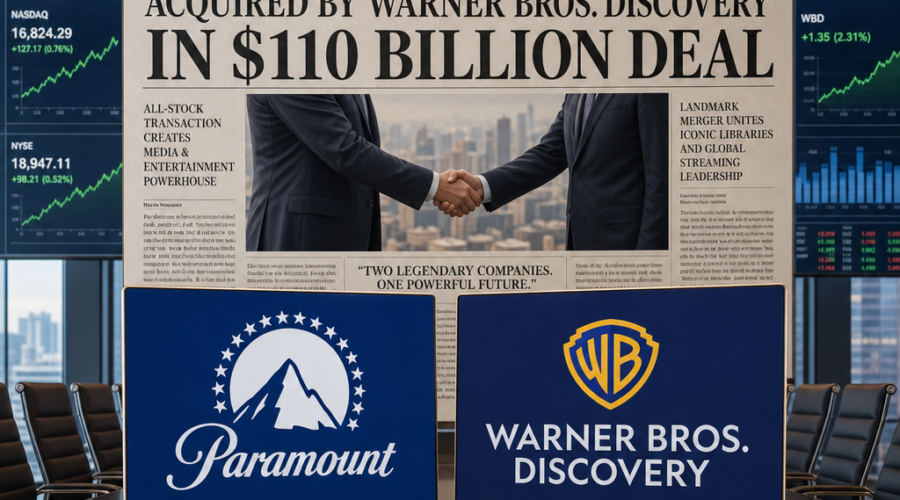
In a landmark decision for the global media landscape, the United Kingdom’s Competition and Markets Authority (CMA) formally cleared Paramount Skydance Corporation’s $110 billion acquisition of Warner Bros. Discovery (WBD) on August 6, 2026. The approval removes a critical international hurdle for a deal that aims to consolidate iconic Hollywood assets—including HBO, CNN, CBS, and Warner Bros. Pictures—into a singular “creative-first” powerhouse capable of challenging the dominance of Big Tech in the streaming era.
Most “AI for Diligence” tools are lying to you. The truth is, they are just ChatGPT wrappers. Experience Kai – a Fortune-100 proven AI harness for M&A/ PE Diligence

💼 Purpose-built harness for Due Diligence
Regulatory Green Light Amid Plurality Concerns
The CMA’s Phase 1 review concluded that the merger does not raise a “realistic prospect of substantially lessening competition” within the UK market. Regulators specifically examined overlaps in theatrical film distribution, subscription video-on-demand (SVOD) services, and children’s television. The authority noted that the combined entity would continue to face robust competition from established rivals such as Disney, Universal, and Sony, as well as evolving digital platforms.
Parallel to the antitrust clearance, Paramount secured a “deed of covenant and undertaking” with the UK Department for Digital, Culture, Media and Sport (DCMS). This agreement addressed initial concerns raised by Culture Secretary Lisa Nandy regarding media plurality and the editorial independence of news outlets. To avert a formal Public Interest Intervention Notice, Paramount provided legally binding commitments to safeguard the distinct editorial identities of UK assets, including Channel 5 and CNN International.
Key Deal Terms and Financial Rationale
The $110.9 billion transaction, structured as an all-cash acquisition at $31 per share, represents one of the largest media consolidations in history. Following a fierce bidding war that saw Netflix decline to escalate its rival $83 billion offer, Paramount Skydance, led by CEO David Ellison and backed by Oracle co-founder Larry Ellison, emerged as the definitive suitor.
| Metric | Details |
|---|---|
| Total Enterprise Value | $110.9 Billion |
| Offer Price | $31.00 per WBD share (Cash) |
| Anticipated Synergies | >$6 Billion (Technology, Real Estate, Operations) |
| Implied Valuation | 7.5x 2026 EBITDA (Fully synergized) |
| Regulatory Approvals | 66 Jurisdictions (including US DOJ, EC, and UK CMA) |
Strategic Implications: The “Next-Generation” Media Empire
The deal rationale centers on achieving the scale necessary to survive the streaming wars. By combining Paramount+ and HBO Max, the new entity creates a formidable library featuring global franchises such as Game of Thrones, Mission: Impossible, Harry Potter, and the DC Universe. Executives from both companies have framed the merger as a defensive and offensive necessity against the capital-intensive platforms of Amazon and Apple.
However, the path to integration remains fraught with operational challenges. Analysts from firms like Goldman Sachs and McKinsey have noted that realizing the projected $6 billion in synergies will likely require significant technology stack consolidation and workforce reductions. Similar to historical cross-border M&A trends, the integration of distinct corporate cultures—Paramount’s studio legacy and Discovery’s unscripted expertise—will be a critical focus for the leadership team.
The American Roadblock: State-Level Opposition
While international regulators have largely signaled approval, the merger faces significant legal headwinds in the United States. A coalition of 12 state attorneys general, led by California, has filed an antitrust lawsuit to block the deal, arguing it will reduce labor market competition and increase consumer prices. A federal judge recently scheduled the antitrust trial for March 2027, potentially delaying the final closing beyond the initial Q3 2026 target.
To mitigate the impact of these delays, Paramount has agreed to pay a “ticking fee” to WBD shareholders, estimated at approximately $650 million per quarter, should the deal remain unclosed past September 30, 2026.
Industry Impact and Future Outlook
The UK clearance is a decisive victory for David Ellison’s vision, signaling that major European regulators view consolidation as a viable strategy for traditional media to maintain relevance. For C-level executives in the TMT (Technology, Media, and Telecommunications) sector, this deal serves as a blueprint for media industry consolidation in a high-interest-rate environment where scale is the primary driver of survival.
- Consolidation of Power: The merger leaves the U.S. with only four “major” film studios, a shift that has drawn criticism from industry guilds including the WGA.
- Investment in UK Creative Sector: As part of the DCMS agreement, Paramount has committed to sustained investment in UK-produced content, potentially boosting the local production ecosystem.
- Journalistic Independence: The “deed of undertaking” will be closely watched by media watchdogs to ensure that CNN and CBS News maintain editorial autonomy under the new ownership.
As the deal moves toward a potential 2027 resolution in U.S. courts, the global media industry will continue to monitor how this “media behemoth” manages its massive debt load while attempting to pivot from legacy linear television to a profitable digital future.