
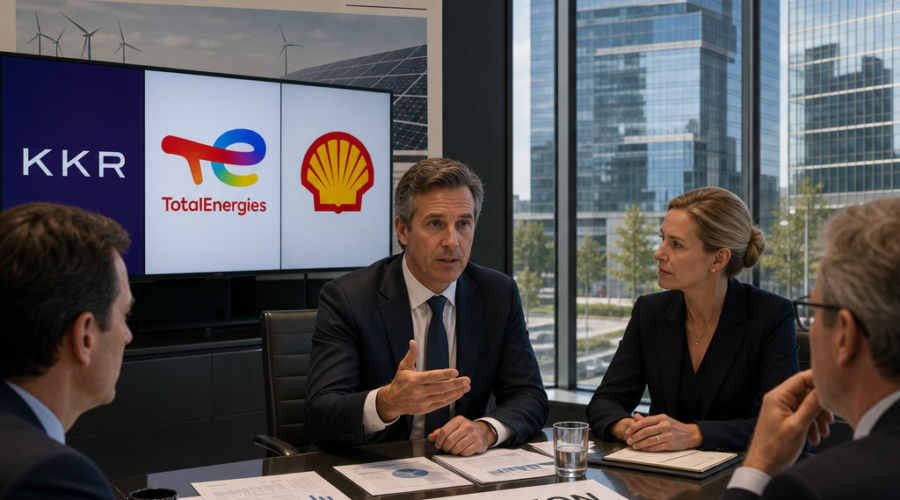
In a definitive move highlighting the shifting strategies of Europe’s energy giants, TotalEnergies SE has executed a dual-track maneuver that simultaneously expands its operating footprint and recycles capital through private equity. The French energy major announced on August 3, 2026, the sale of a 50% stake in a 1.2 gigawatt (GW) renewable energy portfolio to KKR & Co. Inc., alongside the full acquisition of Shell PLC’s European onshore renewables business.
Most “AI for Diligence” tools are lying to you. The truth is, they are just ChatGPT wrappers. Experience Kai – a Fortune-100 proven AI harness for M&A/ PE Diligence

💼 Purpose-built harness for Due Diligence
The Deal Rationale: Capital Recycling and Asset Management
The transaction with KKR values the 1.2 GW portfolio—comprising onshore wind and solar assets across Germany, Spain, France, and Poland—at an enterprise value of €1.8 billion ($2.1 billion). Notably, the investment is being made through an insurance account managed by KKR, a strategic pivot that utilizes long-term, yield-seeking capital rather than traditional private equity drawdown funds. This deployment follows KKR’s massive $19.2 billion final close of its fifth flagship infrastructure fund, signaling robust private equity infrastructure investment trends for 2026.
For TotalEnergies, the “farm-down” model has become a cornerstone of its Integrated Power strategy. By selling minority stakes in mature assets, the company “crystallizes” value and reinvests the proceeds into higher-yield greenfield developments. This approach maintains operational control while de-risking the balance sheet—a critical factor as the firm targets a 12% return on average capital employed (ROACE) by 2030.
Strategic Contrast: TotalEnergies vs. Shell
The simultaneous acquisition of Shell’s European onshore renewables assets underscores a growing divergence among the “Supermajors.” While Shell has pivoted toward asset-backed power trading and high-margin customer solutions—paring back direct ownership of generation assets—TotalEnergies is doubling down on the full electricity value chain.
Comparative Deal Metrics (August 2026)
| Transaction Component | Asset Details | Valuation / Capacity | Counterparty |
|---|---|---|---|
| Stake Sale (Farm-down) | 1.2 GW Solar/Wind (DE, ES, FR, PL) | €1.8 Billion EV | KKR (Insurance Capital) |
| Business Acquisition | Shell European Onshore Renewables | 500 MW (Ops) + 3.5 GW (Pipeline) | Shell PLC |
Leadership Perspectives
“This investment reflects our conviction in the long-term fundamentals supporting Europe’s renewable energy sector,” said Vincent Policard, Co-Head of European Infrastructure at KKR. The firm’s use of insurance-linked investment strategies allows it to hold these core infrastructure assets over longer horizons, matching the steady cash flows generated by long-term Power Purchase Agreements (PPAs).
Stéphane Michel, President of Gas, Renewables & Power at TotalEnergies, emphasized that these transactions allow for “optimized capital allocation.” The move effectively replaces mature, lower-growth equity with a massive 3.5 GW development pipeline spanning Italy, the UK, and Spain, fueling the company’s goal of reaching 100 TWh of net electricity production by 2030.
Market and Regulatory Implications
The deal comes at a time of heightened scrutiny for European energy firms. TotalEnergies continues to navigate a French court mandate to align its business with stricter climate goals, making its renewables capital recycling strategy both a financial and a regulatory necessity. Meanwhile, the exit of Shell from onshore European generation marks the culmination of its “Capital Markets Day 2025” pledge to prioritize shareholder distributions over capital-intensive renewable builds.
Key Trends for C-Suite Observation:
- Infrastructure as an Insurance Play: KKR’s use of Global Atlantic and other insurance subsidiaries to fund infrastructure deals suggests a shift away from 10-year PE cycles toward “permanent” capital structures.
- The Rise of Integrated Power: TotalEnergies is betting that owning the entire chain—from wind turbines to retail customer billing—will provide better defensive moats than pure-play generation or trading.
- Consolidation of Pipelines: As smaller developers face higher costs of capital, major players are aggressively acquiring renewable energy development pipelines to secure growth for the 2030–2035 window.
As the European power grid undergoes a fundamental redesign to handle decentralized loads, the entry of sophisticated financial sponsors like KKR into 50/50 partnerships with industrial operators is likely to become the standard blueprint for the energy transition. For dealmakers, the lesson of August 2026 is clear: the energy transition is no longer about just “green energy”—it is about sophisticated cross-border M&A strategies and the efficient movement of institutional capital.