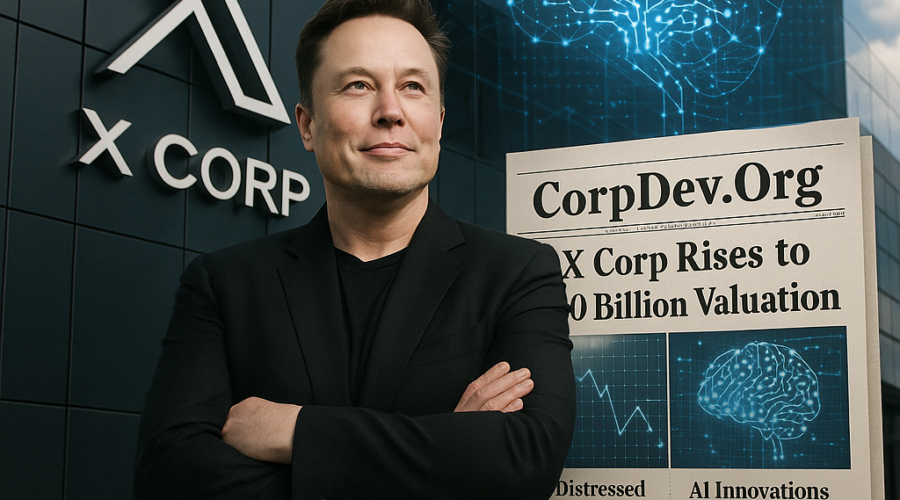
Elon Musk's $44 billion acquisition of Twitter in 2022 was transformed through a series of M&A maneuvers, culminating in a $1.25 trillion mega-merger between SpaceX and xAI in February 2026. X Corp, first acquired by xAI for $33 billion in March 2025, was repositioned as the primary data training engine for the AI model Grok. This strategic pivot allowed original investors like Larry Ellison and Andreessen Horowitz to roll their stakes into the combined entity, realizing paper returns near 200% ahead of a planned $2 trillion SpaceX IPO. The turnaround demonstrates a powerful M&A playbook where a legacy platform's value is redefined by its data utility for a high-growth AI sibling, fundamentally shifting valuation metrics away from traditional user engagement.
- Company
- X Corp (formerly Twitter)
- Key Executive
- Elon Musk
- Core Strategy
- Repurpose X's real-time data as a proprietary training engine for xAI's Grok model.
- Initial Transaction
- $44 Billion acquisition of Twitter (Oct 2022)
- Pivot M&A Event 1
- xAI acquires X Corp in an all-stock deal at a $33B valuation (March 2025).
- Pivot M&A Event 2
- SpaceX acquires xAI in a mega-merger at a $1.25T combined valuation (Feb 2026).
- Key Investors
- Larry Ellison, Pershing Square, Andreessen Horowitz
- Investor Outcome
- Paper returns approaching 200% on initial 2022 capital.
- Liability Management
- Cleared ~$17.5B in debt in early 2026, financed by equity and Starlink cash flow.
- Next Strategic Step
- SpaceX IPO (Ticker: SPCX) at a target valuation of $1.75T – $2.0T (June 2026).
- Regulatory Scrutiny
- SEC and FTC are scrutinizing the 'self-dealing' nature of the private-to-private mergers.
When Elon Musk finalized his $44 billion acquisition of Twitter in late 2022, the financial consensus was near-unanimous: the deal was a “stinker” of historical proportions. By 2023, institutional backers like Fidelity had written down their stakes by more than 70%, and a $13 billion debt stack sat heavily on bank balance sheets, seemingly unmovable. However, as of May 15, 2026, the narrative has undergone a radical transformation. Through a series of aggressive and controversial M&A maneuvers, Musk has successfully pivoted X (formerly Twitter) from a struggling social media platform into the foundational data layer of a trillion-dollar AI and aerospace empire.
Most “AI for Diligence” tools are lying to you. The truth is, they are just ChatGPT wrappers. Experience what real AI for Diligence looks like, built like Claude Code, but for M&A/ PE Diligence:
💼 When Claude Code Marries Due Diligence!
The “Data-for-Equity” Gambit: Restructuring the Capital Stack
The core of the turnaround lies in the strategic integration of X with Musk’s artificial intelligence venture, xAI, and eventually, SpaceX. In March 2025, xAI acquired X Corp in an all-stock transaction that valued the social network at approximately $33 billion. This move effectively swapped the “distressed” social media equity for shares in what would become one of the world’s most valuable AI entities.
By February 2026, the integration deepened when SpaceX acquired xAI in a $1.25 trillion mega-merger. This sequence allowed original X investors—including Larry Ellison, Bill Ackman’s Pershing Square, and Andreessen Horowitz—to roll their holdings into the broader SpaceX/xAI ecosystem. Following SpaceX’s recent move toward a June 2026 IPO at a target valuation of $2 trillion, these investors are now sitting on paper returns approaching 200% on their initial 2022 capital outlay.
Timeline of the $44 Billion Pivot (2022–2026)
| Date | Key Event | Implied Valuation / Impact |
|---|---|---|
| Oct 2022 | Acquisition of Twitter (X) | $44 Billion (Highly Leveraged) |
| March 2025 | xAI acquires X Corp | $33 Billion (All-stock transition) |
| Feb 2026 | SpaceX acquires xAI | $1.25 Trillion Combined Valuation |
| May 2026 | SpaceX IPO Filing | Target: $1.75T – $2.0 Trillion |
Monetizing the Firehose: X as an AI Training Ground
The strategic rationale for this recovery was never based on traditional advertising revenue, which remains 35% below its 2022 peak. Instead, Musk leveraged X’s real-time human conversation dataset as the primary training engine for Grok, xAI’s large language model. In the era of generative AI data licensing, X’s “firehose” of data became a proprietary moat that rivals like OpenAI and Anthropic have struggled to replicate without similar social media assets.
Furthermore, Musk’s aggressive liability management saw X and xAI clear approximately $17.5 billion in debt in early 2026. This deleveraging, financed by a mix of equity raises and SpaceX’s robust Starlink cash flow, removed the “bankruptcy overhang” that had plagued the platform since the 2022 LBO. For deal advisors, this represents a masterclass in cross-platform asset optimization, where the losses of one subsidiary are subsidized by the valuation multiples of a high-growth AI sibling.
Strategic Implications for the M&A Market
- Valuation Shift: Investors are increasingly valuing tech platforms based on “data utility” for AI training rather than traditional DAU (Daily Active User) or ARPU (Average Revenue Per User) metrics.
- Vertical Integration 2.0: The merger of aerospace (SpaceX), telecommunications (Starlink), and AI (xAI) under a single corporate banner creates a vertically integrated innovation engine that is difficult for regulators to categorize.
- Regulatory Scrutiny: The “self-dealing” nature of these mergers—where Musk effectively negotiated with himself across three different companies—has drawn intense scrutiny from the SEC and FTC, serving as a cautionary tale for governance and fiduciary duty in private-to-private M&A.
The Road to $2 Trillion: What’s Next?
As SpaceX prepares for its Nasdaq debut under the ticker SPCX, the “X disaster” has been rewritten as an expensive but necessary infrastructure cost. The anticipated SpaceX IPO valuation reflects not just rockets, but a comprehensive space-based AI computing play. While critics argue that the 200% return for X investors is an accounting miracle fueled by opaque private valuations, the sheer scale of the upcoming public listing may soon provide the ultimate market validation.
For C-suite executives, the lesson is clear: in the 2026 economy, the most valuable M&A moves are those that treat legacy platforms not as standalone businesses, but as raw data fuel for the next generation of artificial intelligence.
Sources
 inc.com
 almcorp.com
 wikipedia.org
 fool.com
 techtimes.com
 forbes.com
 ionanalytics.com
 phemex.com
 electrek.co
 kiplinger.com
 aals.org
 investing.com
 europeanbusinessmagazine.com
 latimes.com
 tesery.com
 maadvisor.com